Before you go · 10 min read
China without Google Maps: how not to get lost

In short: Google Maps is no good for getting around China. Without a VPN or an eSIM with a foreign connection it won't even load, and even when it does, the map is shifted relative to GPS by 100–700 m. The dot showing your position ends up next to the street you're actually standing on. Before you fly, install Amap: in the App Store and Google Play it's called AMap Global, and it's in English. On an iPhone, Apple Maps is a good backup, because in China it uses Chinese map data. Baidu Maps has the most detail, but it's almost entirely in Chinese and isn't easy to get outside China. Most important of all: save the names of your hotels, attractions, metro stations and railway stations in Chinese.
In China we used Baidu Maps and Amap, with Apple Maps as a backup on the iPhone.
Correct as of October 2026. Apps change often, so check the current versions in the store before you travel.
Why Google Maps doesn't work in China
Google Maps has three problems in China. You can get around the first one, but not the other two.
1. It's blocked
All Google services, maps included, are blocked in China by the Great Firewall. Google Maps only loads through a VPN or an eSIM with a foreign connection (more in our article Internet in China). But access is only half the story.
2. The map is shifted, and a VPN won't fix it
Chinese law only allows maps of China to be published in a state coordinate system called GCJ-02, nicknamed "Mars coordinates". It deliberately shifts every point by a seemingly random distance. Your phone's GPS, on the other hand, gives your position in the global WGS-84 system, the same one used everywhere else.
Google draws China's streets in the Chinese system but takes your position straight from GPS. The two layers don't line up, usually by 100–700 m and often by more than half a kilometre. The shift isn't constant, so you can't correct for it by eye. You're standing at a crossroads, and the blue dot puts you in the middle of a block several streets away.
A VPN only decides whether the map loads. The shift is in the data itself, so with a VPN the dot will still be off. Chinese apps (Amap, Baidu Maps) and Apple Maps in China convert your GPS position to the Chinese system, which is why their dot is where you are.
3. The data is out of date
Google hasn't operated in China for years, so its maps of China are updated rarely and from a distance. New metro lines, restaurants and shops are missing, and opening hours are often wrong. Chinese apps keep this data current, because hundreds of millions of people use them.
The bottom line: Google Maps is useful at most at home, to see roughly where things are. Don't navigate by it while you travel in China.
TipIn Hong Kong and Macau Google Maps works normally. It isn't blocked there, and the maps aren't shifted. The problem only affects mainland China.
Amap (高德地图): our first choice
Amap (Gaode in Chinese) is the most popular map app in China. It belongs to the Alibaba group, which Alipay also came from. Since 2025 it has an English version: search for AMap Global in the App Store and Google Play.
- Walking, metro, bus and driving directions. For the metro it shows lines and transfers, and even which entrance to use and which exit to leave by.
- Many places have English names, although small restaurants and shops usually only have Chinese ones.
- Works without a VPN, over the regular Chinese internet.
Searching in Chinese gives the best results: copy the Chinese name of a place and paste it into the search box. In English, Amap will find big attractions, but a small local restaurant is hit and miss. If the app opens in Chinese, switch the language to English in the settings.
NoteInstall Amap before you fly. Google Play doesn't work in China, so with an Android phone it'll be hard to download anything once you're there.
Baidu Maps (百度地图): the most detail, but in Chinese
Baidu is China's answer to Google, and its map is very detailed. It has tons of places, reviews and photos, and in many cities street panoramas, like Street View. Like Amap, it tells you which metro entrance to use and which exit to leave by. The downside: the app is almost entirely in Chinese. There's a partial English mode in the settings, but place names and reviews stay in Chinese anyway.
NoteBaidu Maps is made for the Chinese market and isn't easy to get outside China. In October 2026 it wasn't in the App Store in the UK or the EU at all; in the US, Canadian and Australian stores you'll find it under its Chinese name, 百度地图. We downloaded it from the official Baidu website. The page is in Chinese: the 安卓客户端 button is the Android version (an installer straight from Baidu; your phone will ask you to allow installing from outside the store), and IOS客户端 leads to the Chinese App Store. If you have an iPhone, Amap and Apple Maps are more than enough.
Baidu also uses its own coordinate system, different from Amap's. If you move a point from Baidu to another map by its coordinates, it will land in the wrong place. So move places by name or address.
Apple Maps: a good backup on the iPhone
On an iPhone, Apple Maps switches to Chinese map data from AutoNavi, the company behind Amap, once you're in China. That's why your position and walking directions are correct, and the app works without a VPN. We checked this ourselves.
The catch: Apple Maps has few saved places, especially in English. You type in the name of a restaurant or a smaller attraction, and the map may find nothing. So for Apple Maps you need the exact address, ideally in Chinese. It's easiest to look places up in Amap and use Apple Maps as a backup for walking.
Which map for what?
| App | What for | Our verdict |
|---|---|---|
| Amap (AMap Global) | walking, metro and bus directions; in English | your main map, install before you fly |
| Baidu Maps | the most places, reviews and street panoramas | accurate, but in Chinese and hard to get outside China |
| Apple Maps | walking directions on the iPhone | correct position, but few places, you need the exact address |
| Google Maps | browsing at home, at most | blocked, shifted by 100–700 m, out of date |
Save names in Chinese: it matters more than the app
Taxi drivers and passers-by in China rarely speak English and don't read English names. The same place also has different English names in different apps, and few people can work out what you mean from a name written in the Latin alphabet (pinyin). Everyone understands Chinese characters, so before you travel, save these in Chinese:
- hotels: the name and full address (you'll also put this address on your arrival card, see our article Hotels, trains and flights),
- attractions: the name, and for big parks the specific entrance too,
- metro stations: the station name and line number,
- railway stations: the full name, because big cities have several. Shanghai has 上海站, 上海虹桥站 and 上海南站, among others, and Beijing has 北京站, 北京南站 and 北京西站. "To the station" isn't enough,
- airports: the airport name and terminal,
- restaurants you want to find.
How to do it in practice:
- Make a list of places along your whole route: hotels, attractions, stations.
- Find each place in Amap and copy its name and address in Chinese.
- Save them in your notes and take screenshots. Screenshots work without internet, even if your eSIM stops working.
- Add the places to your favourites in Amap. Then you can get directions to any of them with one tap.
Tipshow your screen with the Chinese name to the taxi driver or passer-by, zoomed in so it can be read from a distance. Don't try to pronounce it: Chinese tones are hard, and the English name usually means nothing to the driver.
On the metro and at the station
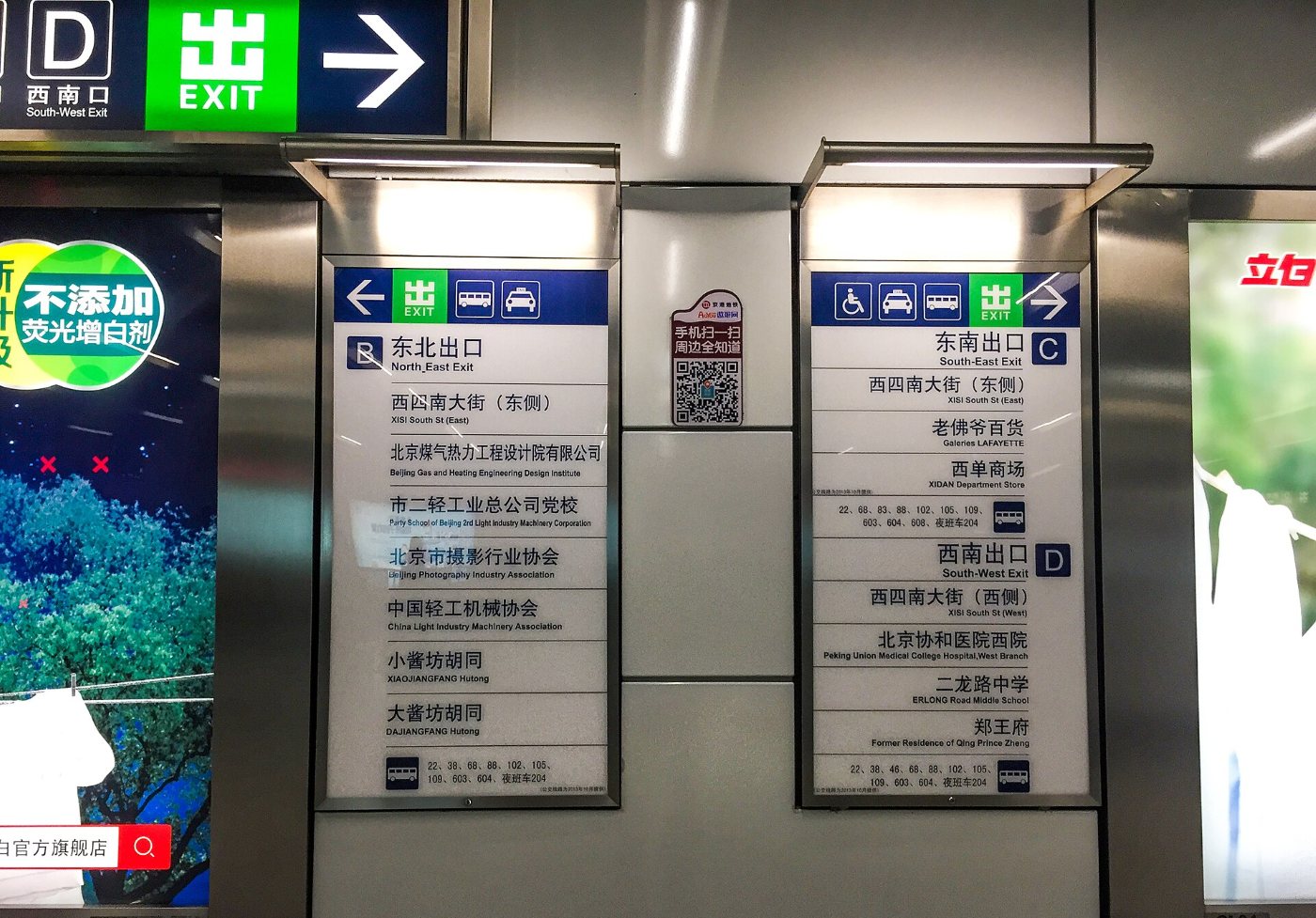
The metro in big Chinese cities has signs in Chinese and English, which makes it the easiest way to get around. Two things are worth knowing:
- Entrances and exits are marked with letters and numbers (A, B, C1, D2…). At big stations they can be several hundred metres apart. Amap and Baidu Maps show which entrance to use and which exit to leave by. It worked for us in both apps, so follow their directions.
- At the railway station, check its full name on your ticket. A train from Shanghai to Beijing may leave from a different station than the one you arrived at.
In Chinese地铁站 dìtiězhàn "metro station", 入口 rùkǒu "entrance", 出口 chūkǒu "exit", 火车站 huǒchēzhàn "railway station", 机场 jīchǎng "airport".
The easiest way to get a taxi is DiDi in Alipay: you pick your destination on the map, and the driver sees it in Chinese (more about DiDi). If you hail a taxi on the street, show the driver the address in Chinese and ask them to turn on the meter.
10 Chinese phrases for taxi drivers and passers-by
The safest way is to show a phrase on your screen, so take a screenshot of this table before you go. Where you see the dots, add or show the Chinese name of the place.
| English | Chinese | Pronunciation |
|---|---|---|
| Please take me to this address. | 请带我去这个地址。 | qǐng dài wǒ qù zhège dìzhǐ |
| I'd like to go to the railway station. | 我要去火车站。 | wǒ yào qù huǒchēzhàn |
| I'd like to go to the airport. | 我要去机场。 | wǒ yào qù jīchǎng |
| Excuse me, where's the metro station? | 请问,地铁站在哪里? | qǐngwèn, dìtiězhàn zài nǎlǐ? |
| Excuse me, how do I get to…? | 请问,……怎么走? | qǐngwèn, … zěnme zǒu? |
| Is it far from here? | 离这里远吗? | lí zhèlǐ yuǎn ma? |
| Please turn on the meter. | 请打表。 | qǐng dǎbiǎo |
| Please stop here. | 请在这里停车。 | qǐng zài zhèlǐ tíngchē |
| How much is it? | 多少钱? | duōshao qián? |
| I'm lost, could you help me? | 我迷路了,可以帮我吗? | wǒ mílù le, kěyǐ bāng wǒ ma? |
Checklist before you fly
- Install Amap (AMap Global) and switch it to English.
- On Android, if you like, add Baidu Maps from the official Baidu website (the 安卓客户端 button).
- On an iPhone, check that you have Apple Maps (it's built in).
- Save the names and addresses of your hotels, attractions, metro stations and railway stations in Chinese, and take screenshots.
- Sort out mobile internet (an eSIM), because without it maps can't plan routes: Internet in China.
- Take a screenshot of the 10 Chinese phrases.
- Save Google Maps for Hong Kong and Macau.
Don't want to figure it all out yourself?
In every one of our travel plans, hotels, attractions and restaurants come with names and addresses in Chinese, ready to type into Amap or show a taxi driver. We've also collected the most important addresses on cards at the end of each plan. See our China travel plans.