Before you go · 7 min read
Time in China: one time zone for the whole country
In short: all of China runs on a single time, Beijing Time (UTC+8), all year round, with no daylight saving. China is 8 hours ahead of London in winter and 7 in summer, 7 or 6 hours ahead of Paris and Berlin, and 13 or 12 hours ahead of New York. China stretches across almost five geographical time zones, but since 1949 every clock in the country has shown the same time. That's why in the far west the sun doesn't rise until about 10:00 in winter. In Xinjiang, some people also use an unofficial local time, 2 hours behind Beijing.
What surprised us most in China was its diversity, and you can see it even on a clock: in December the sun sets in Harbin before 16:00, while in Kashgar it's still early afternoon at that hour.
Correct as of October 2026. Clock-change dates in Europe and the US are set by law there and may change.
What time is it in China right now
China is 8 hours ahead of London in winter and 7 hours in summer, and 13 hours ahead of New York in winter and 12 in summer.
China doesn't use daylight saving time, so the difference changes when your clocks change.
Time difference between China and the UK, Europe and the US
China doesn't change its clocks, but Europe and most of the US do. So the difference changes twice a year:
| Where you are | Beijing is ahead by (your winter) | Beijing is ahead by (your summer) |
|---|---|---|
| London, Dublin, Lisbon | 8 hours | 7 hours |
| Paris, Berlin, Madrid, Rome | 7 hours | 6 hours |
| New York, Toronto | 13 hours | 12 hours |
| Los Angeles, Vancouver | 16 hours | 15 hours |
Europe changes its clocks on the last Sunday of March and October (next: 25 October 2026 and 28 March 2027). The US and Canada change on the second Sunday of March and the first Sunday of November (next: 1 November 2026 and 14 March 2027).
Example: when it's 12:00 noon in London, it's 20:00 in Beijing in winter and 19:00 in summer. When it's 9:00 in New York, it's 21:00 or 22:00 in Beijing.
In Australia it's the other way round: Sydney is 2 hours ahead of Beijing, and 3 hours during Australian daylight saving (October to April).
Hong Kong and Macau are on the same time as Beijing. When you cross the border from mainland China, you don't need to change your watch.
What the difference means on your trip
- Arrival. Flying east from Europe, you "lose" 7–8 hours. If you leave London at 21:00 in summer and the flight takes about 11 hours, you land in Beijing at around 15:00 the next day. From North America you cross the date line, so you also land a calendar day later.
- Calling home. Beijing evenings are the best time: it's midday or early afternoon in Europe and early morning on the US East Coast. At 8:00 in Beijing, Europe is in the middle of the night. How to use WhatsApp and other apps in China: Internet in China.
- Working remotely. A 9-to-5 day in London is 16:00–24:00 in Beijing in summer and 17:00–01:00 in winter. In New York it's an overnight shift.
- Tickets. All times in China, from train departures to the moment museum tickets go on sale, are in Beijing Time, including in Xinjiang and Tibet. If you're waiting for tickets to go on sale from home, convert the time first: it may be the middle of your night. More on bookings: Hotels, trains and flights.
Why does China have only one time zone?
China stretches from 73° to 135° east, across almost five geographical time zones, from UTC+5 to UTC+9. Yet the whole country lives by one clock. It's the largest country in the world with a single time zone. Russia, for comparison, has 11.
It wasn't always like this. In 1918 the Central Observatory in Beijing proposed five time zones, and in 1939 the government of the Republic of China officially adopted them:
| Zone | Time | Area |
|---|---|---|
| Kunlun | UTC+5:30 | western Xinjiang |
| Sinkiang–Tibet | UTC+6 | the rest of Xinjiang and Tibet |
| Kansu–Szechwan | UTC+7 | central China |
| Chungyuan (Central Plains) | UTC+8 | the coast, Beijing, Shanghai |
| Changpai | UTC+8:30 | the northeast |
During the war with Japan the whole country used a single time anyway: UTC+7, the time of the Kansu–Szechwan zone, where the wartime capital Chongqing was located (we cover that period in our article Chongqing). After the war the five zones came back, but only briefly: in 1949–1950 the government of the People's Republic of China introduced a single Beijing Time, UTC+8, across the whole country. It's usually explained by the goal of national unity and simplicity: one time for the railways, government offices, radio and television.
China has only had daylight saving time twice: in 1945–1948 and 1986–1991. Since 1991 the clocks haven't changed.
The sun and the clock: sunrise and sunset
Since the whole country runs on Beijing's time, the sun is "later" the further west you go. In Kashgar the sun is highest in the sky at around 15:00, in Harbin at around 11:30.
In summer the differences are even bigger. On 21 June the sun sets in Kashgar at 22:27 and rises in Harbin at 3:44. In Fuyuan, at the far eastern tip of China, it's light by around 3:00 in June.
In practice, life in the west of the country runs later. In Xinjiang, shops and offices usually open from 10:00 to 19:00 Beijing Time. In Lhasa it's still dark at 8:00 in winter, so you'll start sightseeing later than in Beijing, but the sun doesn't set until around 19:00.
Xinjiang: two times in one region
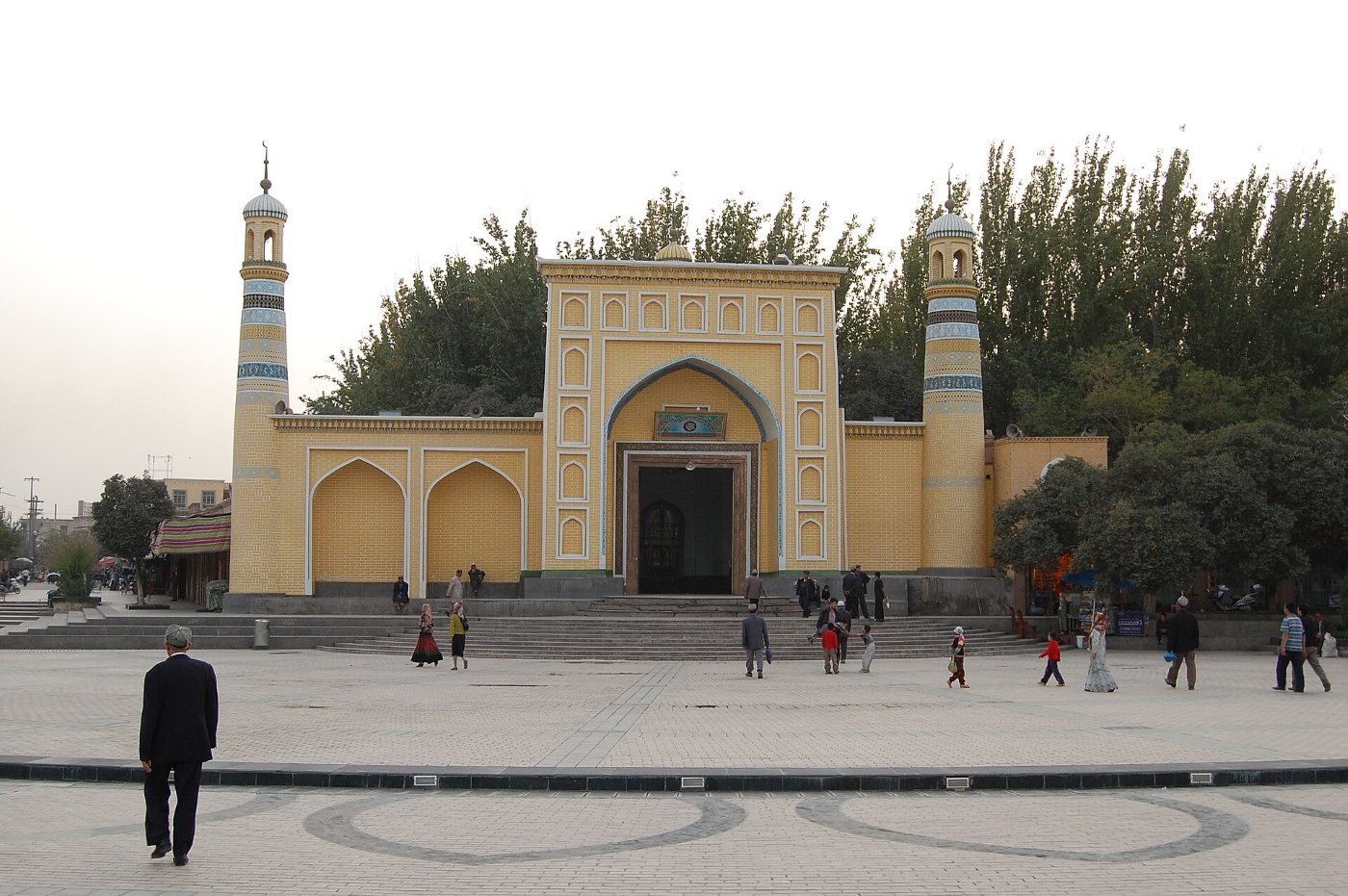
In Xinjiang, alongside Beijing Time, there's an unofficial Xinjiang Time (Ürümqi Time, UTC+6), 2 hours behind. Many Uyghurs and Kazakhs use it, while Chinese-speaking residents usually stick to Beijing Time. Even local television broadcasts its Chinese channel on Beijing Time and its Uyghur and Kazakh channels on Xinjiang Time.
Trains, flights and tickets always use Beijing Time. When you arrange to meet someone in Xinjiang at a specific time, a driver for example, ask which time they mean.
In Chinese北京时间 běijīng shíjiān "Beijing Time", 新疆时间 xīnjiāng shíjiān "Xinjiang Time", 现在几点? xiànzài jǐ diǎn? "What time is it now?"
How to adjust after you land
Travelling east is harder than coming home, because your day gets "shorter" by 7–8 hours (or more from the Americas). A few simple tips:
- Set your watch to Beijing Time on the plane and try to sleep when it's night in China.
- Stay up until the evening on your first day. If you must, nap for 20–30 minutes at most.
- Get out into daylight, ideally in the morning. It's the fastest way to reset your body clock.
- Plan an easy first day: a walk and dinner rather than tickets for an early train.
Flying home is usually easier, because your day gets "longer".
FAQ
What time zone is China in?
China Standard Time, also called Beijing Time: UTC+8, all year round. It applies to the whole of mainland China, and Hong Kong and Macau use the same time.
How many time zones does China have?
Officially one. Geographically China spans almost five time zones, and between 1939 and 1949 it really did have five. In Xinjiang some people also use an unofficial UTC+6.
Why does China have only one time zone?
Since 1949–1950 the People's Republic of China has used a single Beijing Time for the whole country. It's usually explained by the goal of national unity and simplicity: one time for the railways, government and media.
Does China have daylight saving time?
No. China used daylight saving time in 1986–1991, and the clocks haven't changed since.
What's the time difference between China and the UK?
Beijing is 8 hours ahead of the UK in winter and 7 hours ahead in summer, when the UK is on British Summer Time.
Sources
- Wikipedia: Time in China (the five zones of 1918–1949, daylight saving time, Xinjiang Time, office hours in Xinjiang, sunrise and sunset table)
- NOAA Solar Calculator (the algorithm we used for the chart; the results match the Wikipedia table to the minute)
- Directive 2000/84/EC (summer time in the EU from the last Sunday of March to the last Sunday of October)
Don't want to figure it all out yourself?
Each of our travel plans is a day-by-day route with times, connections between cities with prices, and addresses in Chinese to show your taxi driver. See our China travel plans.