Destinations and inspiration · 11 min read
Chongqing – the most cyberpunk city in the world
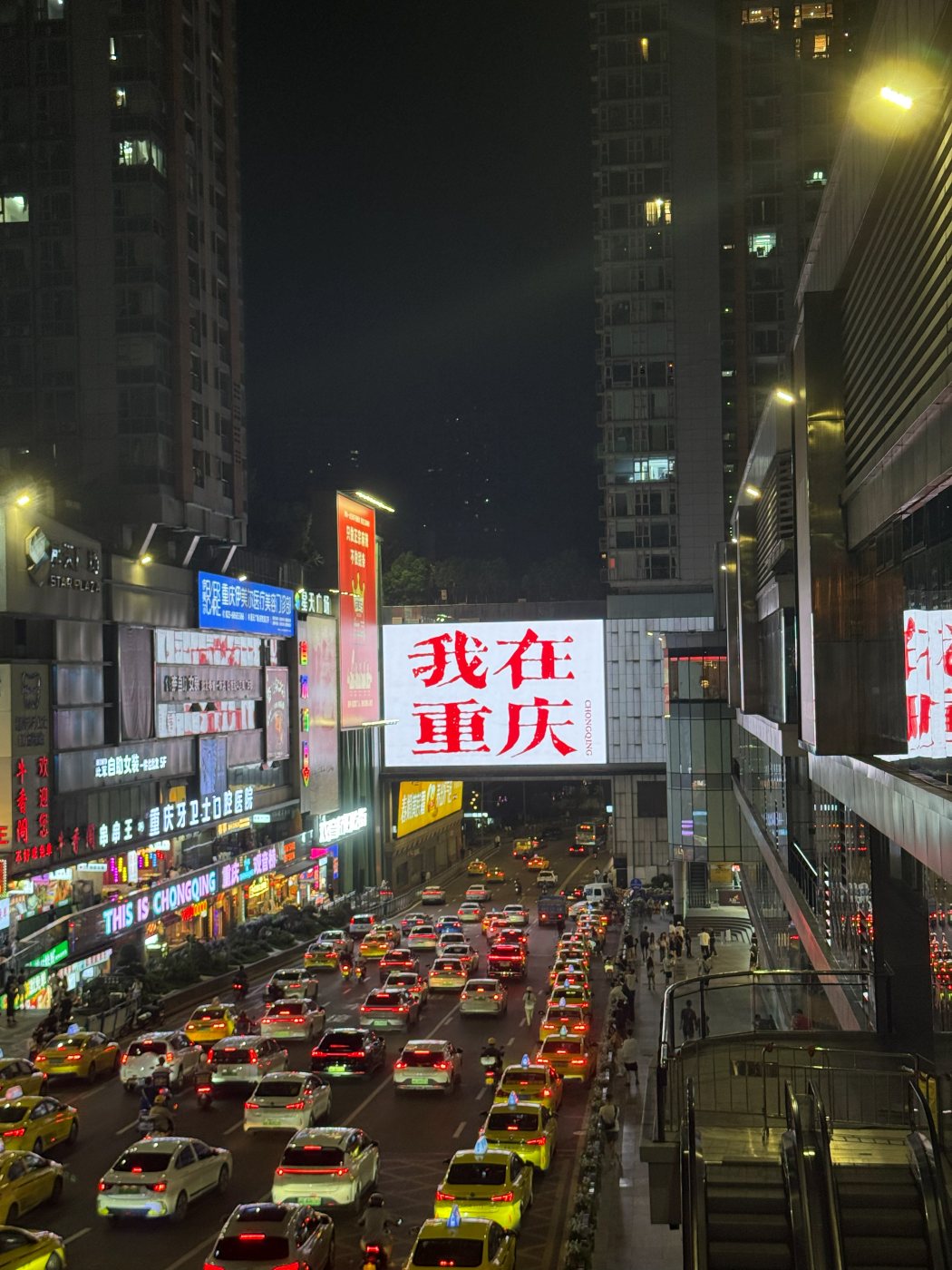
In short: Chongqing is a city built on steep hills where the Yangtze and Jialing rivers meet. Streets, flyovers and railways are stacked in layers: the metro runs through an apartment block, and from the 22nd floor you step straight out onto a square. During the war with Japan and the Second World War, for more than eight years, Chongqing was the capital of China. Two days are enough for the highlights, and 3–4 days with a trip to Dazu or Wulong. Spring or autumn is best, as summer goes above 35°C. From Chengdu it's 1–1.5 hours by bullet train.
What surprised us most in China was its technological development, and nowhere shows it like Chongqing. Multi-level flyovers, skyscrapers growing out of hillsides and neon reflected in the river make you feel like you're in a science fiction film.
Correct as of 12 October 2026. Check ticket prices and timetables before you travel. Amounts in yuan are converted at the National Bank of Poland rate into the currency you pick in the site menu.
Why Chongqing looks like a science fiction film
Chongqing is a municipality the size of Austria (about 82,000 km²) with more than 32 million people, over 20 million of them in the city itself. Its centre sits on a rocky peninsula between two rivers, so flat land is scarce. Buildings climb the slopes, roads run one above another, and the same address can have an entrance on the ground floor and another on the twentieth. Chinese people call Chongqing the "8D city", and also the "fog city", because fog covers it about 68 days a year, mostly in spring and autumn.
A few examples:
- The Huangjuewan interchange has five levels of roadway, the highest 37 m above the ground. It confuses even local drivers' navigation.
- The Crystal, the "horizontal skyscraper" of Raffles City, is a glass bridge about 300 m long, suspended some 250 m above the ground on four towers at the tip of the Chaotianmen peninsula.
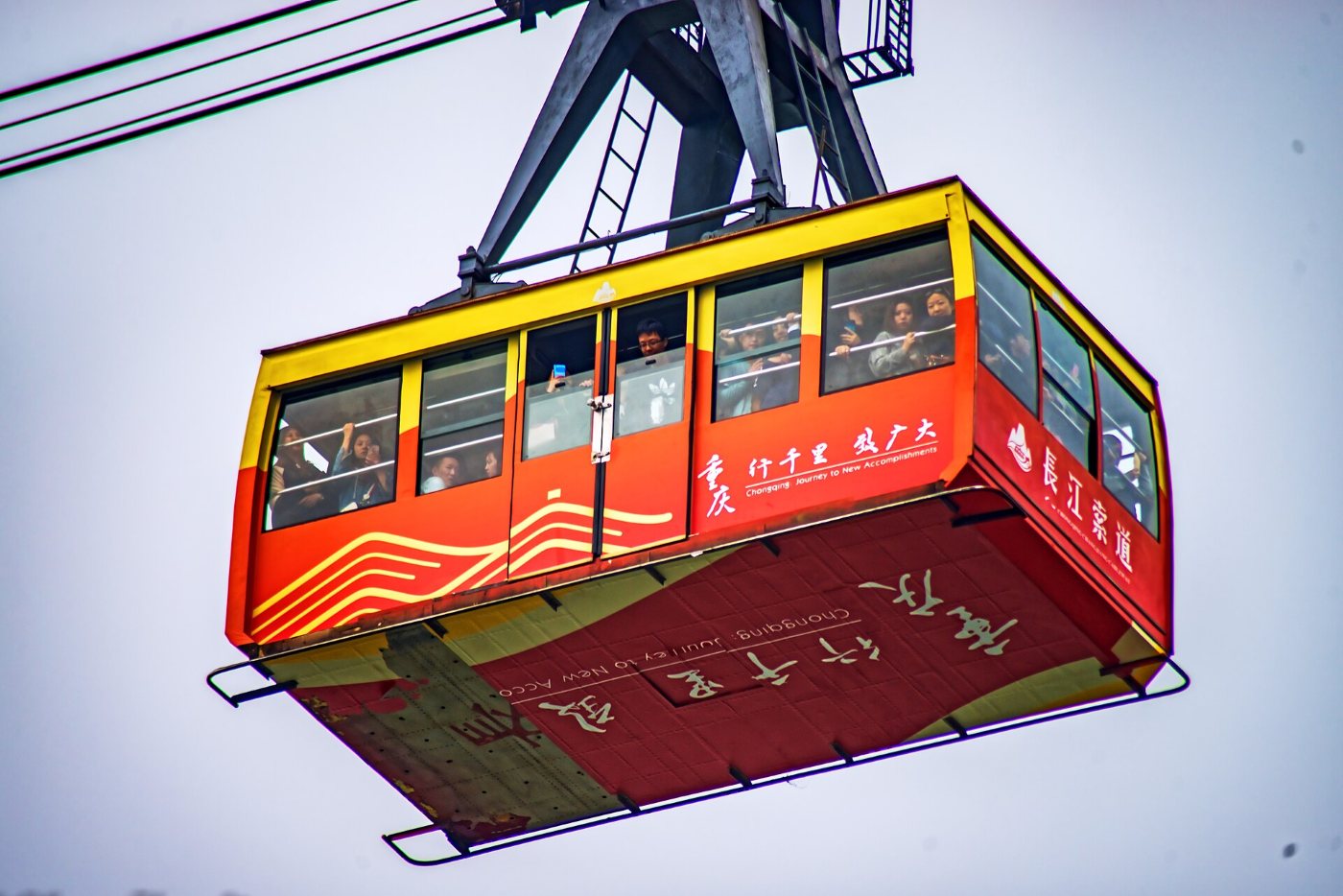
- The Yangtze River Cableway, opened in 1987, was built as everyday transport for residents and is now one of the city's biggest attractions.
History: from the state of Ba to China's wartime capital
Chongqing has more than 3,000 years of history. It was one of the capitals of the ancient state of Ba, which was conquered by the state of Qin in 316 BC. Named after the Yu River, today's Jialing, the city was called Yuzhou for centuries, and the character 渝 (yú) is still its abbreviation, for example on number plates. It got its present name in 1189 from a Song dynasty prince who, within a single year, became first a prince and then emperor. That's why Chongqing (重庆) means "double celebration".
China's wartime capital. In November 1937, as the Japanese army approached Nanjing, the government of the Republic of China moved the capital to Chongqing, far inland, behind the mountains and the Yangtze gorges. The city remained China's capital until 1946. Ministries, factories, universities and foreign embassies moved here.
The bombing. From 1938 to 1944 Japanese aircraft carried out hundreds of raids on the city, killing more than 10,000 people. Residents sheltered in tunnels carved into the rocky hills. On 5 June 1941 several thousand people suffocated in one of them. Some of the old shelters are now warehouses, cafés and restaurants, including hotpot places.
After the war. From late August 1945, the leaders of the two sides of China's civil war, Chiang Kai-shek and Mao Zedong, negotiated here for six weeks. The Jiefangbei monument in the centre first commemorated victory over Japan, and got its present name, the Liberation Monument, after the Communists took the city in 1949. In 1997 Chongqing was separated from Sichuan province and became China's fourth municipality directly under the central government, alongside Beijing, Shanghai and Tianjin.
What to see in Chongqing: 10 places
1. Hongyadong at night
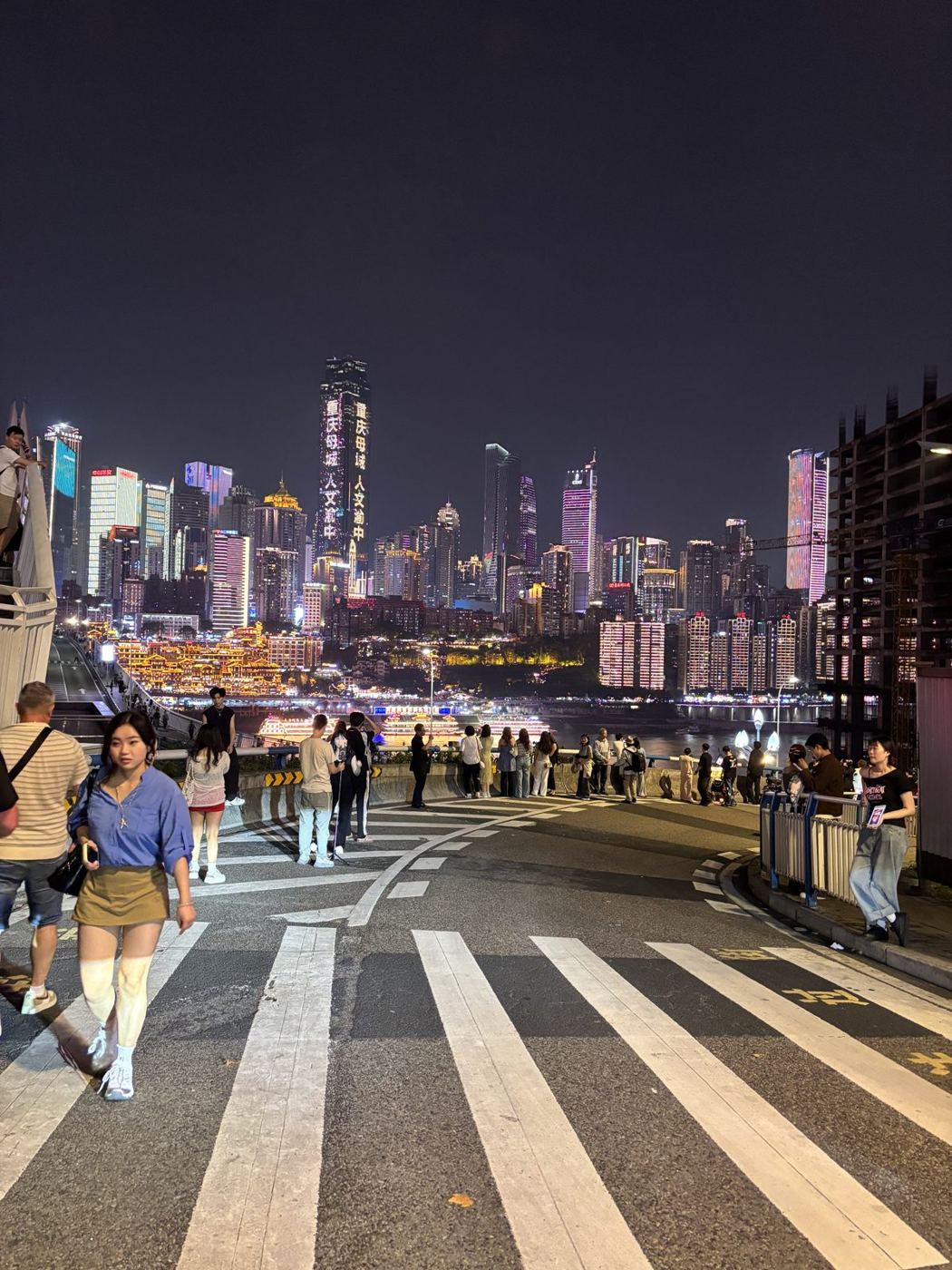
An 11-storey complex in the style of old stilt houses, hugging the cliff above the Jialing River. After dark it lights up and looks like something out of an animated film. Inside are shops, food stalls and terraces, and the best view of the whole thing is from Qiansimen Bridge. Entry is free, but it gets very crowded in the evening.
2. Liziba: the metro through a building
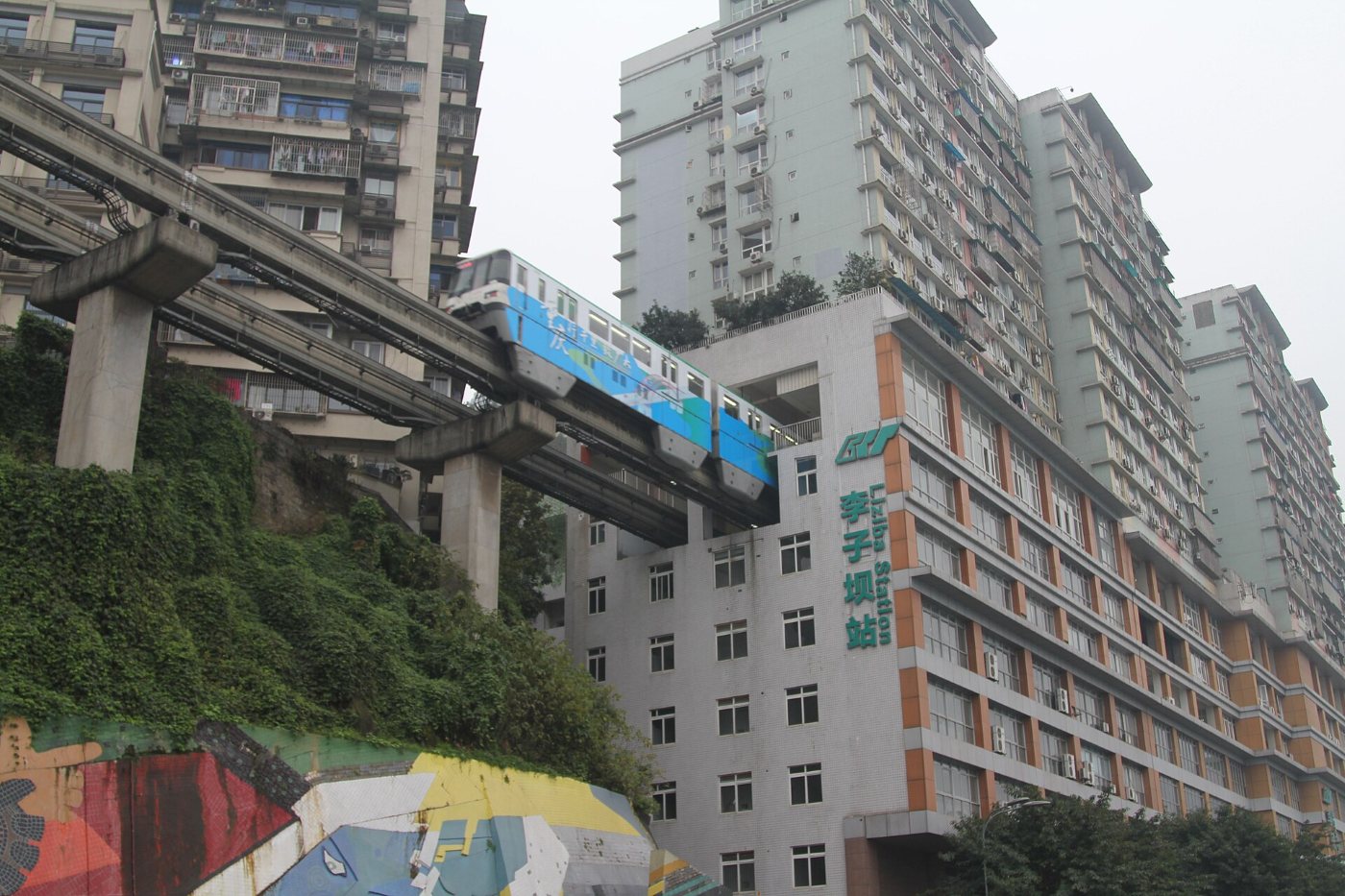
At Liziba station, the Line 2 monorail runs straight into a 19-storey residential building and stops at the level of floors 6–8. Get off at the station, go down to the viewing platform under the tracks and wait for the next train. You can watch it pass through for free, every few minutes.
3. The Yangtze River Cableway
The cable car crosses the river in about 4 minutes on a 1,166 m line. A ticket costs ¥30 (about 17 PLN) one way and ¥50 (about 29 PLN) return (2026 prices). The queue can take an hour, so come on a weekday before dusk or book an entry time in the cableway's WeChat mini-program.
4. Jiefangbei and the Shibati steps
The Liberation Monument (Jiefangbei), originally a monument to victory over Japan, stands at the very heart of the centre, surrounded by skyscrapers and neon. A few minutes away is the restored Shibati district: steep lanes and stairs leading down towards the river, with small restaurants and teahouses.
5. The Kuixing Building: the 22nd floor at street level
The building stands on a slope, so from the lower street you enter on the 1st floor, and from the 22nd floor you walk out onto a plaza at the top, which is also a street. It's the easiest way to understand why navigation in Chongqing goes haywire.
6. Chaotianmen and Raffles City
At the tip of the peninsula, where the muddy Yangtze meets the green Jialing, stands Raffles City with The Crystal on top. The bridge has a viewing deck with a glass floor, and down below is the pier where night cruises depart.
7. The "Two Rivers" night cruise
The one-hour cruise from Chaotianmen pier along the illuminated banks of both rivers costs about ¥128 (about 74 PLN)–¥198 (about 115 PLN). It's the easiest way to see the skyline if you've had enough of stairs.
8. The Yikeshu viewpoint on Nanshan
From the Nanshan hills across the Yangtze you can see the whole centre. Come by taxi after dark, when the peninsula with Raffles City lights up.
9. Ciqikou
An old town and former port on the Jialing: stone lanes, snacks, crafts and teahouses. Take metro Line 1 to Ciqikou station. It's very crowded at weekends, so come on a weekday morning.
10. Eling Park and Eling Erchang
A hilltop park with views of both rivers, and next to it an old factory turned into cafés, galleries and craft shops. A good place for a break and lunch between Liziba and the centre.
What to eat in Chongqing
- Hotpot (火锅): a boiling broth made with beef tallow, red with chilli and Sichuan pepper, in which you cook meat and vegetables yourself. The classic Chongqing pot is divided into nine compartments (九宫格). To start, order a split pot (鸳鸯锅): half spicy, half mild.
- Xiaomian (重庆小面): noodles in a spicy sauce for breakfast, about ¥10 (about 6 PLN)–¥15 (about 9 PLN) a bowl at any street eatery.
- Suanla fen (酸辣粉): hot and sour sweet potato starch noodles.
- Laziji (辣子鸡): pieces of chicken fried in a mountain of dried chillies.
In ChineseYou order the spice level separately. 微辣 (wēi là) means "mildly spicy" and is plenty for most Europeans. 不辣 (bù là) means "not spicy".
How many days in Chongqing
- 1 day: Liziba, Jiefangbei, the Yangtze cable car, and in the evening Hongyadong and hotpot.
- 2 days: add Ciqikou, Eling Park and a night cruise or the Nanshan viewpoint.
- 3–4 days: add a day trip to Dazu or Wulong.
Day trips from Chongqing
- Dazu Rock Carvings (UNESCO): thousands of Buddhist sculptures carved into the rock between the 9th and 13th centuries. The bullet train from Chongqing North to Dazu South takes about 35 minutes, then it's 50–60 minutes by taxi to Baodingshan. A direct tourist bus also runs from Jiefangbei in the centre (about 2 hours).
- Wulong Karst (UNESCO): the Three Natural Bridges, rock arches over a gorge, and the Longshuixia canyon. Scenes from "Transformers: Age of Extinction" were filmed here. The bullet train from Chongqing East to Wulong South takes about 35–50 minutes, then a bus or taxi takes 30–40 minutes. When booking, choose Wulong South (武隆南), not the old Wulong station.
- A Three Gorges cruise on the Yangtze: cruise ships sail from Chongqing to Yichang, usually in 4 days (3 nights). Prices start at a few hundred dollars per person.
- Chengdu: pandas, teahouses and Sichuan opera are 1–1.5 hours from Chongqing by bullet train (what to see in Chengdu).
Getting there and getting around
- By air: Jiangbei Airport (CKG) is about 45–60 minutes from the centre by metro (Line 3 or 10, about ¥6 (about 3 PLN)–¥8 (about 5 PLN)), or about 40 minutes by taxi or DiDi (¥60 (about 35 PLN)–¥90 (about 52 PLN)). From Europe you'll usually connect in Beijing, Shanghai or another hub, though Air China flies weekly from Budapest in the summer schedule (where to fly from).
- By train: bullet trains from Chengdu run every 10–20 minutes. Chongqing has several stations (including Chongqing North, Chongqing West, Chongqing East and Shapingba), so check the exact name on your ticket (common mistakes in China).
- Around the city: by metro (two lines are monorails) and by taxi or DiDi. Navigation in Chongqing can be unreliable, because your destination may be ten floors above or below you. Use Amap or Apple Maps and check which level the entrance is on (China without Google Maps).
Where to stay in Chongqing
The most convenient area is Yuzhong district, near Jiefangbei or Hongyadong. Most sights are then within walking distance or 1–2 metro stops, and you don't need a taxi through traffic in the evening. When booking, check that the hotel accepts foreigners, and read the directions carefully: in some hotels the reception is several floors above the street entrance.
When to visit Chongqing
Best from March to May and from September to November. In July and August the average is 34°C by day and 25°C at night, and the record is 43.7°C: Chongqing is one of China's traditional "furnaces". Winter brings 6–10°C, grey skies and frequent fog, but also fewer tourists. More: When is the best time to visit China?
Our itineraries with Chongqing
| Itinerary | Days | Route |
|---|---|---|
| Cyberpunk & Pandas | 8 | Chongqing → Chengdu → Leshan → Emei |
| Emperors & Hotpot | 10 | Beijing → Tianjin → Xi'an → Chongqing |
| From the Avatar Mountains to Hong Kong | 13 | Chongqing → Zhangjiajie → Guilin → Hong Kong |
| Sichuan Deluxe | 14 | Chengdu → Jiuzhaigou → Chongqing → Zhangjiajie → Chongqing |
All four include a full "vertical city" day in Chongqing: Jiefangbei, Liziba, Eling Park, Ciqikou, the Yangtze cable car and the night skyline, with times, prices and addresses in Chinese.
Frequently asked questions
How many days do you need in Chongqing?
Two days cover the highlights: Hongyadong, Liziba, the Yangtze cable car, Ciqikou and the night skyline. With a day trip to Dazu or Wulong, plan 3–4 days.
Was Chongqing ever the capital of China?
Yes. From November 1937 to 1946, during the war with Japan, Chongqing was the provisional capital of the Republic of China. Much earlier, in antiquity, it was one of the capitals of the state of Ba.
Chongqing or Chengdu?
Ideally both, since they're only 1–1.5 hours apart by bullet train. Chongqing is a futuristic city on hills with the spiciest hotpot, while Chengdu means pandas, teahouses and a slower pace. Our Cyberpunk & Pandas itinerary combines the two.
Is Chongqing safe?
Yes, like most big cities in China. Evening walks around the centre are completely normal. Just watch out for steep stairs and traffic, and for evening crowds by the river.
Is Chongqing hotpot very spicy?
Yes, Chongqing hotpot is considered the spiciest in China. Order a split pot (half spicy, half mild) and the spice level 微辣, "mildly spicy".
How do I get from Chengdu to Chongqing?
By bullet train from Chengdu East to one of Chongqing's stations, such as Shapingba or Chongqing West. Trains run every 10–20 minutes, the journey takes 1–1.5 hours and a second-class ticket costs about ¥100 (about 58 PLN).
Sources
- Wikipedia: Chongqing (area, 2020 census population, fog, climate data from the China Meteorological Administration)
- Wikipedia: History of Chongqing, Bombing of Chongqing and Liberation Monument
- Wikipedia: Liziba station and Yangtze River Cableway; Chongqing Bendibao: Yangtze River Cableway fares (2026, in Chinese)
- Wikipedia: Huangjuewan interchange
- The Structural Engineer: The Crystal skybridge at Raffles City
- Wikivoyage: Dazu and China for Travelers: Wulong day trip
- Our four itineraries with Chongqing (as of October 2026)
Chongqing in a ready-made itinerary
In our itineraries Chongqing is planned hour by hour: from the airport transfer, through Liziba and the Yangtze cable car, to the night skyline, with ticket prices, recommended hotpot places and addresses in Chinese. See the itineraries with Chongqing or all our China itineraries.