Food and culture · 20 min read
Tea in China: types, plantations and regions
In short: all Chinese tea comes from one plant, Camellia sinensis. The six types (green, white, yellow, oolong, red and dark) differ in how the leaves are processed: whether they're withered, fired, rolled, and how far they're oxidised. The most expensive tea comes from the first spring harvest, made only from buds and processed by hand. The best Longjing picked before the Qingming festival costs over ¥5,000 per jin (500 g), while a later harvest fired by machine costs many times less. Day to day, Chinese people drink tea at ¥100–400 per jin. The best place to try it is a teahouse: below you'll find three in each of 10 cities (luxury, atmospheric and budget), with names and addresses in Chinese.
The teahouse we remember best is Heming in Chengdu's People's Park: bamboo chairs, lidded cups and locals playing mahjong at the next table. In Beijing we were surprised to find quiet courtyard teahouses hidden in the hutongs a few steps from the crowded streets, and in Shanghai there was tea at Huxinting on the pond by Yu Garden: expensive, but with a view of the zigzag bridge and old rooftops you won't forget.
Correct as of October 2026. Tea prices are approximate retail prices in China per jin (斤, 500 g). We checked the teahouses in October 2026, but check opening hours in Amap or Dianping before you go.
The six types of Chinese tea
| Type | In Chinese | Oxidation | What makes it different | Examples |
|---|---|---|---|---|
| Green | 绿茶 lǜchá | none | quick firing in a hot wok stops oxidation | Longjing, Biluochun, Huangshan Maofeng |
| White | 白茶 báichá | light, natural | only withering and drying, no firing or rolling | Baihao Yinzhen, Bai Mudan, Shoumei |
| Yellow | 黄茶 huángchá | light | after firing, the leaves "yellow" under a cover | Junshan Yinzhen, Mengding Huangya |
| Oolong | 乌龙茶 wūlóngchá | partial, from a few % to about 70% | tossing the leaves and repeated charcoal roasting | Tieguanyin, Da Hong Pao, Fenghuang Dancong |
| Red | 红茶 hóngchá | full | long oxidation, no firing | Keemun, Dianhong, Jin Jun Mei, Lapsang Souchong |
| Dark | 黑茶 hēichá | microbial fermentation | piling and years of ageing | pu-erh, Anhua teas, Liubao |
NoteWhat the West calls black tea is red tea in China (红茶, after the colour of the brew). Chinese "black" tea (黑茶) is dark tea, such as pu-erh.
Flower teas (花茶) are a separate group, most often jasmine: green tea layered with fresh jasmine flowers several times until it soaks up their scent. In Beijing it's the most popular everyday tea.
How tea is made: from bush to cup
Picking
- The younger the leaf, the more expensive the tea. The most valuable are buds only (单芽), then a bud with one leaf (一芽一叶) and a bud with two leaves (一芽二叶). It takes 4–5 jin of fresh leaves to make 1 jin of dry tea.
- Timing: green teas picked before the Qingming festival, around 5 April, are called 明前 (míngqián, "before Qingming") and are the most expensive. Those picked before the Guyu festival, around 20 April (雨前, yǔqián), are cheaper. Summer and autumn harvests cost even less, although autumn Tieguanyin, for example, has its fans.
- By hand or by machine: the best teas, especially bud-only teas, are picked by hand. Everyday and teabag teas are cut by machine, together with older leaves and stalks.
Processing step by step
- Withering (萎凋): the spread-out leaves lose water and soften. For white tea, that's almost all the processing there is.
- "Kill-green" (杀青, shāqīng): brief heating, usually in a hot wok, which stops oxidation. That's why green tea stays green.
- Rolling (揉捻): the leaves are rolled or flattened. This breaks the cells, so the tea releases its flavour more easily when brewed.
- Oxidation (Chinese colloquially call it 发酵, "fermentation"): exposed to air, the leaves darken. Red tea is fully oxidised, oolong partly, green not at all.
- Drying and roasting (干燥, 焙火): in the sun (that's how pu-erh leaves are dried), in an oven or over charcoal. The best Wuyi Mountain oolongs are roasted over charcoal several times, with breaks, for many hours.
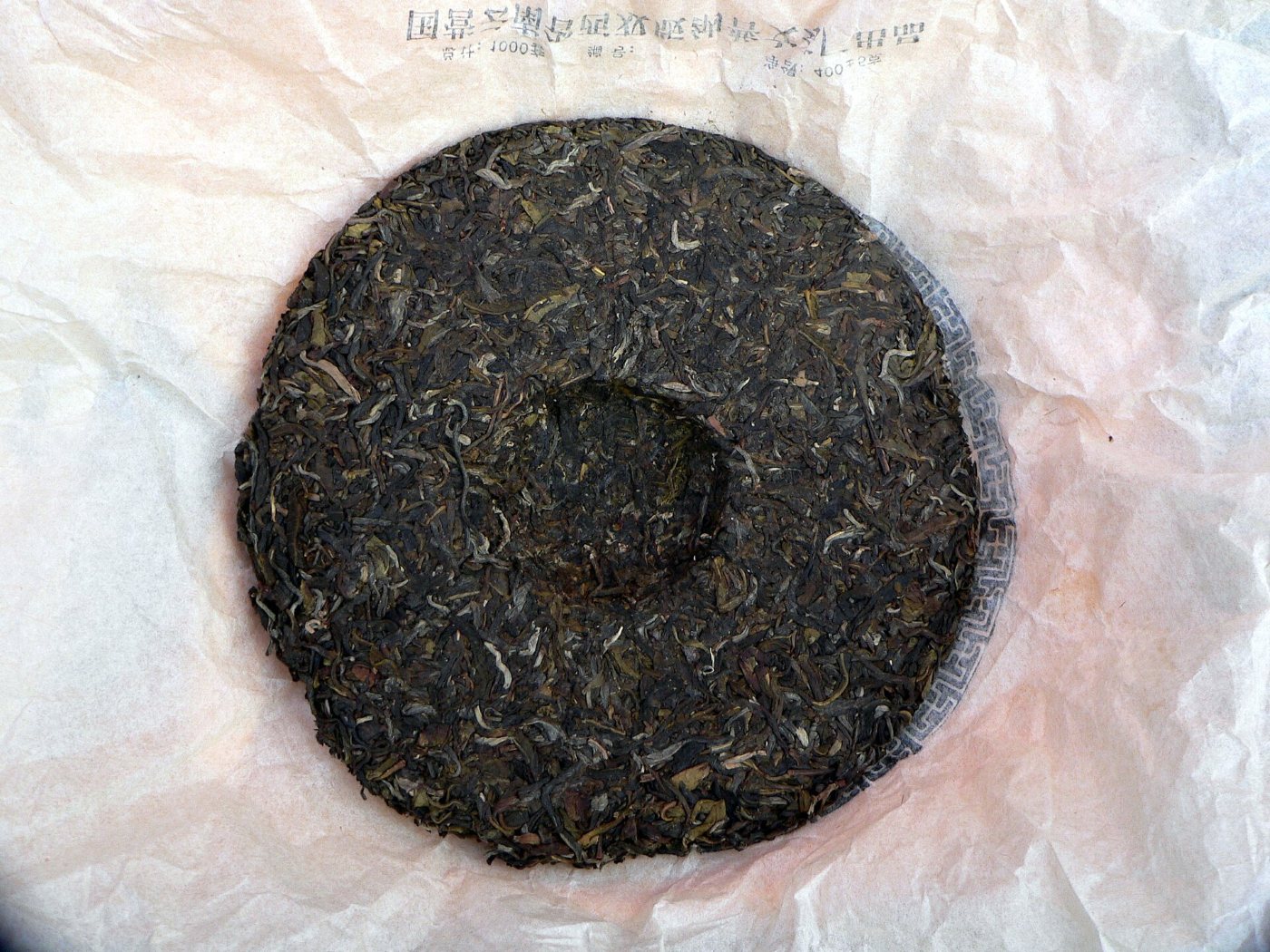
- Ageing (dark teas only): raw pu-erh (生普) is pressed into 357 g cakes and stored for years. Ripe pu-erh (熟普) is sped up by piling damp leaves (渥堆) for several weeks. This method was developed in Kunming in the 1970s.
Handmade or machine-made?
For centuries tea was made entirely by hand. Today most of it is made with the help of machines, and handwork multiplies the price.
- Longjing is fired by hand in a wok: the tea master presses, smooths and turns the leaves with their palm in the hot pan, which gives them their flat shape. Machines arrived in Longjing production around 2005. Today there are three kinds: fully handmade, semi-handmade (machine plus hand finishing) and machine-made. For the best Longjing from the Shifeng area, the final firing must be done by hand.
- How to tell them apart: hand-fired tea is drier (up to about 7% moisture, machine-made about 9%), heavier, and sinks faster once you add water. Machine-made tea is lighter, more uniform and more likely to float.
- Pu-erh is often still picked by hand and sun-dried. Cakes are traditionally pressed with a stone weight, and with hydraulic presses in big factories.
How much Chinese tea costs
Approximate retail prices in China. The same name can cost very different amounts depending on where it's grown, when it's picked and the vintage.
| Tea | Everyday | Good | Top |
|---|---|---|---|
| Longjing (green) | about ¥400 per jin (later harvest, outside the best villages) | ¥1,000–3,000 per jin | over ¥5,000 per jin (pre-Qingming, West Lake, handmade), the very best up to ¥20,000 |
| Tieguanyin (oolong) | ¥80–200 per jin | ¥200–600 per jin | from ¥600 per jin |
| Da Hong Pao (Wuyi oolong) | about ¥300 per jin | ¥500–900 per jin | ¥1,000–3,000 per jin and up |
| Fuding white | Shoumei from about ¥150 per jin | Bai Mudan about ¥400–1,200 per jin | Baihao Yinzhen from about ¥1,200 per jin |
| Pu-erh (357 g cake) | ripe from about ¥80–200 per cake | raw about ¥300–1,000 per cake | old-tree, e.g. Lao Banzhang, several thousand ¥ per cake |
Old pu-erhs, decades old, are collector's items: Shanghai teahouses have charged up to around ¥100,000 (about 58060 PLN) for a single brewing of the rarest ones.
TipBuy tea at tea markets, such as Maliandao (马连道) in Beijing, Tianshan (天山茶城) in Shanghai, Fangcun (芳村) in Guangzhou or Kangle (康乐茶城) in Kunming. In every shop you can ask for a tasting (试茶, shì chá) and compare prices. Watch out for "tea invitations" from friendly strangers in the street (more about this scam).
Tea regions
| Province | Most famous teas | Where to see plantations |
|---|---|---|
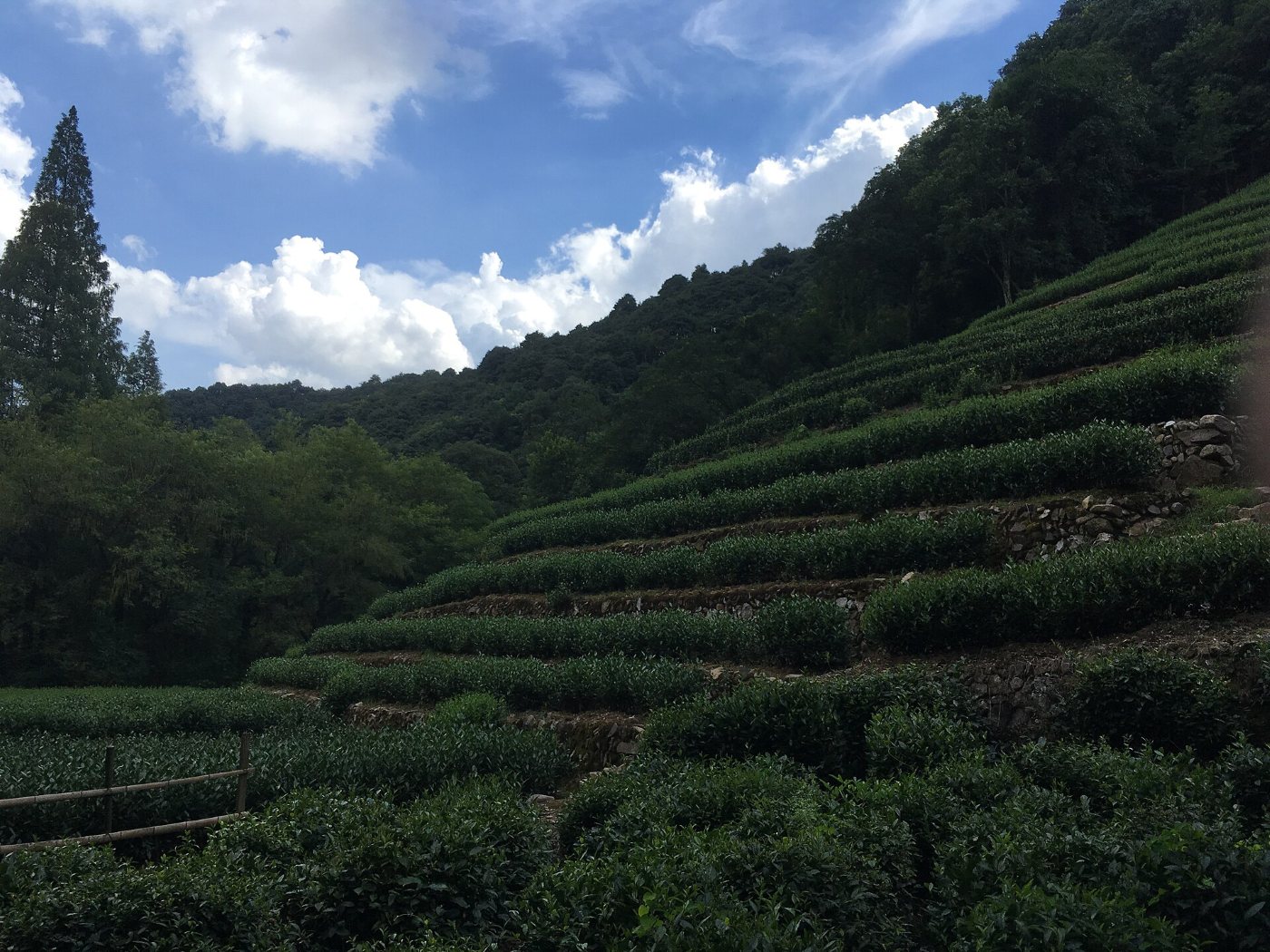
| Zhejiang | Longjing (西湖龙井) | Longjing and Meijiawu villages near Hangzhou |
| Jiangsu | Biluochun (碧螺春) | Dongting Mountain on Lake Tai near Suzhou |
| Anhui | Huangshan Maofeng (黄山毛峰), Keemun (祁门红茶), Lu'an Guapian (六安瓜片) | around the Yellow Mountains (Huangshan) |
| Fujian | Tieguanyin (铁观音), Da Hong Pao (大红袍), Lapsang Souchong (正山小种), white tea (福鼎白茶), jasmine | Anxi, the Wuyi Mountains, Fuding |
| Yunnan | pu-erh (普洱), Dianhong (滇红) | Xishuangbanna, Pu'er and Lincang |
| Guangdong | Fenghuang Dancong (凤凰单丛) | the Fenghuang Mountains near Chaozhou |
| Sichuan | Zhuyeqing (竹叶青), Mengding (蒙顶) | Mount Emei, Mount Mengding near Ya'an |
| Hunan | Junshan Yinzhen (君山银针), Anhua dark teas | Junshan Island on Dongting Lake, Anhua |
| Hubei | Enshi Yulu (恩施玉露), Chibi pressed dark tea (青砖茶) | Enshi; in the 19th century Hankou (today Wuhan) was the hub of the tea trade with Russia |
| Guangxi | Liubao (六堡茶), Hengzhou jasmine | around Wuzhou and Hengzhou |
How Chinese people drink tea
- Lidded cup (盖碗, gàiwǎn): the leaves are brewed right in the cup, and the lid holds them back when you drink or pour.
- Gongfu cha (功夫茶): a small teapot, lots of leaves and many short infusions of a dozen or so seconds each. We describe the whole ritual step by step below.
- Green tea is often drunk straight from a glass with the leaves floating in it.
- In a teahouse you pay for the tea, and hot water refills are free and unlimited. In Chengdu the waiters pour it spectacularly from long-spout kettles (长嘴壶).
- In the south (Guangzhou, Hong Kong, Macau), "drinking tea" (饮茶, yum cha) means eating dim sum. To ask for a refill, leave the teapot lid ajar, and when someone pours you tea, thank them by tapping the table twice with two fingers (more in our article on etiquette).
In Chinese喝茶 hē chá "to drink tea", 加水 jiā shuǐ "more hot water, please", 试茶 shì chá "to taste tea", 多少钱一斤? duōshao qián yì jīn? "how much per jin?"
The tea ritual: gongfu cha step by step
Gongfu cha (功夫茶, written 工夫茶 in Chaozhou, roughly "tea made with skill and patience") is a way of brewing tea from Chaozhou in Guangdong province and southern Fujian. The Chaozhou version has been on China's national list of intangible cultural heritage since 2008, and its full performance has 22 steps. Day to day, just a few of them are enough. This is how tea is brewed at home, in teahouses and at every tasting in a tea market, most often oolongs and pu-erh. The tea market is the easiest place to see it: the seller will brew any tea you want to try this way.
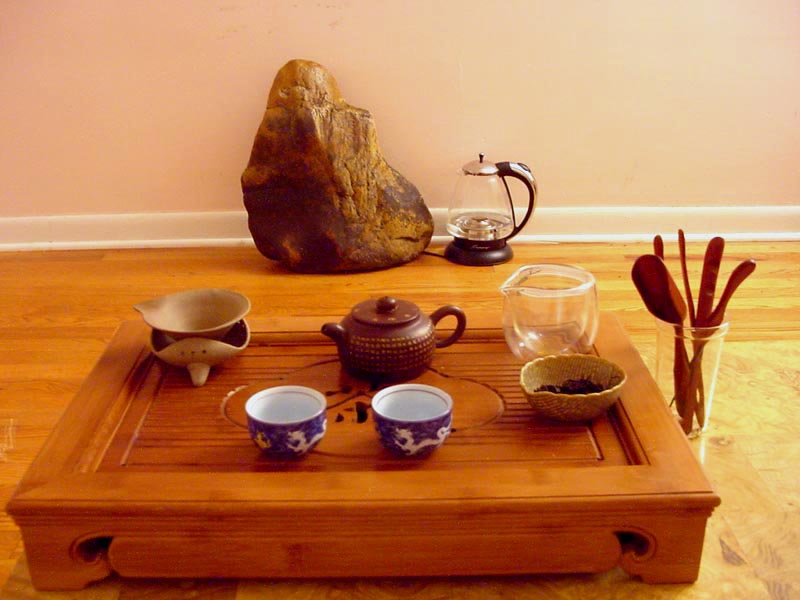
The tea set
| Item | In Chinese | What it's for |
|---|---|---|
| Tea tray with drainage | 茶盘 chápán | holds the whole set, and the water you pour away drains into it |
| Lidded cup or Yixing clay teapot | 盖碗 gàiwǎn, 紫砂壶 zǐshāhú | the leaves are brewed in them; they usually hold 100–150 ml |
| "Fairness pitcher" | 公道杯 gōngdàobēi | the whole infusion is poured into it so everyone gets tea of the same strength |
| Cups | 品茗杯 pǐnmíngbēi | tiny, two or three sips each; in Chaozhou there are traditionally three |
| Dish for the dry leaves | 茶荷 cháhé | the host uses it to show the tea to guests before brewing |
| Tongs and strainer | 茶夹 chájiā, 茶漏 chálòu | the tongs move the cups, and the strainer catches bits of leaf |
The lidded cup has three parts and is also called 三才碗, the "cup of the three powers": the lid is heaven, the saucer is earth and the cup itself is man.
Step by step
- Warming the set (温杯 wēn bēi): the host pours boiling water over the lidded cup or teapot, the fairness pitcher and the cups, then empties the water onto the tray. The cups are moved with tongs so nobody touches the rims the guests will drink from.
- Showing the leaves (赏茶 shǎng chá): the dry leaves go round the guests on the 茶荷 so they can look at them and smell them.
- Adding the leaves (投茶 tóu chá): far more leaves than in the West, about 7–8 g per 110 ml for oolong, or roughly a third of the cup. Once wet, the rolled balls unfurl and fill it completely.
- Rinsing (洗茶 xǐ chá, also 醒茶 xǐng chá, "waking the tea"): the leaves are covered with boiling water, which is poured away at once. This is done with oolongs, pu-erhs and other dark teas, but usually not with green or white tea. The rinse is sometimes poured over the little clay figures on the tray (茶宠 chá chǒng, "tea pets").
- Brewing (冲泡 chōngpào): the water is poured from a height so the leaves swirl, then the lid goes on for a moment: 5–15 seconds for the first infusions, a little longer for each one after. A clay teapot also gets boiling water poured over the outside to keep it hot.
- Pouring off (出汤 chū tāng): the whole infusion, down to the last drop, goes into the fairness pitcher. The leaves mustn't sit in water, or the next infusion turns bitter. The traditional Chaozhou style has no fairness pitcher: the host pours straight from the teapot, circling over the three cups (关公巡城, "General Guan Gong patrols the city walls"), then shares out the last, strongest drops one by one into each cup (韩信点兵, "Han Xin counts his soldiers").
- Filling the cups (分茶 fēn chá): cups are filled to about 70%. The saying goes 酒满敬人,茶满欺人: a full glass of alcohol shows respect, while a full cup of tea is rude, because you can't comfortably pick it up when it's hot. The most important or oldest guest is served first, and the host pours their own cup last.
- Drinking (品茶 pǐn chá): first the aroma, then the tea in three small sips. Chinese people like to point out that the character 品 ("to taste") is made of three 口 ("mouth") characters. The cup is usually held with the thumb and index finger at the rim and the middle finger under the base. This grip is called 三龙护鼎, "three dragons guard the cauldron".
- More infusions: oolong lasts for 6–10 infusions, a good pu-erh for more than 10, and each tastes a little different. At the end it's worth looking at the unfurled leaves (叶底 yèdǐ). Whole, springy leaves are a sign of good tea.
Water temperature
| Tea | Temperature | What to watch for |
|---|---|---|
| Green and yellow | 75–85 °C | brew them in a glass or a lidded cup left uncovered, because covered leaves "stew" |
| White | 85–95 °C | older white tea, such as Shoumei, can take boiling water |
| Red | 90–95 °C | it turns bitter if brewed too long |
| Oolong | 95–100 °C | the darker the roast, the hotter the water |
| Pu-erh and other dark teas | 100 °C | always rinse first |
Drinking tea with Chinese hosts
- Drink straight away. The infusions are small and cool quickly, and the host waits for you to empty your cup before brewing the next one.
- Your host will refill an empty cup at once. When you've had enough, leave a little tea in it and say 够了,谢谢 (gòu le, xièxie, "that's enough, thank you").
- To thank someone for pouring, tap the table with your fingers (叩指礼 kòuzhǐ lǐ): the index and middle fingers, slightly bent, a few times. Legend says the custom was invented by the companions of the Qianlong Emperor. Travelling incognito, the emperor poured tea for them himself, and since they couldn't kneel before him without giving him away, they "bowed" with their fingers.
- The teapot spout shouldn't point at a guest (壶嘴不对人). Hosts put the teapot down with the spout facing to the side.
- A curiosity: in the Qing dynasty, an official who picked up his cup and invited his guest to drink was signalling that the meeting was over (端茶送客, "serve tea to see the guest off"). Today you'll only see it in historical TV dramas.
Teahouses: three in each of 10 cities
In each city we picked three places: luxury, with the best teas and service, atmospheric, where you'll see how tea is drunk here, and budget. Show the Chinese address to your taxi driver or enter it in Amap (how to do it).
Beijing
| Teahouse | Address in Chinese | Why go | |
|---|---|---|---|
| Luxury | Laoshe (老舍茶馆) | 北京市西城区前门西大街正阳市场3号楼 | tea, snacks and an evening show: Peking opera, acrobats, comedy sketches; about ¥180–280 per person |
| Atmospheric | Cha Wei Cha She (茶味茶舍,雍和宫店) | 北京市东城区官书院胡同18号 | a courtyard teahouse in a hutong, 180 m from exit F of Yonghegong metro station; about ¥200 per person, 10:00–19:00, closed on Tuesdays |
| Budget | "Big bowl tea" at Laoshe (老舍茶馆大碗茶) | 北京市西城区前门西大街正阳市场3号楼 | the same price since 1979: 2 fen (¥0.02) a bowl, daily 10:00–16:00 |
Shanghai
| Teahouse | Address in Chinese | Why go | |
|---|---|---|---|
| Luxury | Huxinting (湖心亭茶楼) | 上海市黄浦区豫园路257号 | Shanghai's most famous teahouse, on the pond by Yu Garden, with a zigzag bridge; open since 1855, renovated in 2025; expensive, but with a view |
| Atmospheric | Laoshanghai Chaguan (老上海茶馆) | 上海市静安区江宁路495号博鸿大厦顶层01-05室 | a teahouse full of old Shanghai memorabilia on the top floor of a tower; it moved here in 2022 from near Yu Garden, where old guidebooks still send people; about ¥90 per person, 10:00–22:00 |
| Budget | Tianshan Chacheng (天山茶城) | 上海市长宁区玉屏南路28号 | an old Shanghai tea market with dozens of shops: tastings are usually free, and you buy tea by the jin; 8:30–20:30 |
Chengdu
| Teahouse | Address in Chinese | Why go | |
|---|---|---|---|
| Luxury | Mi Xun (谧寻茶室) at The Temple House hotel | 成都市锦江区笔帖式街81号 | vegetarian cuisine and a choice of rare teas; one Michelin star in 2026 |
| Atmospheric | Guanyinge in Pengzhen (观音阁老茶馆) | 成都市双流区彭镇马市坝街62号 | a century-old teahouse in a former temple, open from 5:00 am; UNESCO heritage conservation award (2024); tea about ¥10–20, about 40 min by car from the centre |
| Budget | Heming (鹤鸣茶社) | 成都市青羊区少城路12号(人民公园内) | in People's Park since 1923: bamboo chairs, mahjong and ear cleaning; tea about ¥15–35 |
For tea with Sichuan opera and a face-changing show, go to Shunxing (顺兴老茶馆, 成都市武侯区世纪城路166号). We visit it in our Chengdu travel plans.
Chongqing
| Teahouse | Address in Chinese | Why go | |
|---|---|---|---|
| Luxury | Bainian Chongqing Chaguan (百年重庆茶馆) | 重庆市渝中区解放碑得意世界A裙2-2 | Sichuan opera four times a day, face changing and pouring from a long-spout kettle |
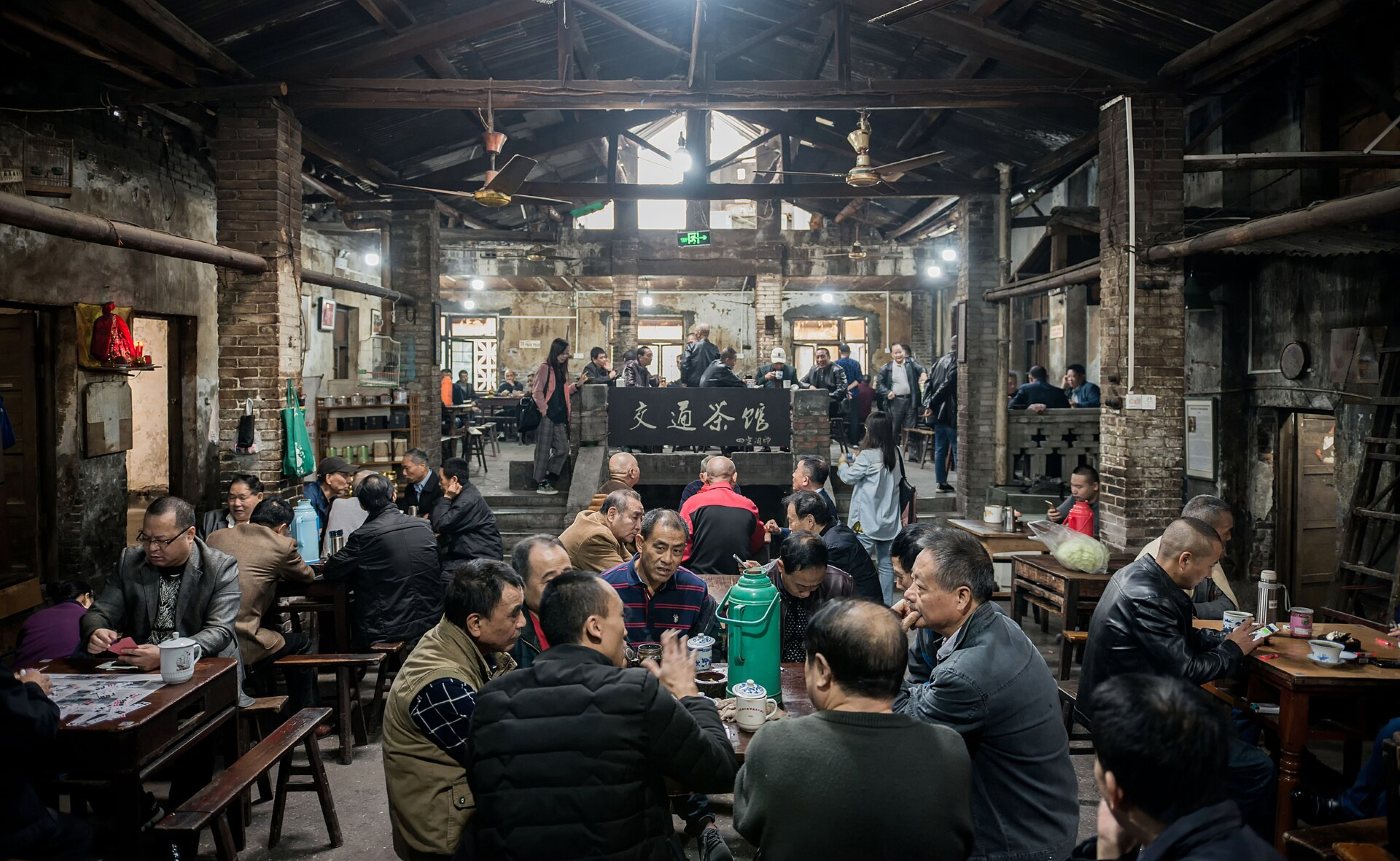
| Atmospheric | Jiaotong (交通茶馆) | 重庆市九龙坡区黄桷坪正街20号 | an old teahouse with soot-blackened beams and wooden benches, open from 6:30 |
| Budget | Hanlin Yuan in Ciqikou (磁器口翰林院) | 重庆市沙坪坝区磁南街1号 | tea in a former Qing dynasty school; wicker chairs, lidded cups, about ¥15–30 |
Wuhan
| Teahouse | Address in Chinese | Why go | |
|---|---|---|---|
| Luxury | Yongmei Chalu (八马茶业·东湖咏梅茶庐) at the East Lake Hotel | 武汉市武昌区东湖路142号东湖宾馆内 | an elegant Bama Tea teahouse in a historic hotel on East Lake; about ¥140 per person, 9:00–21:00 |
| Atmospheric | the teahouse at Guqin Terrace (古琴台茶室) | 武汉市汉阳区古琴台景区内(月湖东畔) | a traditional teahouse in the Guqin Terrace garden, where legend says the musician Yu Boya found his "soulmate" (知音); reopened after renovation in 2024 |
| Budget | Caomujia (草木家·茶院) | 武汉市武昌区粮道街昙华林101号昙华林核心区B1号113号 | a teahouse in the historic Tanhualin district, with wooden furniture and greenery; about ¥50 per person, 11:00–19:30 |
Xi'an
| Teahouse | Address in Chinese | Why go | |
|---|---|---|---|
| Luxury | Fubaoge (福宝阁茶楼) | 西安市碑林区德福巷66号 | a five-storey traditional teahouse on Defu Lane, with performances |
| Atmospheric | Zhenguan (贞观茶空间) | 西安市雁塔区庙坡头路与雁南二路交叉口向东60米 | a waterside teahouse in the Tang dynasty city wall ruins park, with outdoor seating; about ¥200 per person, 10:00–23:00 |
| Budget | "three cannons" tea in the Muslim Quarter (回民街三炮台) | 西安市莲湖区北院门(回民街) | sweet tea with rock sugar, longan and raisins in a lidded cup, a few to a dozen-odd ¥ in the restaurants |
Shenzhen
| Teahouse | Address in Chinese | Why go | |
|---|---|---|---|
| Luxury | Yici (一慈茶馆) | 深圳市福田区莲花路1110-7 | a quiet teahouse at the foot of Lianhua Hill, with Wuyi and Chaozhou oolongs |
| Atmospheric | Jingyi (静颐茶馆) | 深圳市罗湖区宝安南路3038号金塘大厦7楼 | a traditional-style vegetarian teahouse, open for over 20 years |
| Budget | Fanlou (蘩楼) | 深圳市罗湖区人民南路2002号佳宁娜广场4楼 | dim sum and tea close to the Luohu border crossing to Hong Kong |
Guangzhou
| Teahouse | Address in Chinese | Why go | |
|---|---|---|---|
| Luxury | Panxi Jiujia (泮溪酒家) | 广州市荔湾区龙津西路151号 | a garden restaurant on Liwan Lake, dim sum recommended by the Michelin Guide |
| Atmospheric | Taotaoju (陶陶居) | 广州市荔湾区第十甫路20号 | a historic teahouse in the old Xiguan district, 7:00–22:30; tea about ¥15–35 per person |
| Budget | Diandude (点都德,聚福楼店) | 广州市越秀区惠福东路470号 | a popular chain with affordable dim sum, near Beijing Road |
You can buy tea at one of China's biggest tea markets, Fangcun (芳村茶叶市场).
Hong Kong
| Teahouse | Address in Chinese | Why go | |
|---|---|---|---|
| Luxury | Luk Yu (陸羽茶室) | 香港中環士丹利街24-26號 | since 1933, art deco interiors and classic dim sum, 7:00–22:00 |
| Atmospheric | Lock Cha (樂茶軒) | 香港金鐘紅棉路10號香港公園羅桂祥茶藝館地下 | a teahouse in the colonial building of the Museum of Tea Ware in Hong Kong Park, vegetarian dim sum |
| Budget | Lin Heung (蓮香樓) | 香港上環德輔道中249-253號東寧大廈地下 | a century-old teahouse with dim sum on trolleys, in its new Sheung Wan location since May 2026; 6:00–24:00 |
Macau
| Teahouse | Address in Chinese | Why go | |
|---|---|---|---|
| Luxury | Chalou (茶樓) at Grand Lisboa Palace | 澳門路氹上葡京綜合度假村 | elegant dim sum and over a dozen premium teas |
| Atmospheric | Long Wa (龍華茶樓) | 澳門提督市北街3號(紅街市旁) | a 1962 teahouse by the Red Market: wooden tables and ceiling fans, and you help yourself to tea and dim sum; 7:00–14:00 |
| Budget | Tai Long Fong (大龍鳳茶樓) | 澳門十月初五街127號 | an old teahouse where Cantonese opera arias are sung in the afternoons |
Where tea reigns: places beyond the big cities
Hangzhou
| Place | Address in Chinese | Why go | |
|---|---|---|---|
| Luxury | Hupanju (湖畔居茶楼,湖滨店) | 杭州市上城区圣塘景区1号 | the most famous teahouse on West Lake; the best seats with a view have a minimum spend of about ¥180 |
| Atmospheric | Longjing village (龙井村) | 杭州市西湖区龙井村 | tea with the growers, among the Longjing fields; free entry, haggle over the price of tea |
| Budget | China National Tea Museum (中国茶叶博物馆) | 杭州市西湖区龙井路88号 | free entry, exhibitions on growing and processing, a teahouse among the fields; closed one day a week |
More places for tea lovers
- Kunming: Kangle Tea Culture City (康乐茶文化城, 昆明市官渡区官南大道1683号), one of China's largest pu-erh markets, with hundreds of shops and tastings.
- Wuyi Mountains (Fujian): the home of Da Hong Pao and Lapsang Souchong. The six Da Hong Pao "mother bushes" grow on a cliff in the Jiulongke gorge. No leaves have been picked from them since 2006.
- Anxi (Fujian): the capital of Tieguanyin.
- Fuding (Fujian): white teas, including Baihao Yinzhen.
- Xishuangbanna (Yunnan): ancient tea trees and pu-erh villages such as Lao Banzhang.
- Mount Emei (Sichuan): Zhuyeqing tea from plantations on the slopes of the sacred mountain, which we climb in several of our plans.
FAQ
What is the most popular tea in China?
Green: it accounts for over half of all tea produced in China. In the north, especially Beijing, people drink a lot of jasmine, in the south oolongs, and in Yunnan pu-erh.
What's the difference between red tea and black tea?
They're the same tea. The Chinese call it red (红茶) after the colour of the brew, and Westerners call it black after the colour of the leaves. Chinese "black" tea (黑茶) is dark tea, such as pu-erh.
Why are some Chinese teas so expensive?
It comes down to where they're grown, when they're picked, the size of the leaves and handwork. The most expensive are the first spring harvests of buds only, fired by hand, from the best villages. Pu-erh also gains value with age.
Where can I buy good tea in China?
At tea markets, where you can taste several teas before buying, or in shops of well-known brands, such as Wuyutai (吴裕泰) and Zhang Yiyuan (张一元) in Beijing. Avoid shops that strangers in the street lead you to.
What does a Chinese tea ceremony look like?
The most popular is gongfu cha from Chaozhou. The tea set is warmed with boiling water, the leaves are briefly rinsed, then brewed many times for a few to a dozen-odd seconds in a small lidded cup or clay teapot. The tea is poured into a "fairness pitcher" and shared out into tiny cups, filled to about 70%. You drink in small sips and thank whoever pours by tapping the table with your fingers.
Do I have to eat something in a Chinese teahouse?
No. You pay for the tea, and snacks (seeds, fruit, biscuits) are optional. The exception is dim sum teahouses in the south, where tea goes with the food.
Sources
- Wikipedia: Tea processing (processing steps and tea types)
- The Paper: prices of pre-Qingming Longjing (2025, in Chinese)
- NetEase: handmade vs machine-made Longjing (in Chinese)
- China Intangible Cultural Heritage: 潮州工夫茶艺 (Chaozhou gongfu cha, national list since 2008, 22 steps; in Chinese)
- Zdic: 盖碗 (the "cup of the three powers"; in Chinese)
- South China Morning Post: tea to 70% of the cup, alcohol to the brim
- Prices of Tieguanyin, Da Hong Pao, white tea and pu-erh: shop price lists and tea reviews from 2023–2025 (Zhihu, 51puer)
- Teahouses: Trip.com, Time Out Hong Kong, the Michelin Guide, press articles from 2025–2026 and checks in the Amap and Baidu maps (October 2026)
Tea in our travel plans
In our Along the Yangtze plan you drink Longjing among the plantations near Hangzhou, in our Chengdu plans, such as Spicy Chengdu, you sit in the Heming teahouse among the locals, and in The Road to Shangri-La you taste pu-erh in its homeland, Yunnan. All with addresses in Chinese and prices. See all our plans.