Food and culture · 10 min read
Chinese New Year 2027: date, zodiac sign and should you travel then
In short: Chinese New Year 2027 (the Spring Festival, 春节) falls on Saturday 6 February and starts the Year of the Fire Goat. The most important moment is New Year's Eve on the evening of 5 February, and the celebrations end with the Lantern Festival on 20 February. Chinese people get at least 4 days off (usually 8–9 with swapped working days), and around the holiday the world's biggest travel rush lasts about 40 days. As a visitor you'll see temple fairs, lanterns and fireworks, but you'll pay more for trains and hotels, and some small restaurants close for a few days.
For Chinese people the New Year is like Christmas and New Year's Eve rolled into one: hundreds of millions travel back to their family homes and cities change beyond recognition for a few days. Below we explain when the 2027 holidays fall, how they're celebrated and whether it's worth travelling to China at that time.
Correct as of October 2026. China's State Council usually publishes the official 2027 holiday calendar in November – we'll add the exact dates then.
When is Chinese New Year 2027?
Chinese New Year follows the lunar calendar, so the date changes every year: it always falls between 21 January and 20 February, on the second new moon after the winter solstice.
| What | Date in 2027 | Notes |
|---|---|---|
| New Year's Eve (除夕) | Friday 5 February | family dinner, fireworks at night |
| New Year (春节) | Saturday 6 February | start of the Year of the Goat |
| Days off in China | from 5 February, about a week | 4 statutory days; exact calendar in November 2026 |
| Holiday travel rush (春运) | about 22 January – 2 March | forecast; in 2026 it lasted 40 days (2 February – 13 March) |
| Lantern Festival (元宵节) | Saturday 20 February | day 15, end of the festivities |
| Next New Year | 26 January 2028 | Year of the Monkey |
Since 2025 Chinese workers get 4 statutory days off: New Year's Eve and the first three days of the year. The state adds weekends and "swapped" working Saturdays, so the break usually lasts 8–9 days. In 2026 it was 9 days (15–23 February), the longest ever.
Year of the Goat 2027: what sign is it?
In the Chinese zodiac 2027 is the Year of the Goat (羊, yáng), or more precisely the Fire Goat (丁未, dīngwèi). The Chinese word 羊 covers goat, sheep and ram, which is why you'll see all three names in English. The Goat is the eighth of the twelve animals and traditionally stands for gentleness, calm and artistic talent.
The Year of the Goat runs from 6 February 2027 to 25 January 2028. Earlier Goat years were 1943, 1955, 1967, 1979, 1991, 2003 and 2015. Note: if you were born in January or early February, your sign is usually the animal of the previous year, because the Chinese year starts later than ours.
How Chinese people celebrate
Preparations. Before the holiday the whole house is cleaned to "sweep out" bad luck. Red pairs of New Year poems (春联, chūnlián) go up on the doors, together with the character 福 ("good fortune"), often upside down. An upside-down 福 reads 福倒了, and "倒" (dào, upside down) sounds like "到" (dào, arrived) – "good fortune has arrived".
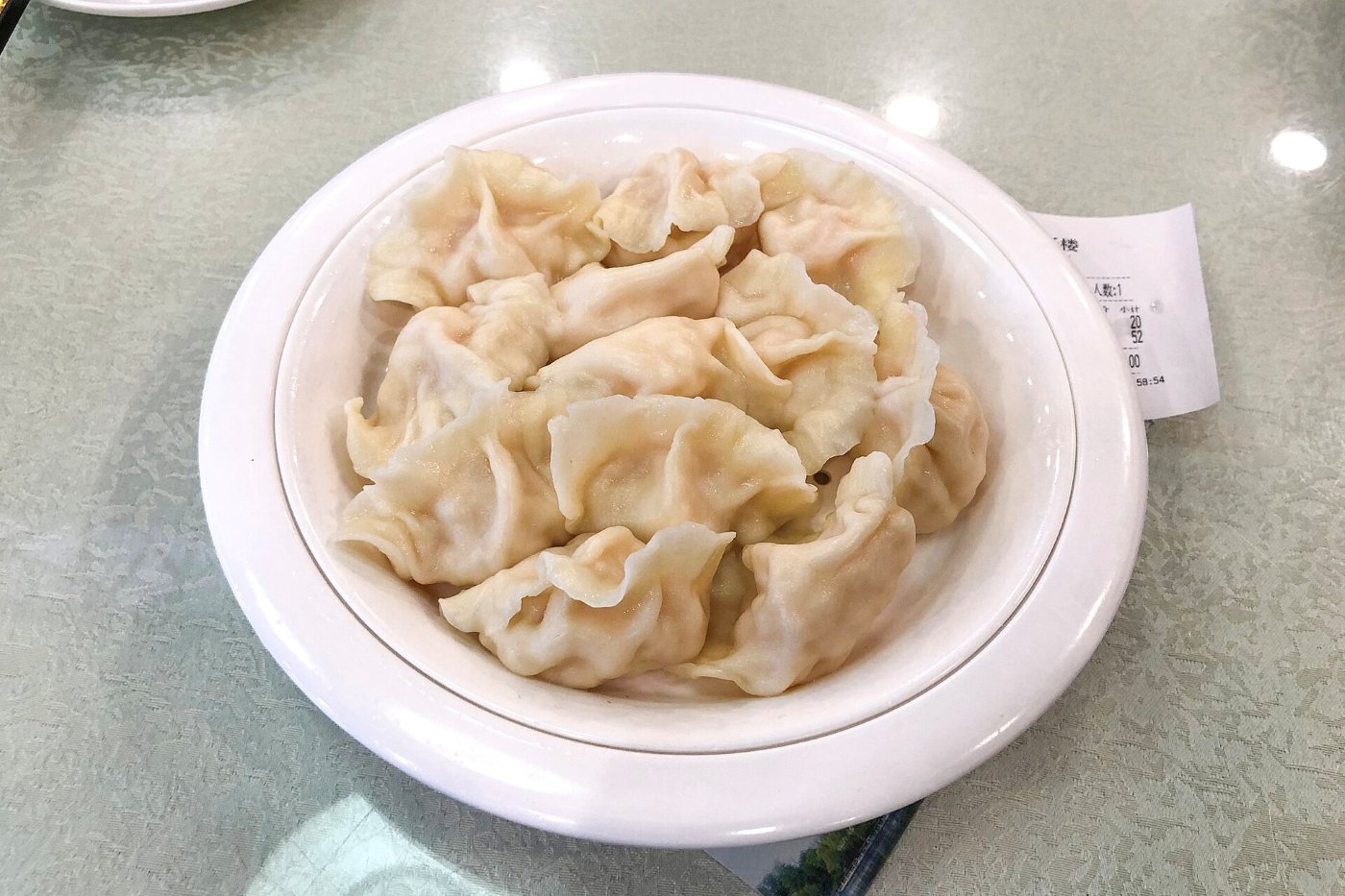
New Year's Eve (除夕). The most important evening of the year: the whole family sits down to dinner (年夜饭, niányèfàn). There has to be fish, because 鱼 (yú) sounds like 余 ("surplus"), and the wish 年年有余 means "abundance every year". In the north families make jiaozi dumplings (饺子), shaped like old silver ingots. In the south people eat rice cake 年糕 (niángāo), whose name sounds like "higher every year". After dinner most of China watches the CCTV New Year Gala (春晚), and at midnight the fireworks start.
Red envelopes (红包, hóngbāo). Older relatives give money in red envelopes to children and younger family members, and bosses give them to employees. Amounts with an 8 are lucky, amounts with a 4 are not (4 sounds like "death"). What surprised us in China is how closely tradition and modern life go together: red envelopes are now more and more often sent through WeChat, and "grabbing envelopes" in the family group chat is a New Year game of its own.
The first days of the year. On day one people visit their closest family and exchange wishes; on day two married daughters visit their parents with their husbands (回娘家). Day five (破五) is the "reopening" after the holiday: many shops and businesses go back to work, and people welcome the God of Wealth with fireworks.
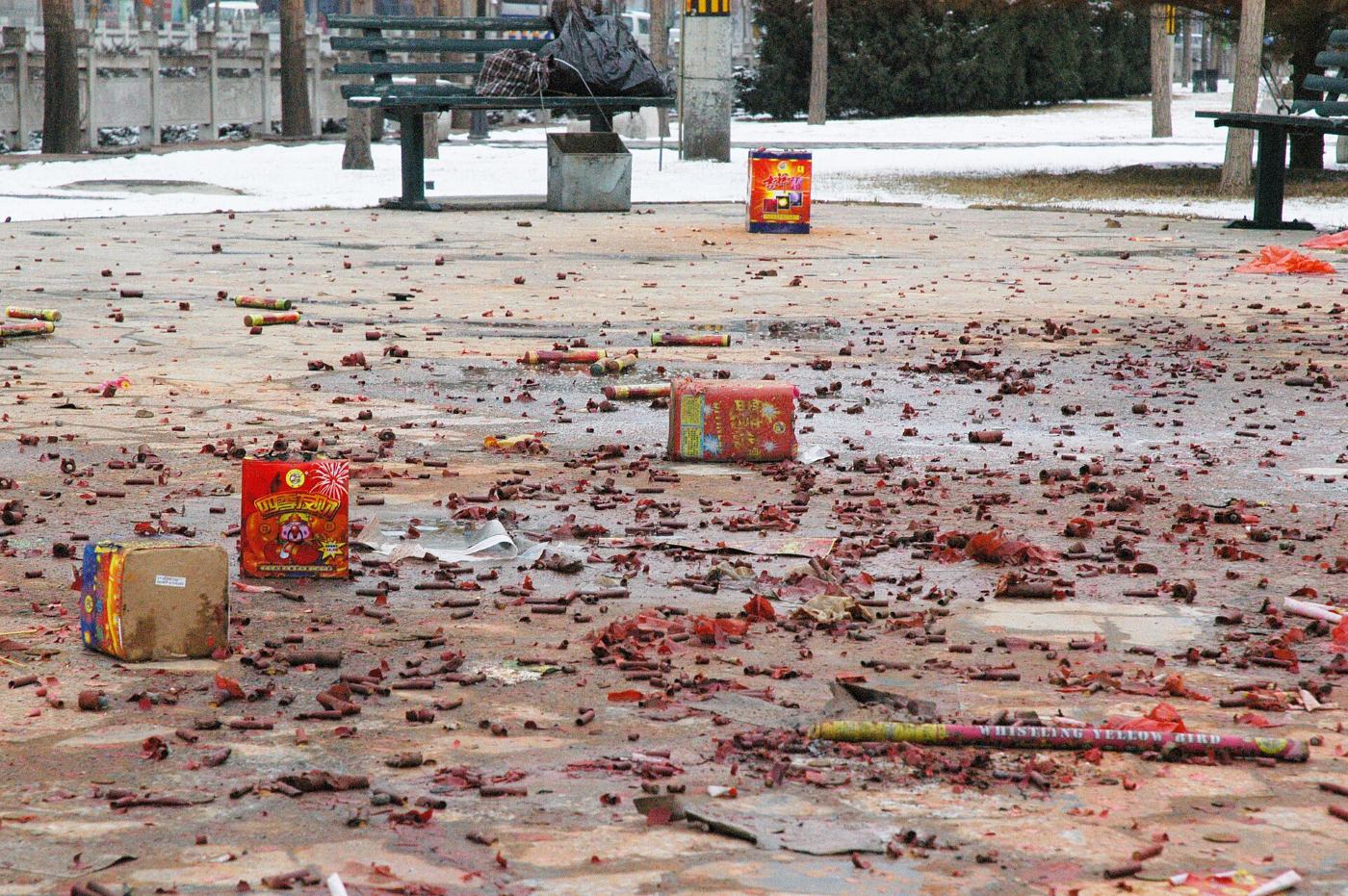
Fireworks. According to legend, the bang of firecrackers scares away the monster Nian (年). In the centres of big cities, including Beijing inside the Fifth Ring Road and Shanghai inside the Outer Ring Road, firecrackers and fireworks are now banned, but in the suburbs and the countryside they go on until morning on New Year's Eve.
Lantern Festival (元宵节). On the fifteenth day – 20 February in 2027 – cities light up with lanterns, people eat sweet glutinous rice balls (汤圆 or 元宵) and solve riddles written on the lanterns. This day closes the holiday season.
Is it worth travelling to China during Chinese New Year?
It depends on what you're after. The atmosphere is unique, but it's the hardest time of the year logistically.
| Pros | Cons |
|---|---|
| temple fairs, lanterns, decorations, lion dances | trains and flights sold out and more expensive, especially on routes to home towns |
| Beijing and Shanghai get quieter as millions of workers go home to the countryside | crowds at famous sights like in Golden Week |
| Harbin's Ice and Snow World is open in winter | some small restaurants and shops are closed in the first days of the year |
| fireworks and a parade in Hong Kong | hotels in popular places cost more |
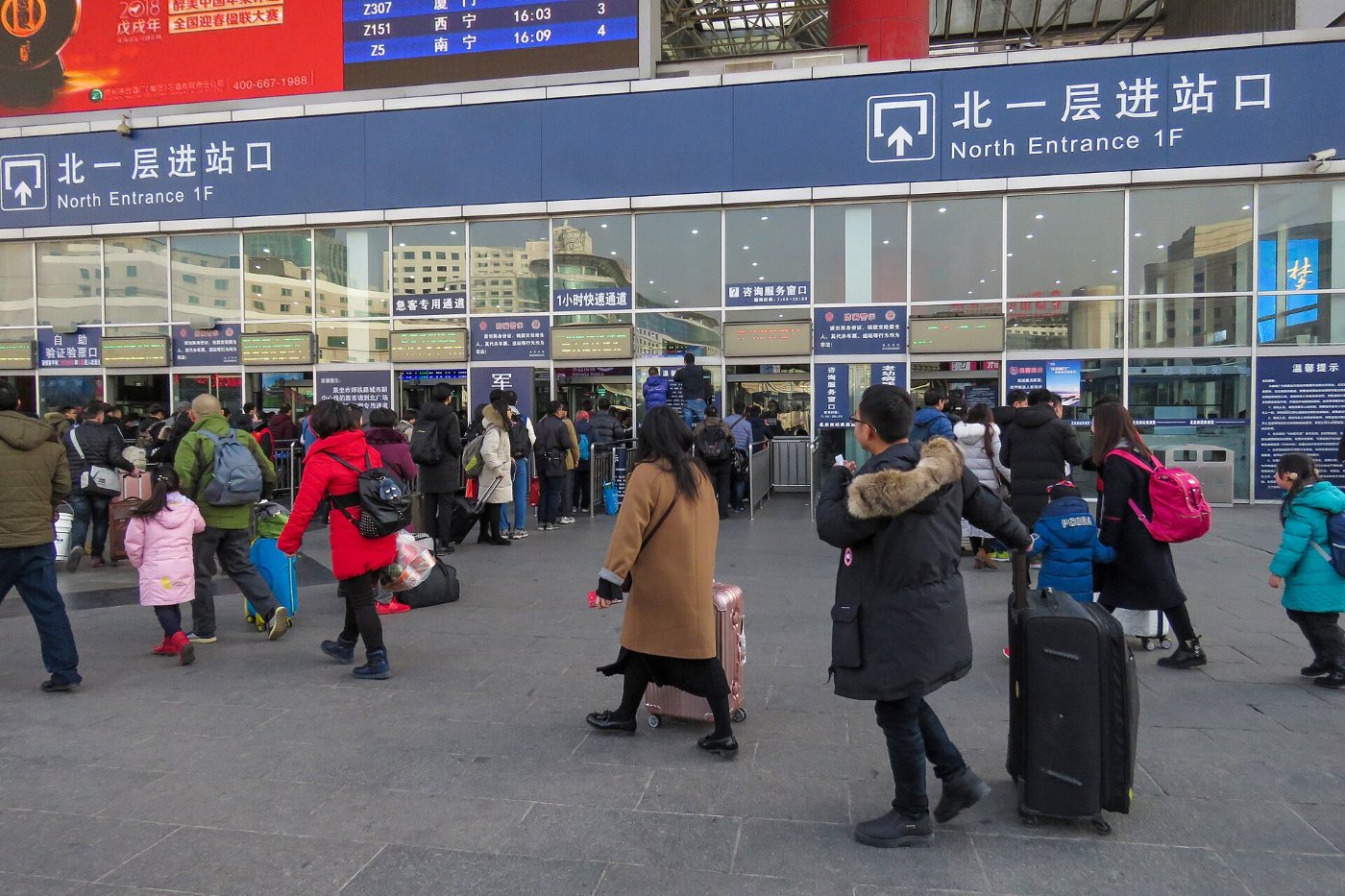
The holiday travel rush (春运, chūnyùn) is the largest annual human migration on Earth. In 2026 it lasted 40 days and, according to China's Ministry of Transport, involved 9.41 billion inter-regional trips. Most people travel in the week before New Year (going home) and on days 4–8 after it (going back to the cities).
Our advice: if you don't specifically want to see the festival, come before about 20 January or after 2–3 March. It's cheaper and quieter then, and in winter you can still see Harbin, for example. More on the seasons: best time to visit China.
How to plan a trip over Chinese New Year
- Buy train tickets as soon as sales open. Rail tickets go on sale 15 days before travel (12306 or Trip.com). On popular routes at the peak they sell out within minutes. How to buy one: hotels, trains and flights.
- Travel "against the flow". On New Year's Eve and the first days of the year trains are emptier because everyone is already home. The worst days are the week before New Year and days 4–8 after it.
- Book hotels with free cancellation and check prices earlier than usual.
- Book a table for New Year's Eve or eat at your hotel. Many restaurants offer a special Eve dinner menu and seats run out early.
- Check opening hours. Big sights and chain restaurants stay open, but small family-run places often close from New Year's Eve until day five. Mobile payments work as normal: how to pay in China.
- Check the entry rules for your passport. Many nationalities can visit China visa-free for up to 30 days, but some of these arrangements are only confirmed until 31 December 2026: China visa-free entry.
Where to spend Chinese New Year
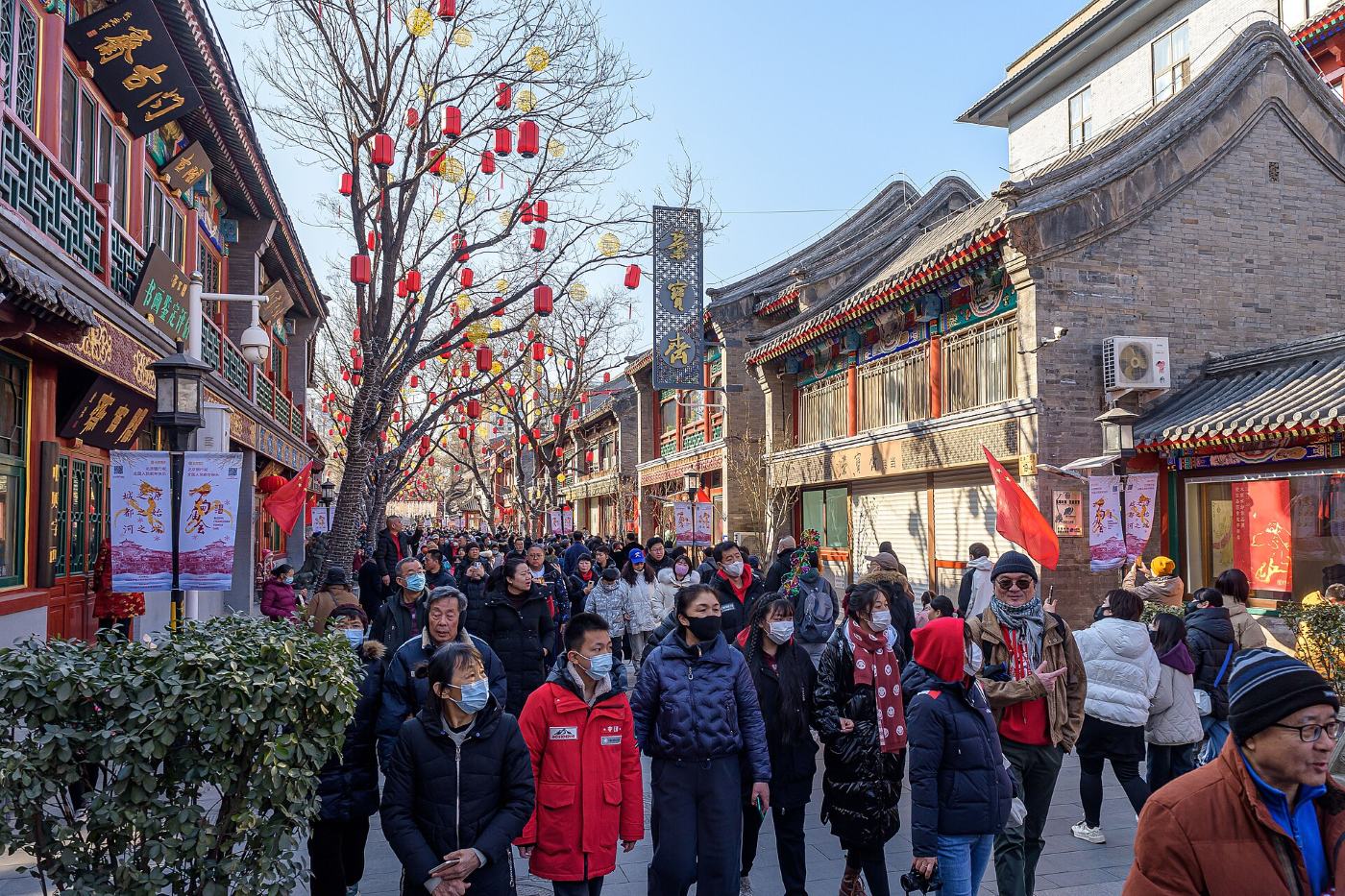
Beijing – temple fairs (庙会). During the first week of the year parks host fairs with food, crafts and performances. In 2026 the fairs in Ditan (地坛) and Longtan (龙潭) parks ran from day 1 to day 7, with tickets at about ¥30 (about 17 PLN). The most atmospheric one is the Changdian fair on Liulichang street (琉璃厂), shown in the photo at the top. Guide: Beijing in 3–4 days.
Harbin – Ice and Snow World. February is still ice sculpture season: the park stayed open until 26 February in 2025 and until 21 February in 2026. Over the holiday, though, it's at its busiest. Guide: Harbin in winter.
Hong Kong – parade and fireworks. On day one there's an evening parade in Tsim Sha Tsui (in 2026 at 8 pm, along Canton Road and Nathan Road), and on day two fireworks go off over Victoria Harbour at 8 pm. If the schedule repeats, in 2027 that would be 6 and 7 February. People claim spots on the promenade in the afternoon. Guide: Hong Kong in 2–4 days.
Everywhere – the Lantern Festival. Lantern displays are held in many cities, often in parks and around old temples. Tickets for the biggest shows are usually booked online.
Chinese New Year greetings
| In Chinese | Pronunciation | Meaning |
|---|---|---|
| 新年快乐 | xīnnián kuàilè | Happy New Year |
| 春节快乐 | chūnjié kuàilè | Happy Spring Festival |
| 恭喜发财 | gōngxǐ fācái | Wishing you prosperity (in Cantonese kung hei fat choi) |
| 万事如意 | wànshì rúyì | May everything go as you wish |
| 身体健康 | shēntǐ jiànkāng | Good health |
| 羊年大吉 | yángnián dàjí | Happy Year of the Goat |
TipA simple 新年快乐 works anywhere – in a shop, at the hotel or in a taxi. Chinese people are genuinely pleased when a foreigner wishes them a happy New Year in Chinese.
What not to do at Chinese New Year
- Don't sweep or take out the rubbish on day one – tradition says you'd be sweeping the luck out of the house.
- Don't give a clock as a present (送钟 sounds like "seeing someone off to their funeral") or anything in sets of 4. More: etiquette in China.
- Avoid talking about death and illness and don't argue – the start of the year should be auspicious.
- Accept a red envelope with both hands and don't open it in front of the giver.
- Wear red rather than black and white – white and black are associated with mourning.
FAQ
When is Chinese New Year 2027?
On Saturday 6 February 2027. New Year's Eve is on 5 February, and the celebrations end with the Lantern Festival on 20 February.
What is 2027 in the Chinese zodiac?
The Year of the Goat, or more precisely the Fire Goat (丁未). It runs from 6 February 2027 to 25 January 2028.
How long is the Chinese New Year holiday?
There are 4 statutory days off (New Year's Eve and the first three days of the year), but with weekends and swapped working days the break usually lasts 8–9 days. Traditionally the festival lasts 15 days, until the Lantern Festival.
Is everything closed during Chinese New Year?
No. Big sights, shopping malls, chain restaurants, hotels and transport keep running, although some museums shorten their hours on New Year's Eve. It's mainly small family-run restaurants and shops that close – usually from New Year's Eve until day five.
Is February a good time to visit China?
Yes, if you choose dates outside the peak of the holiday travel rush, or if you deliberately want to see the festival. The north is freezing then (Harbin, Beijing), the south is mild (Hong Kong, Guangzhou, Sanya).
When is Chinese New Year 2028?
On 26 January 2028, when the Year of the Monkey begins.
Sources
- Farmers' Almanac: Chinese New Year (2027 date and the Fire Goat year)
- China Briefing: China's 2026 public holidays (State Council calendar: Spring Festival 15–23 February 2026)
- Henan Provincial Government: 2026 holiday travel rush summary (2 February – 13 March, 9.41 billion trips)
- Beijing Municipal Government: 2026 temple fairs (Ditan and Longtan, 17–23 February 2026)
- Hong Kong Transport Department: 2026 parade and fireworks (17 and 18 February 2026)
- Trip.com: China train ticket sales rules (sales open 15 days before travel)
A ready-made plan for winter in China
Travelling in January or February? A ready-made plan saves you hours of research: day by day, with prices and addresses in Chinese to show your taxi driver. See our China travel plans.