Destinations and inspiration · 17 min read
Harbin in winter: Ice Festival 2026–2027 guide – dates, tickets, what to wear
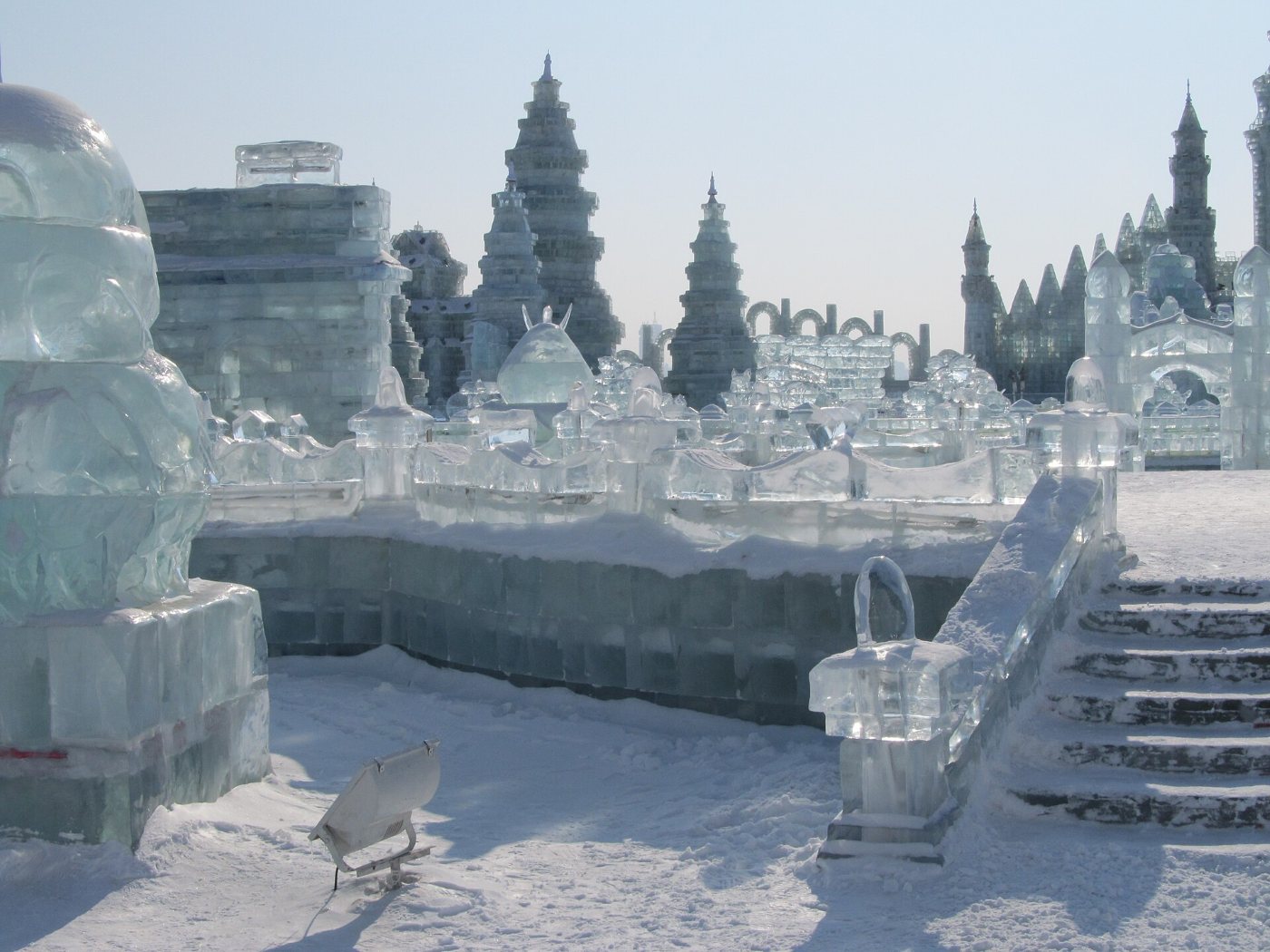
In short: every winter Harbin, in China's far north-east, builds a city of ice. Its centrepiece, Ice and Snow World, usually opens between 17 and 21 December and runs until late February, and the official Harbin International Ice and Snow Festival opens every year on 5 January. As of 19 October 2026 the 2026–2027 opening date and prices haven't been announced; in 2025/26 an adult ticket cost ¥328 (about 191 PLN). In January it's about −12°C by day and −22°C at night. Plan 2–3 days: Harbin is 4.5 hours from Beijing by bullet train.
What surprised us most in China was its technology, and the railway to Harbin shows it well: north of Shenyang, bullet trains run on the Harbin–Dalian line, opened in 2012 as the world's first high-speed railway built for extreme cold, with trains designed for −40°C.
Correct as of 19 October 2026. Where the 2026–2027 season hasn't been announced yet, we give 2025/26 figures and say so. Amounts in yuan are converted at the National Bank of Poland rate into the currency you pick in the site menu.
Harbin Ice Festival 2026–2027 at a glance
| Question | Answer |
|---|---|
| What is it? | several parks and events, above all Ice and Snow World, the Sun Island snow sculptures and the Zhaolin Park ice lanterns |
| When? | Ice and Snow World usually from 17–21 December to late February; official opening on 5 January |
| 2026–2027 dates | not announced yet (as of 19 October 2026) |
| Tickets | Ice and Snow World ¥328 (about 191 PLN) for adults in 2025/26; Zhaolin Park free |
| Weather | January: about −12°C by day, −22°C at night, dry and often sunny |
| Getting there | 4.5–6.5 hours by bullet train from Beijing, or a domestic flight to Harbin (HRB) |
| Busiest and priciest | the opening days, New Year and Lunar New Year (6 February in 2027) |
Ice and Snow World: dates, tickets and tips
When does it open?
The 28th Harbin Ice and Snow World (哈尔滨冰雪大世界) was announced on 12 October 2026: a record 1.25 million m² and 400,000 m³ of ice and snow. A few days later the park added a "Frozen" zone created with Disney China, with ice sculptures of Elsa, Anna and Olaf. The opening date will follow. Recent openings were 18 December 2023, 21 December 2024 (the winter solstice) and 17 December 2025.
The 2024/25 season ran until 26 February 2025, but in 2026 the park closed early, on 21 February, when record warm days melted the ice. If you're going in late February, don't leave it until your last day.
Tickets
In 2025/26 a standard adult ticket cost ¥328 (about 191 PLN), or ¥298 (about 174 PLN) in the first week (17–23 December). In 2025 the presale started on 10 October; for 2026–2027 none had been announced by 19 October 2026. Buy on Trip.com with your name and passport number, and show your passport at the gate (some foreign visitors have to collect their ticket at the service counter first). Under the 2024/25 rules, children under 6 (or under 1.2 m) and over-65s got in free and students paid less; ask whether the over-65 rule applies to foreigners.
What's inside
In 2025/26 the park covered 1.2 million m². The Super Ice Slide had 24 lanes, the longest 521 m, and the Snowflake Ferris Wheel stood 120 m tall. The park is rebuilt from scratch every winter, with ice cut from the frozen Songhua River in blocks of about 1.6 × 0.8 m: artificial ice has air bubbles and is too weak to carve. An indoor hall, the Dream Ice and Snow Pavilion, also has ice and snow attractions in summer.
When to go
Arrive at about 3 pm to see the buildings in daylight and then lit up after sunset, which is at about 3:50 pm in December, 4 pm in early January and 5 pm in mid-February. Realistically, you'll last about 4 hours in the cold.
Avoid the opening days and Lunar New Year if you can: more than 40,000 people came on the opening day in December 2023, and the 2025/26 record was 120,900 visitors on the third day of Lunar New Year, against an average of 47,100 a day. If you want to ride the Super Ice Slide, go there first, as its queue can stretch for several hundred metres. Opening hours for 2026–2027 haven't been published; guides give roughly 9–11 am until 9:30–10 pm.
How to get there
The park is on the north bank of the Songhua River, in the western part of Sun Island. Take metro line 2 to Ice and Snow World station (冰雪大世界), three stops from Central Street (中央大街); exit 3 is about 50 m from the ticket hall. At closing time taxis are almost impossible to find and drivers quote fixed fares, so take the metro back (in winter 2024/25 it ran until 11 pm).
In Chinese冰雪大世界 (Bīngxuě Dà Shìjiè) is Ice and Snow World, 太阳岛 (Tàiyáng Dǎo) is Sun Island, 兆麟公园 (Zhàolín Gōngyuán) is Zhaolin Park and 中央大街 (Zhōngyāng Dàjiē) is Central Street. Show the characters to a taxi driver or type them into DiDi or Amap.
Sun Island, Zhaolin Park and the 5 January opening
Sun Island Snow Sculpture Expo (太阳岛雪博会): snow rather than ice, held since 1988. The 38th edition opened on 31 December 2025 (after a trial opening on 27 December), with 260 groups of sculptures. In 2024/25 a ticket agency listed ¥198 (about 115 PLN) for adults and opening hours of 9 am to 5 pm. Go in the morning: Sun Island station is one stop before Ice and Snow World on line 2, so you can move on to the ice palaces in the afternoon.
Zhaolin Park (兆麟公园), a few minutes' walk from Central Street, is where it all started: the first ice lantern show was held here in 1963. Entry has been free since 2018, with no tickets or bookings. The 52nd fair opened on 30 December 2025 with more than 300 ice and snow sculptures, and in 2025 it closed on 17 February. Come after dark, when the lanterns are lit.
5 January: the Harbin International Ice and Snow Festival has opened on this date every year since 1985. In 2026 the ceremony was held at Ice and Snow World, with fireworks over the Songhua River in the evening. The 43rd festival should open on 5 January 2027, but you don't need to be there on the day: the parks open earlier and stay open until February.
What to wear in Harbin in winter
Average temperatures (1991–2020) are −10°C by day and −19°C at night in December, −12°C and −22°C in January, and −6°C and −18°C in February. The record is −42.6°C. Indoors it's the opposite: the heating runs from about 20 October for 6 months, and in one study of a Harbin apartment block rooms averaged 26°C. Dress in layers you can take off.
- Base layer: thermal underwear, top and bottom, in merino wool or a synthetic fabric, not cotton.
- Mid layer: a fleece or a light down jacket.
- Outer layer: a long, windproof down coat with a hood.
- Boots: insulated and waterproof, with one pair of medium-weight socks rather than two, so they aren't tight.
- Hat, scarf and gloves: a hat that covers your ears, and gloves with touchscreen fingertips.
- Heat packs (暖宝宝, nuǎnbǎobǎo): stick them on your clothes, never directly on your skin.
- Forgot your boots? You can rent snow boots at the entrance to Ice and Snow World for about ¥30 (about 17 PLN)–¥50 (about 29 PLN) a pair.
TipCold drains phone batteries fast, and a frozen phone can switch off until it warms up. Keep it in an inside pocket with a heat pack on the outside of the pocket, carry a power bank, and don't charge a phone while it's still cold: in Harbin you pay for almost everything by phone. If you fly to Harbin within China, your power bank needs the 3C (CCC) mark. Since 28 June 2025 power banks without it aren't allowed on domestic flights.
Harbin's Russian and European past
Harbin grew up with the railway. In 1896 the Qing government let Russia build the Chinese Eastern Railway across Manchuria, and the Russians chose Harbin as its base. After the 1917 revolution the city became a refuge for Russians, and its European architecture earned it the nicknames "Oriental Moscow" and "Oriental Paris". The city also had a large Jewish community, and the New Synagogue (1921) is now a museum of Harbin's Jewish history and culture.
Many of the railway's engineers were Poles: on 16 May 1898 one of them, Adam Szydłowski, put up the first barracks of the railway settlement on the Songhua, a date Polish sources give as the founding of Harbin. Around 1920 up to 10,000 Poles lived here, and their St Stanislaus Church (1909) is now Harbin's Catholic Cathedral of the Sacred Heart of Jesus.
What to see in Harbin beyond the ice
- Central Street (中央大街): a 1,450 m pedestrian street laid out in 1898, paved in the 1920s with about 800,000 granite blocks shaped like loaves of bread. It ends on the river at the Flood Control Monument (1958).
- St Sophia Cathedral: a green-domed Russian Orthodox church built in 1923–1932, 10–15 minutes' walk from Central Street. Since 1997 it has been an architecture museum (about ¥20 (about 12 PLN) to go inside, according to guides); the square in front is always open.
- The frozen Songhua River: in 2025/26 an ice carnival with nearly 60 attractions, such as horse-drawn sleighs, opened on the ice on 25 December, each paid for separately. Winter swimmers train in a pool cut in the ice, even at about −13°C.
- The old railway bridge: opened in 1901 on the Chinese Eastern Railway and almost 1 km long. Trains stopped using it in 2014, and you can now walk across it, including a glass-floored section of about 30 m.
- Harbin Grand Theatre (哈尔滨大剧院): a white, wave-shaped opera house by the architects MAD, completed in 2015. You can walk up the paths on its facade to the roof terrace without a ticket.
- Siberian Tiger Park (东北虎林园): on the north bank, home to more than 800 tigers according to guides; you tour it by bus. Qunar lists ¥125 (about 73 PLN) for adults including the bus, open 8:30 am to 4:30 pm.
How many days in Harbin
- 1 day: Central Street and St Sophia in the morning, Ice and Snow World from 3 pm until after dark.
- 2 days: add the Sun Island snow sculptures, the Zhaolin Park lanterns and the frozen river.
- 3 days: add the Siberian Tiger Park, the Grand Theatre and the old railway bridge, or a day trip to Yabuli.
Day trips: Yabuli and Snow Town
- Yabuli (亚布力): one of China's biggest ski resorts, about 190–200 km from Harbin, which hosted the alpine skiing at the 2025 Asian Winter Games. The fastest trains to Yabuli West take just over an hour, then it's about 25 minutes by car to the slopes.
- Snow Town (中国雪乡, Xuexiang): a forest village about 280 km from Harbin, in Mudanjiang prefecture, where snow lies for up to about 7 months and is usually about 2 m deep. Take a high-speed train to Yabuli West or Mudanjiang (1–2 hours), then a bus (2–3 hours on mountain roads from Mudanjiang) or a private transfer (from about ¥400 (about 233 PLN) from Yabuli West, according to travel agencies). It's a long way, so consider staying a night.
Further north, Mohe, China's northernmost city (record −53.0°C on 22 January 2023), is easiest to reach by plane from Harbin (winter flights are sometimes cancelled); the train takes well over 10 hours.
What to eat and drink in Harbin
- Guobaorou (锅包肉): crispy pork in a sweet and sour sauce, created in Harbin around 1907 by the chef Zheng Xingwen, who made it milder for Russian guests. At Lao Chu Jia (老厨家), run by the fourth generation of his family, a portion for 2–3 people costs ¥38 (about 22 PLN)–¥48 (about 28 PLN); expect to queue at mealtimes.
- Red sausage (红肠, hóngcháng): first made in 1909 by Lithuanian sausage makers at the Churin company; its other name, 里道斯 (lǐdàosī), comes from the Russian for "Lithuanian sausage".
- Madier ice lollies (马迭尔冰棍): made from milk and eggs by the Modern Hotel on Central Street (founded in 1906) for over a century, about ¥3 (about 2 PLN)–¥5 (about 3 PLN). Eating one at −20°C is a local tradition.
- Russian flavours: dalieba (大列巴), a huge round loaf whose name comes from the Russian for bread, and Russian dishes at Huamei (华梅西餐厅), 112 Central Street, open since 1925.
- Winter food: frozen pears (冻梨), tanghulu (candied hawthorns on a stick), chicken stewed with mushrooms (小鸡炖蘑菇) and iron pot stew (铁锅炖), with corn cakes baked on the rim of the pot.
- Harbin Beer: founded in 1900 by a Pole, Jan Wróblewski, to supply the railway builders, and often described as China's oldest brewery.
A meal in a mid-range north-eastern restaurant costs about ¥60 (about 35 PLN)–¥150 (about 87 PLN) per person, more on Central Street. More: China's regional cuisines.
Where to stay in Harbin
Stay in Daoli, around Central Street: St Sophia, Zhaolin Park and the river are within walking distance, and Central Street station is three stops from Ice and Snow World. Some riverside hotels look across to the lit-up ice palaces. During the festival, book 2–4 weeks ahead: prices peak at New Year and Lunar New Year. Check that your hotel accepts foreign guests (hotels, trains and flights).
Getting to Harbin and getting around
- By train from Beijing: about 20–25 high-speed trains a day take 4.5–6.5 hours from Beijing Chaoyang (not Beijing South or West) to Harbin West. The fastest take 4 h 33 min; second class costs about ¥545 (about 318 PLN)–¥655 (about 382 PLN). Overnight sleepers from Beijing station take 10–12 hours. Around New Year, 5 January and Lunar New Year, buy tickets as soon as they go on sale. More: Beijing to Harbin by train.
- By air: we haven't found any direct flights from Europe, so you'll connect, for example in Beijing or Guangzhou. Harbin airport (HRB) is about 40 km from the centre and has no metro: the airport bus costs ¥20 (about 12 PLN) and takes about an hour, a taxi about ¥100 (about 58 PLN)–¥150 (about 87 PLN).
- In the city: the metro has 3 lines, with fares of ¥2 (about 1 PLN)–¥6 (about 3 PLN), and line 2 links Central Street, Sun Island and Ice and Snow World. For taxis, use DiDi. Harbin has four railway stations, so check the one on your ticket; most bullet trains use Harbin West (metro line 3).
- Paying: for the 2025 Asian Winter Games Alipay rolled out its contactless Alipay Tap at about 6,000 places in Harbin, including Ice and Snow World. Link your card before you go (how to pay in China) and sort out mobile data (internet in China).
Visa: 30 days visa-free or the 240-hour transit
NoteThe festival season straddles New Year. China's 30-day visa-free entry for 50 countries, including most of the EU, the UK, Canada and Australia, currently runs until 31 December 2026. If your trip is in January or February 2027, check whether it has been extended before you book (China visa-free).
The 240-hour visa-free transit (57 countries, including the US) lets you spend up to 10 days in China if you fly in from one country and leave for another. In Heilongjiang only Harbin is a permitted area, and the province's only port of entry is Harbin airport (HRB), though you can also enter elsewhere, for example in Beijing. Yabuli is in Shangzhi, which is administered by Harbin, so it should be covered; Snow Town and Mohe aren't. The train from Beijing passes through Jilin province, which the transit doesn't cover; we haven't found an official ruling on that, so a domestic flight is the safer choice. Rules and a route checker: 240-hour visa-free transit.
When to visit Harbin
For the ice, go between late December and mid-February, when all three parks are usually open. Early January is a good compromise: the festival opens on 5 January and Lunar New Year is still a month away, while from late February the risk of a thaw grows. In summer Harbin has a beer festival and the "Harbin Summer" music festival, which dates back to 1961. More: Best time to visit China.
Harbin and our itineraries
NoteWe don't have a ready-made itinerary with Harbin yet. The easiest option is to add 2–3 days in Harbin to an itinerary that starts in Beijing: take the bullet train up to Harbin, come back to Beijing and start day 1. Beijing in winter is cold but dry and quiet, and the Forbidden City costs ¥40 (about 23 PLN) instead of ¥60 (about 35 PLN). If you'd rather have a trip built around the ice festival, we can put together a custom plan.
| Itinerary | Days | Route |
|---|---|---|
| Emperors & Hotpot | 10 | Beijing → Tianjin → Xi'an → Chongqing |
| China's Golden Triangle+ | 11 | Beijing → Xi'an → Shanghai → Ningbo |
Both fit the 240-hour transit on their own, but not with 2–3 extra days in Harbin.
Frequently asked questions
When does the Harbin Ice Festival 2026–2027 start?
The official opening is on 5 January 2027. Ice and Snow World usually opens earlier, between 17 and 21 December; the 2026 date hadn't been announced by 19 October 2026.
How much does a ticket to Harbin Ice and Snow World cost?
In 2025/26 a standard adult ticket cost ¥328 (about 191 PLN), or ¥298 (about 174 PLN) in the first week. Prices for 2026–2027 haven't been announced. The Zhaolin Park lanterns are free.
What should I wear to the Harbin Ice Festival?
Three layers (thermal underwear, a fleece and a long windproof down coat with a hood), insulated waterproof boots, a hat that covers your ears, a scarf, touchscreen gloves and heat packs.
How do I get from Beijing to Harbin?
By high-speed train from Beijing Chaoyang to Harbin West: 4.5–6.5 hours, from about ¥545 (about 318 PLN) in second class. There are also overnight sleepers and 2-hour flights.
Can I visit Harbin on the 240-hour visa-free transit?
Yes: Harbin is a permitted area, and you can enter at Harbin airport or elsewhere, for example in Beijing. If you enter in Beijing, fly on to Harbin: the train passes through Jilin province, which isn't covered. Snow Town and Mohe aren't covered either.
Sources
- China News Service: 28th Ice and Snow World announced (12 October 2026, in Chinese); Science and Technology Daily: the "Frozen" zone (in Chinese)
- China Daily on the openings in 2023, 2024 and 2025; China News Service: early closure in February 2026 (in Chinese)
- Guangming Daily: 2025/26 ticket prices (in Chinese); Xinhua: the 2025/26 Ice and Snow World
- China Daily: Sun Island Snow Sculpture Expo; Xinhua: Zhaolin Park ice lanterns (in Chinese); Xinhua: festival opening on 5 January 2026
- Wikipedia: Harbin (1991–2020 climate data), Central Street, St Sophia Cathedral, Harbin Brewery, Harbin–Dalian high-speed railway and Yabuli Ski Resort
- Culture.pl: Harbin, a Polish city in China; China Daily: Snow Town of China
- China Discovery: what to wear in Harbin in winter; China for Travelers: Harbin Ice Festival
- Our Beijing to Harbin train guide and 240-hour transit page (rules as of 20 August 2026)