Destinations and inspiration · 14 min read
Xi'an in 2–3 days: what to see in China's ancient capital
In short: Xi'an (often written Xian) is China's ancient capital, known for over a thousand years as Chang'an, and the starting point of the Silk Road. It's famous for the Terracotta Army, the best-preserved city wall in China, which you can cycle around, and the Muslim Quarter with its street food. You need 2 days for the highlights, or 3–4 days with the museums or a trip to Mount Hua. The one thing to sort out before you go: Terracotta Army tickets are sold online only, with your passport, up to 7 days ahead. The best time to visit is spring (April–May) or autumn (September–October). From Beijing it's about 5 hours by high-speed train.
What surprised us most in China was its technological progress, and Xi'an shows it side by side with history: 2,200-year-old clay soldiers stand an hour's ride from a station where high-speed trains cover the 1,000-plus km to Beijing in under 5 hours.
Correct as of 14 October 2026. Check ticket prices and booking rules before you travel. Amounts in yuan are converted at the National Bank of Poland rate into the currency you pick in the site menu.
What to see in Xi'an: 10 places
1. The Terracotta Army
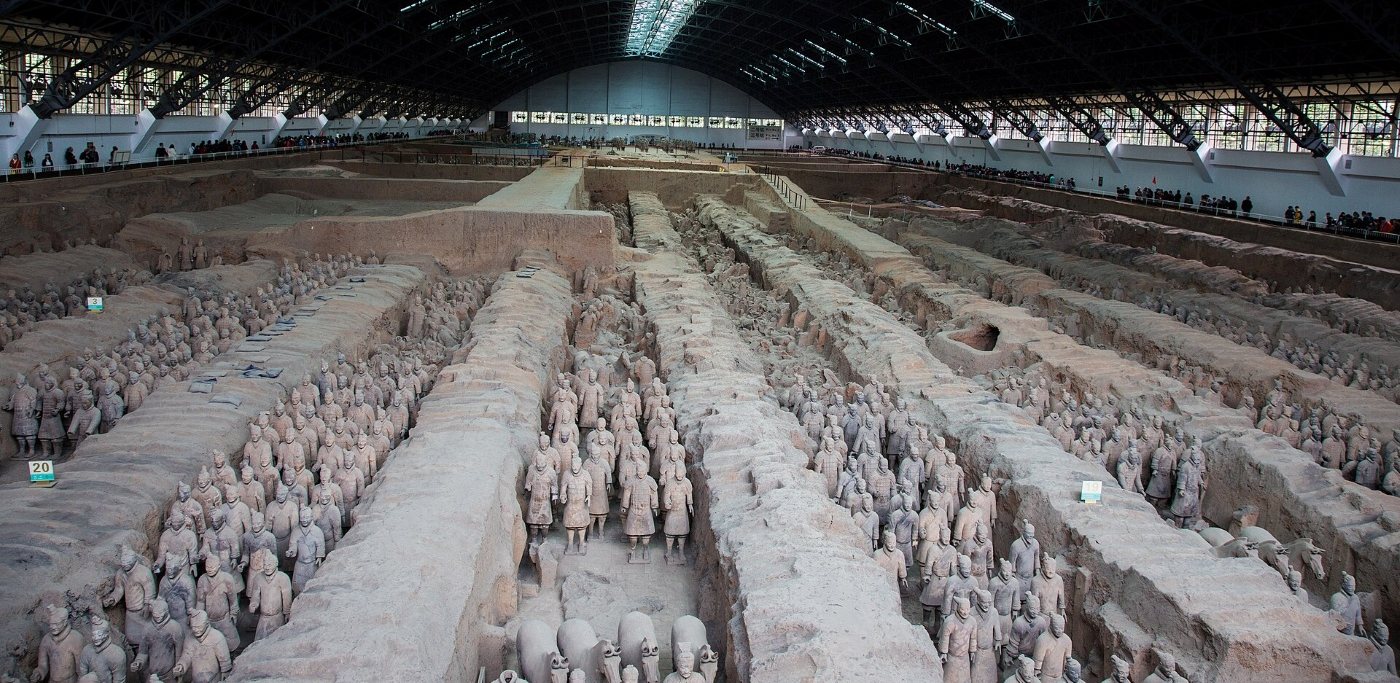
More than 8,000 clay soldiers, horses and chariots that have guarded the tomb of Qin Shi Huang, the first emperor of a unified China, for over 2,200 years. Farmers digging a well found them in 1974. The largest is Pit 1 (230 × 62 m), with over 6,000 figures in battle formation, each with a different face. Start there, then see Pits 2 and 3 and the bronze chariots in the museum. Allow 3–4 hours. A ticket costs ¥120 (about 70 PLN) and also covers the park by the emperor's burial mound (Lishan), with a free shuttle bus. An audio guide or a human guide is worth it: without the stories, the pits start to look alike.
NoteTickets are sold online only, with your passport number, up to 7 days before your visit: through the museum's official WeChat account (秦始皇帝陵博物院) or on Trip.com or Klook. Your passport is scanned at the gate, so it is your ticket. Tickets go fastest in the summer holidays and during Chinese public holidays.
Getting there: tourist bus 306 (游5) leaves from the east square of the old Xi'an Railway Station (西安火车站), takes about an hour and costs ¥7 (about 4 PLN). Board only at the official stop: touts near the station run their own "306 buses" that stop at shops on the way. Alternatively, take metro line 9 to Huaqingchi and a 10-minute bus or DiDi from there. A DiDi from the centre costs about ¥120 (about 70 PLN)–¥160 (about 93 PLN) each way. Next to Huaqingchi station is the Huaqing Palace: the imperial hot springs where the famous consort Yang Guifei bathed, and the site of the 1936 Xi'an Incident. If you have the energy, combine it with the Terracotta Army in one day.
2. Cycling the city wall
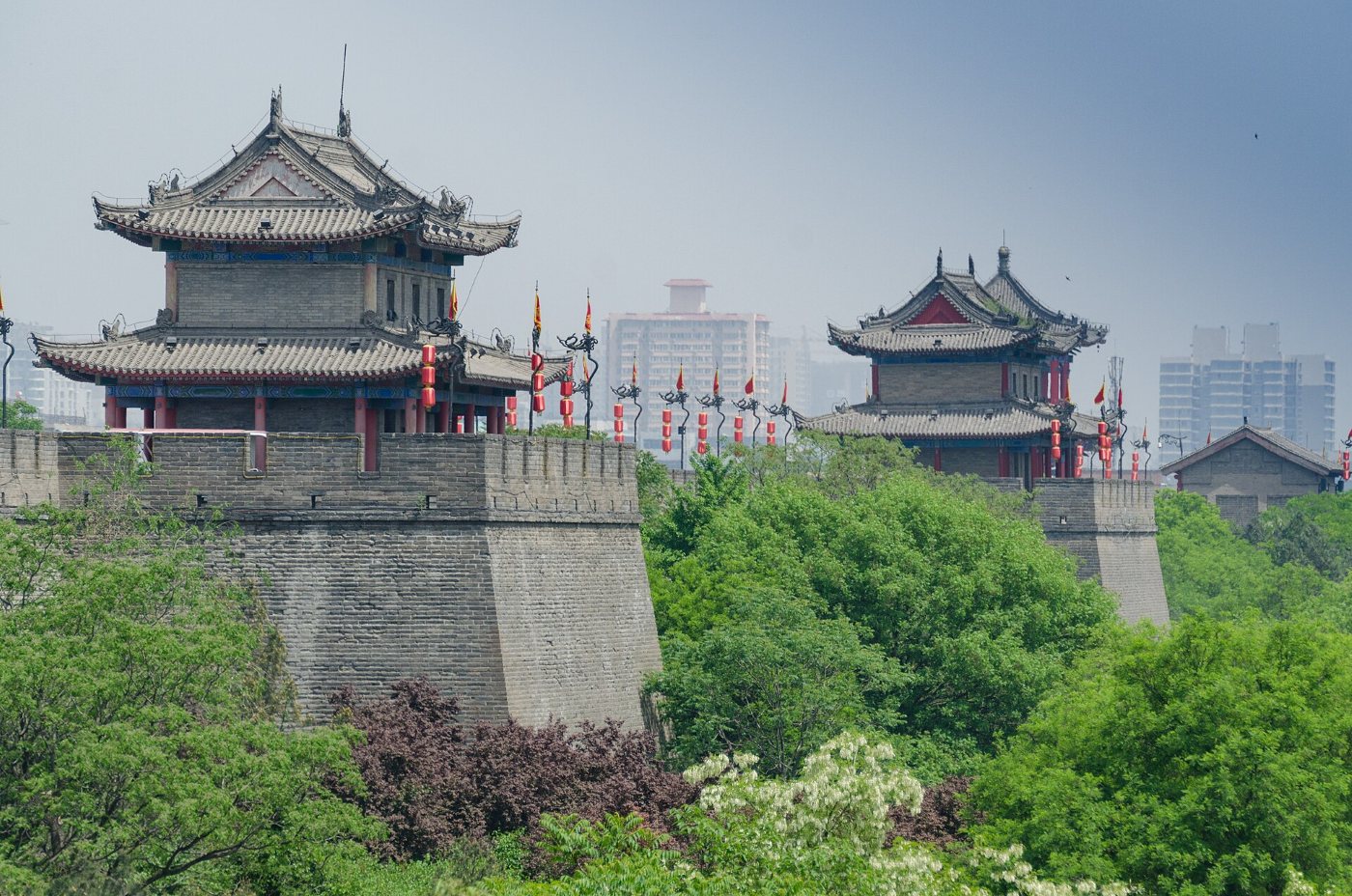
Xi'an is surrounded by the best-preserved city wall in China: 13.7 km around, 12 metres high and so wide on top that you can cycle along it. It was built in 1370–1378, under the Ming dynasty. A ticket costs ¥54 (about 31 PLN) and a bike ¥45 (about 26 PLN) for 3 hours (tandem ¥90 (about 52 PLN), refundable deposit). A full loop takes about 2 hours by bike or 4 on foot. The easiest way up is the South Gate (Yongningmen, 永宁门), open until about 10 pm. It's most beautiful just before sunset, when the red lanterns come on.
3. The Bell and Drum Towers
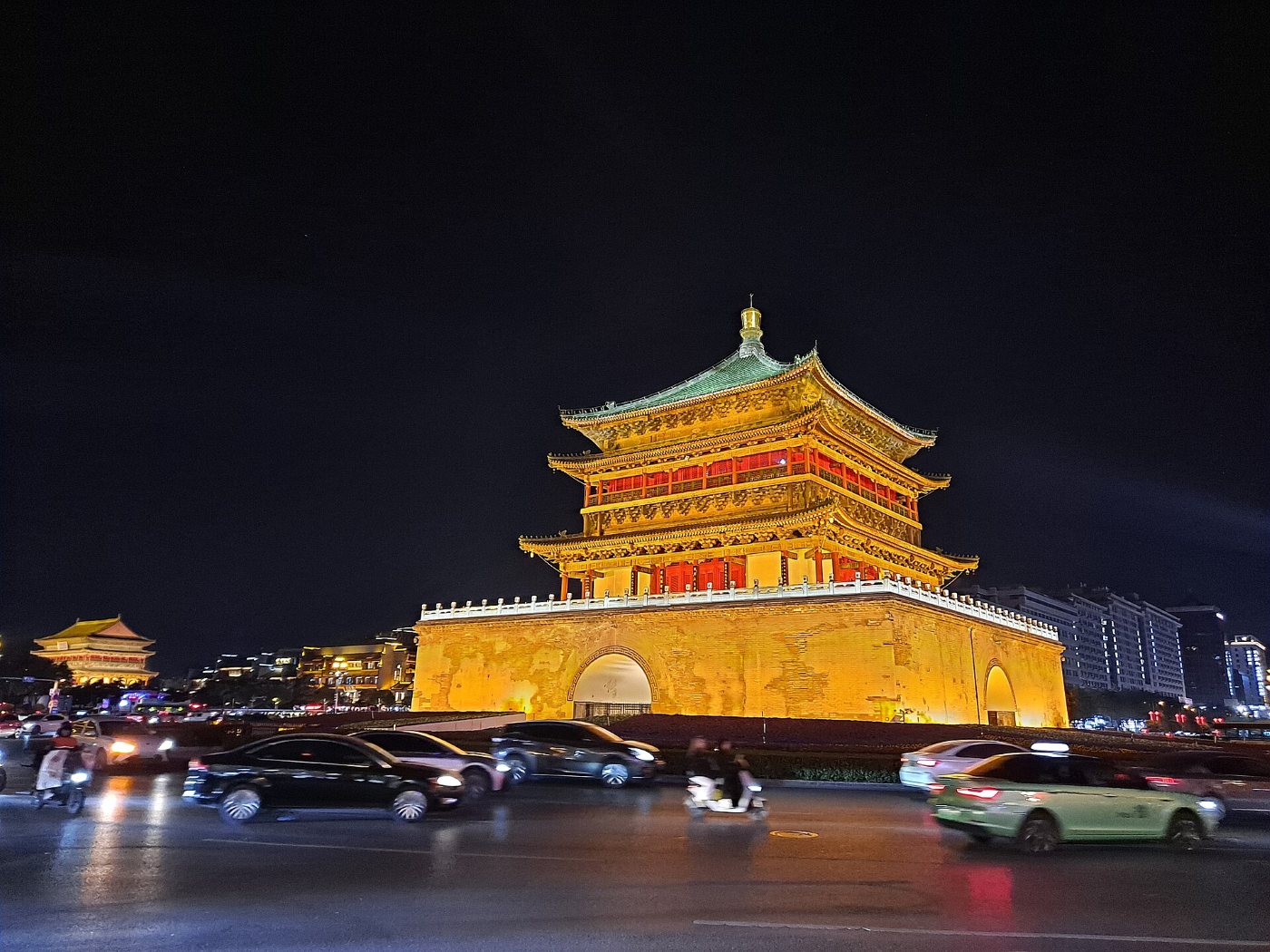
Two towers in the very centre of the city: the Bell Tower (1384) stands on a roundabout where the four main streets leading to the city gates meet, and the Drum Tower (1380) a few hundred metres away. You reach the Bell Tower through an underpass from Zhonglou metro station. A ticket costs ¥30 (about 17 PLN) for one tower or ¥50 (about 29 PLN) for both. After dark both are beautifully lit, and from the Drum Tower balcony you can see the entrance to the Muslim Quarter.
4. The Muslim Quarter and the Great Mosque
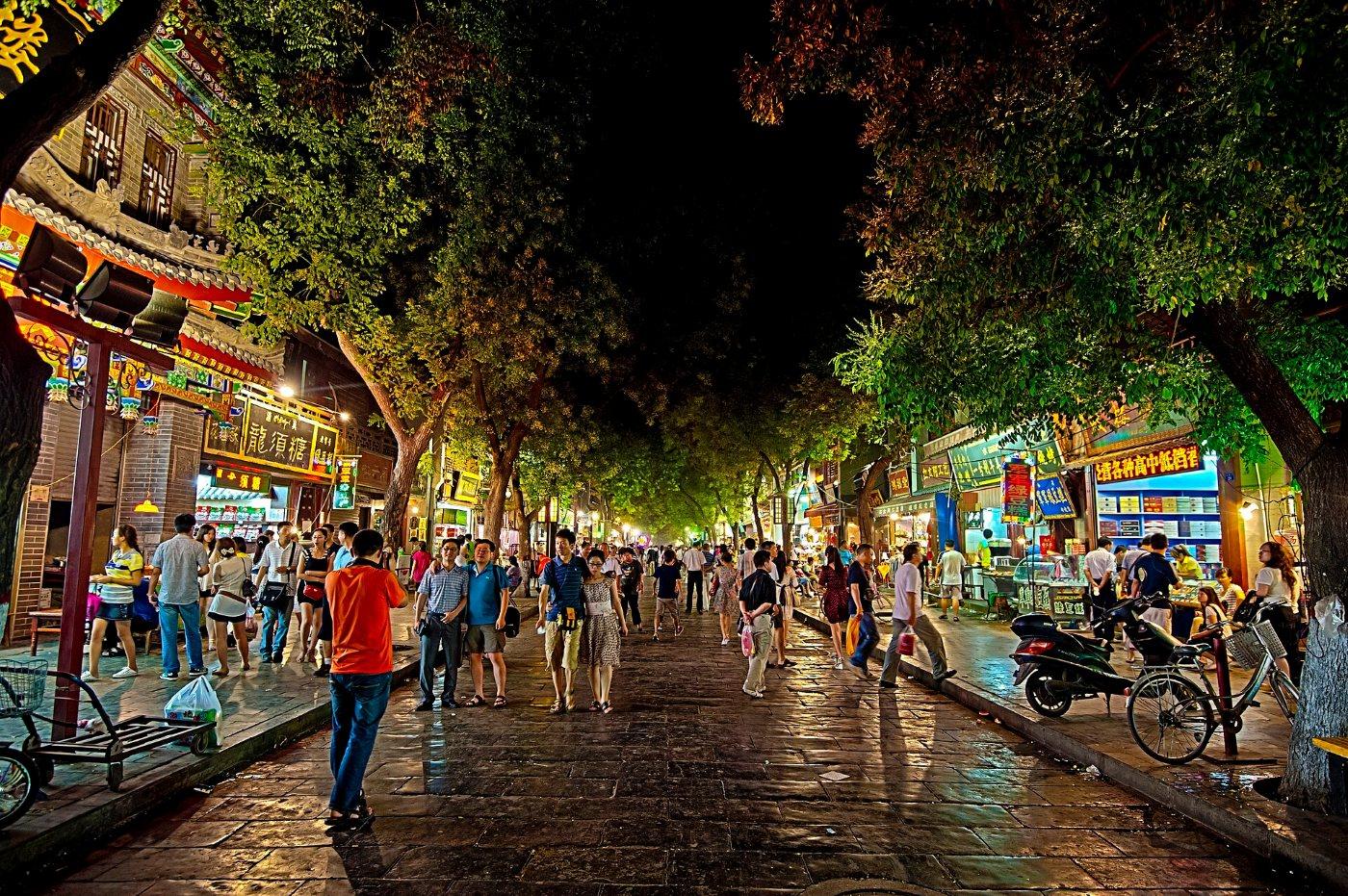
Behind the Drum Tower begins the Muslim Quarter (回民街), home to the Hui, China's Chinese-speaking Muslims, for over a thousand years. The main street, Beiyuanmen (北院门), is an evening food market: roujiamo, lamb skewers, soup dumplings and persimmon cakes. It's very touristy, so for dinner head into the side lanes or to Sajinqiao (洒金桥), where locals eat. On Huajue Lane (化觉巷) stands the Great Mosque (ticket about ¥25 (about 15 PLN)): it looks like a Chinese temple, with pavilions, courtyards and a pagoda-shaped minaret. By tradition it was founded in 742, and most of today's buildings date from the Ming dynasty. Only Muslims may enter the prayer hall.
5. The Big Wild Goose Pagoda
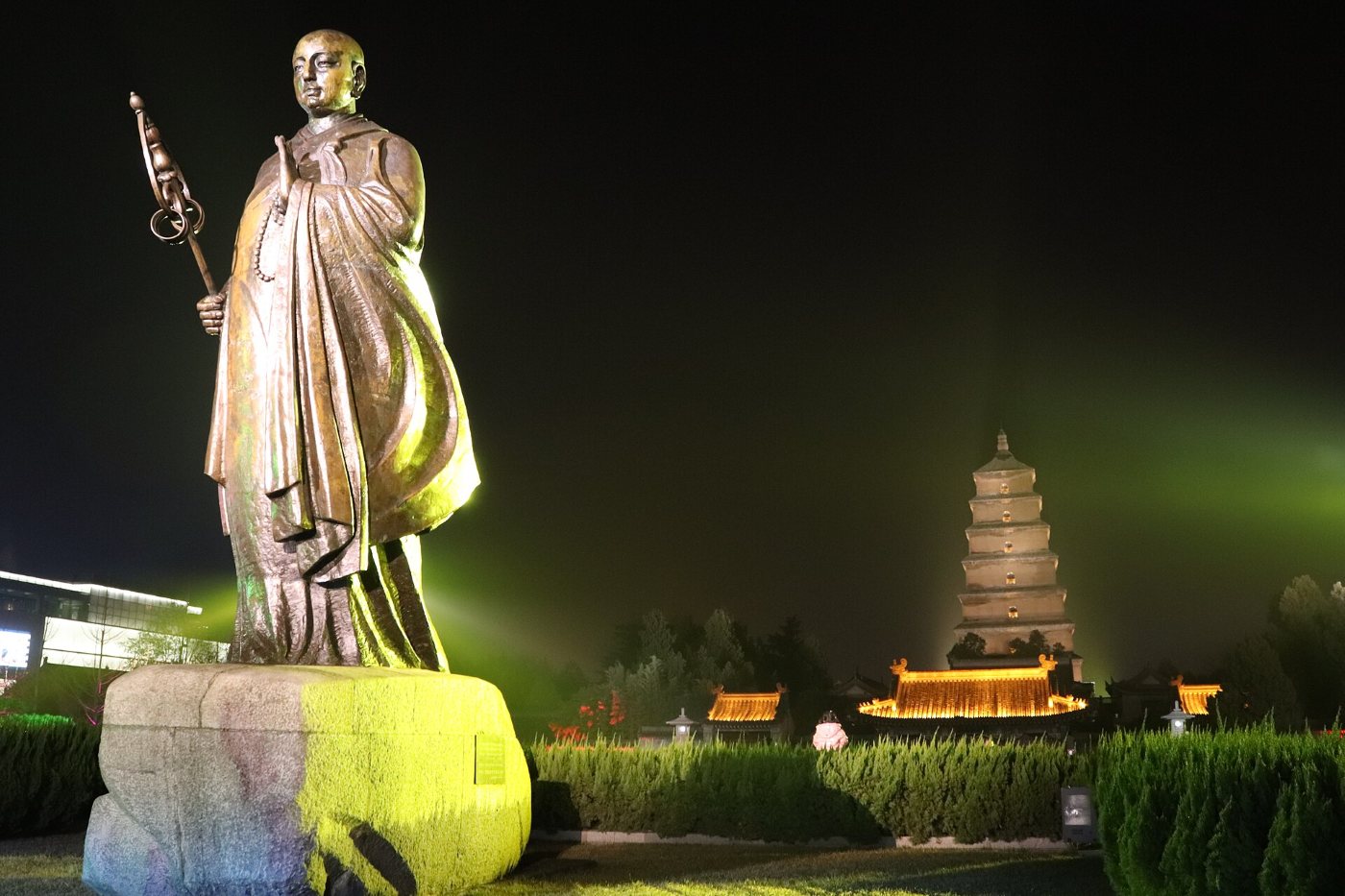
A 64-metre brick pagoda from 652, built for the monk Xuanzang, who brought Buddhist sutras back from India after a 17-year journey – the story behind the classic novel Journey to the West. The pagoda stands in the Da Ci'en Temple (ticket about ¥40 (about 23 PLN), climbing the pagoda another ¥25 (about 15 PLN)). The north square hosts one of the largest fountain shows in Asia, free: the evening show is usually around 9 pm, with daytime shows in summer too (Tuesdays evening only; check times locally). Take metro line 3 or 4 to Dayanta.
6. Datang Everbright City at night
From the pagoda's south square runs a roughly 2-km Tang-dynasty-style promenade (大唐不夜城, "the Great Tang City That Never Sleeps"): lit pavilions, statues of poets and emperors, street performers in period costume and crowds of young Chinese in traditional hanfu, which you can rent on the spot. Free entry. Come after dark, and expect crowds at weekends.
7. Shaanxi History Museum
One of the best museums in China: from Stone Age tools and Zhou dynasty bronzes to gold and ceramics from the Tang era, when Chang'an was one of the largest cities in the world. The main exhibition is free but needs a reservation with your passport. Slots are released 5 days ahead at 5 pm through the museum's official WeChat account (陕西历史博物馆) and go within minutes. If you miss out, there's the paid Tang mural gallery (¥270 (about 157 PLN)), whose ticket replaces the reservation. The museum is closed on Mondays (except public holidays). The new Qin-Han branch (秦汉馆) in Xixian, by Qingong station on line 14, is less crowded.
8. The Forest of Steles (Beilin Museum)
China's largest collection of stone steles: around 3,000 tablets with Confucian classics, master calligraphy and the Nestorian Stele of 781, the oldest record of Christianity in China. A ticket costs ¥85 (about 49 PLN). The museum is right by the South Gate, reached along Shuyuanmen street (书院门) with its shops selling brushes, paper and ink.
9. The Small Wild Goose Pagoda and Xi'an Museum
The Big Pagoda's quieter sister: a 43-metre pagoda from the early 8th century in a park, next to the Xi'an Museum with relics from old Chang'an. Entry is free, with your passport and a daily cap, so it's best to book ahead. Closed on Tuesdays. A good place to escape the crowds.
10. Mount Hua – a mountain above the abyss
One of China's five sacred mountains, with granite peaks up to 2,154 m, stairs cut into the rock and the famous plank walk bolted to a vertical cliff, done in a harness for an extra fee. The high-speed train from Xi'an North to Huashan North takes about 30–35 minutes (¥57 (about 33 PLN)–¥67 (about 39 PLN) in 2nd class), then a free bus takes you to the visitor centre. A ticket costs ¥160 (about 93 PLN) from March to November and ¥100 (about 58 PLN) in winter; cable cars are extra: about ¥80 (about 46 PLN) to the North Peak and ¥140 (about 81 PLN) to the West Peak, one way. A popular route: cable car up to the West Peak, walk across the peaks and take the North Peak cable car down. Allow a full day, bring your passport, water and food, and skip the plank walk if you're afraid of heights.
Tickets and bookings: what to buy before you go
| Place | Price | How to buy |
|---|---|---|
| Terracotta Army | ¥120 (about 70 PLN) | online only, up to 7 days ahead, passport |
| City wall | ¥54 (about 31 PLN) + bike ¥45 (about 26 PLN) for 3 h | on site or online, passport |
| Bell and Drum Towers | ¥30 (about 17 PLN) one, ¥50 (about 29 PLN) both | on site, passport |
| Great Mosque | about ¥25 (about 15 PLN) | on site |
| Big Wild Goose Pagoda | about ¥40 (about 23 PLN) + pagoda ¥25 (about 15 PLN) | on site or online |
| Shaanxi History Museum | free | WeChat, 5 days ahead from 5 pm, passport; closed Mondays |
| Forest of Steles (Beilin) | ¥85 (about 49 PLN) | on site |
| Small Wild Goose Pagoda and Xi'an Museum | free | booking with passport; closed Tuesdays |
| Mount Hua | ¥160 (about 93 PLN) (Dec–Feb ¥100 (about 58 PLN)) + cable cars | online, passport |
| Datang Everbright City | free | – |
TipAll bookings are in your name, tied to your passport number, and the document is scanned at the entrance. Bring the same passport you booked with. Online payments are easiest with Alipay or WeChat Pay linked to your card (how to pay in China).
How many days in Xi'an
- 1 day: the Terracotta Army in the morning, the wall in the afternoon and an evening in the Muslim Quarter. Doable, but rushed.
- 2 days: add the Bell and Drum Towers, the Big Wild Goose Pagoda and Datang Everbright City at night.
- 3 days: a calmer pace, plus the Shaanxi History Museum, the Forest of Steles and the Small Pagoda.
- 4 days: add a full day on Mount Hua.
In our itineraries Xi'an gets two nights: the afternoon after you arrive by train (the wall and the Muslim Quarter) and a full day with the Terracotta Army, the Big Wild Goose Pagoda and Datang Everbright City.
What to eat in Xi'an
Xi'an lies in China's wheat-growing north, so noodles, breads and lamb rule here, and the influence of Hui Muslim cooking is everywhere.
- Roujiamo (肉夹馍): the "Chinese burger" – a crisp flatbread stuffed with chopped braised meat. Beef or lamb in the Muslim Quarter, pork elsewhere. About ¥15 (about 9 PLN)–¥25 (about 15 PLN).
- Biangbiang noodles: belt-wide, hand-pulled noodles with chilli doused in hot oil. The character "biang" has over 50 strokes and is one of the most complex in Chinese.
- Yangrou paomo (羊肉泡馍): you crumble a hard flatbread into a bowl yourself, and the cook pours lamb broth over it. The classic address is Laosunjia (老孙家).
- Liangpi (凉皮): cold, slippery noodles with vinegar, chilli and bean sprouts. Perfect in the heat.
- Guantang baozi (灌汤包子): soup dumplings, for example at Jia San (贾三灌汤包子) in the Muslim Quarter.
- Shizi bing (柿子饼): fried persimmon cakes with a sweet filling.
More on the food of Xi'an and the Silk Road: There is no such thing as Chinese food – a flavour map of China.
Getting there and getting around
- From the airport: Xi'an Xianyang Airport (XIY) is about 40 km north-west of the centre. Metro line 14 runs to Xi'an North station, then line 2 to Zhonglou by the Bell Tower: about 1–1.25 hours in total for a few yuan. A taxi or DiDi to the centre costs about ¥100 (about 58 PLN)–¥150 (about 87 PLN). Vienna has nonstop flights to Xi'an (China Eastern); more on choosing your arrival airport in First time in China.
- By train: high-speed trains leave from Xi'an North (西安北站) in the north of the city: to Beijing in about 4.5–5.5 hours (Beijing to Xi'an by train), to Shanghai in 6–7 hours (Xi'an to Shanghai by train), to Chongqing in 5–6 hours (Xi'an to Chongqing by train) and to Chengdu in about 3–4 hours (what to see in Chengdu). The old Xi'an Railway Station (西安站) sits right by the wall – the bus to the Terracotta Army leaves from here.
- Metro: the easiest way around the city. Line 2 crosses the centre north to south via the Bell Tower, and lines 3 and 4 serve the Big Wild Goose Pagoda. A ride costs a few yuan; pay with an Alipay or WeChat QR code. There's a bag check at every entrance.
- Taxis and DiDi: cheap, but the centre gets jammed at rush hour. Show the driver the address in Chinese (China without Google Maps).
Where to stay in Xi'an
The most convenient base is inside the wall, around the Bell Tower (Zhonglou station, line 2): you can walk to the Muslim Quarter and up onto the wall, with the metro right outside. It's quieter near the South Gate and Shuyuanmen street. If you prefer a more modern area, choose Qujiang by the Big Wild Goose Pagoda and Datang Everbright City. When booking, check that the hotel accepts foreigners (common mistakes in China).
When to visit Xi'an
The best months are April to May and September to October. September is Xi'an's wettest month, but October is usually fine. Summers are hot – about 33°C by day on average in July – and the Terracotta Army pits get stuffy. Winters are dry and cold (around 5°C by day and -4°C at night in January), but there are few tourists and the wall and Mount Hua are cheaper. Sandstorms can occur in spring. Avoid public holidays (1–7 October and early May), when Terracotta Army tickets sell out fastest. More: When is the best time to visit China?
Xi'an in our itineraries
| Itinerary | Days | Route |
|---|---|---|
| China's Golden Triangle+ | 11 | Beijing → Xi'an → Shanghai → Ningbo |
| Emperors & Hotpot | 10 | Beijing → Tianjin → Xi'an → Chongqing |
In both itineraries Xi'an gets two days planned hour by hour: from the train and cycling the wall, through dinner in the Muslim Quarter, to the Terracotta Army by bus, the Big Wild Goose Pagoda and Datang Everbright City at night, with ticket prices, recommended restaurants and addresses in Chinese.
Frequently asked questions
How many days do you need in Xi'an?
Two days are enough for the Terracotta Army, the city wall, the Muslim Quarter and the Big Wild Goose Pagoda. Three days let you add the Shaanxi History Museum and the Forest of Steles, and four a trip to Mount Hua.
How do I get to the Terracotta Army?
Cheapest is bus 306 (游5) from the east square of the old Xi'an Railway Station: about an hour for ¥7 (about 4 PLN). Board only at the official stop, not the touts' buses. You can also take metro line 9 to Huaqingchi and then a bus or DiDi, and the most comfortable option is a DiDi from the centre (about ¥120 (about 70 PLN)–¥160 (about 93 PLN)).
Do I need to buy Terracotta Army tickets in advance?
Yes. There's no ticket office on site: tickets are sold online only, with your passport, up to 7 days ahead (on WeChat or via Trip.com or Klook). In high season and over Chinese holidays, buy them as soon as sales open.
Was Xi'an the capital of China?
Yes, for over a thousand years. As Chang'an it was the capital of more than a dozen dynasties, including the Han and the Tang; in the 8th century it was one of the largest cities in the world and the start of the Silk Road. Right next to it lay Xianyang, the capital of the first emperor, Qin Shi Huang.
How do you pronounce Xi'an?
Roughly "shee-ahn", in two syllables. In Chinese 西安 means "Western Peace", and the apostrophe separates the syllables. That's why the correct spelling is Xi'an, although you'll often see Xian too.
Do I need a visa for Xi'an?
Citizens of 50 countries, including most of the EU, the UK, Canada and Australia, can enter China visa-free for up to 30 days under a scheme that runs until 31 December 2026. US citizens can use the 240-hour visa-free transit or get a visa. Details and current rules: China visa-free.
Sources
- Wanderinchina: Terracotta Army – tickets and getting there (2026)
- China for Travelers: Shaanxi History Museum, Big Wild Goose Pagoda and Bell and Drum Towers (August 2026)
- Wikipedia: Terracotta Army, Fortifications of Xi'an, Giant Wild Goose Pagoda and Mount Hua
- Climate: China Meteorological Administration, 1991–2020 averages (as in When is the best time to visit China?)
- Our Xi'an itineraries (as of October 2026); photos from Wikimedia Commons (authors and licences in the captions)
Xi'an in a ready-made itinerary
In our itineraries Xi'an is planned hour by hour: from the high-speed train from Beijing, through cycling the wall and dinner in the Muslim Quarter, to the Terracotta Army and the Big Wild Goose Pagoda, with ticket prices, recommended restaurants and addresses in Chinese for the taxi driver. See China's Golden Triangle+ or Emperors & Hotpot.