Before you go · 13 min read
How to buy train tickets in China as a foreigner: Trip.com, 12306, classes and refunds
In short: you buy high-speed train tickets in China online with your passport – most easily on Trip.com in English with a foreign card, or in China Railway's official 12306 app, where you need to register and verify your passport before you go. Tickets go on sale 15 days before departure. You don't print anything: your passport is your ticket, checked at the station entrance and at the platform gate. Second class is perfectly comfortable; first class costs about 1.6 times as much and business class about 3 times as much. Refunds are free up to 8 days before departure and cost 5–20% after that. Get to the station 45–60 minutes before departure.
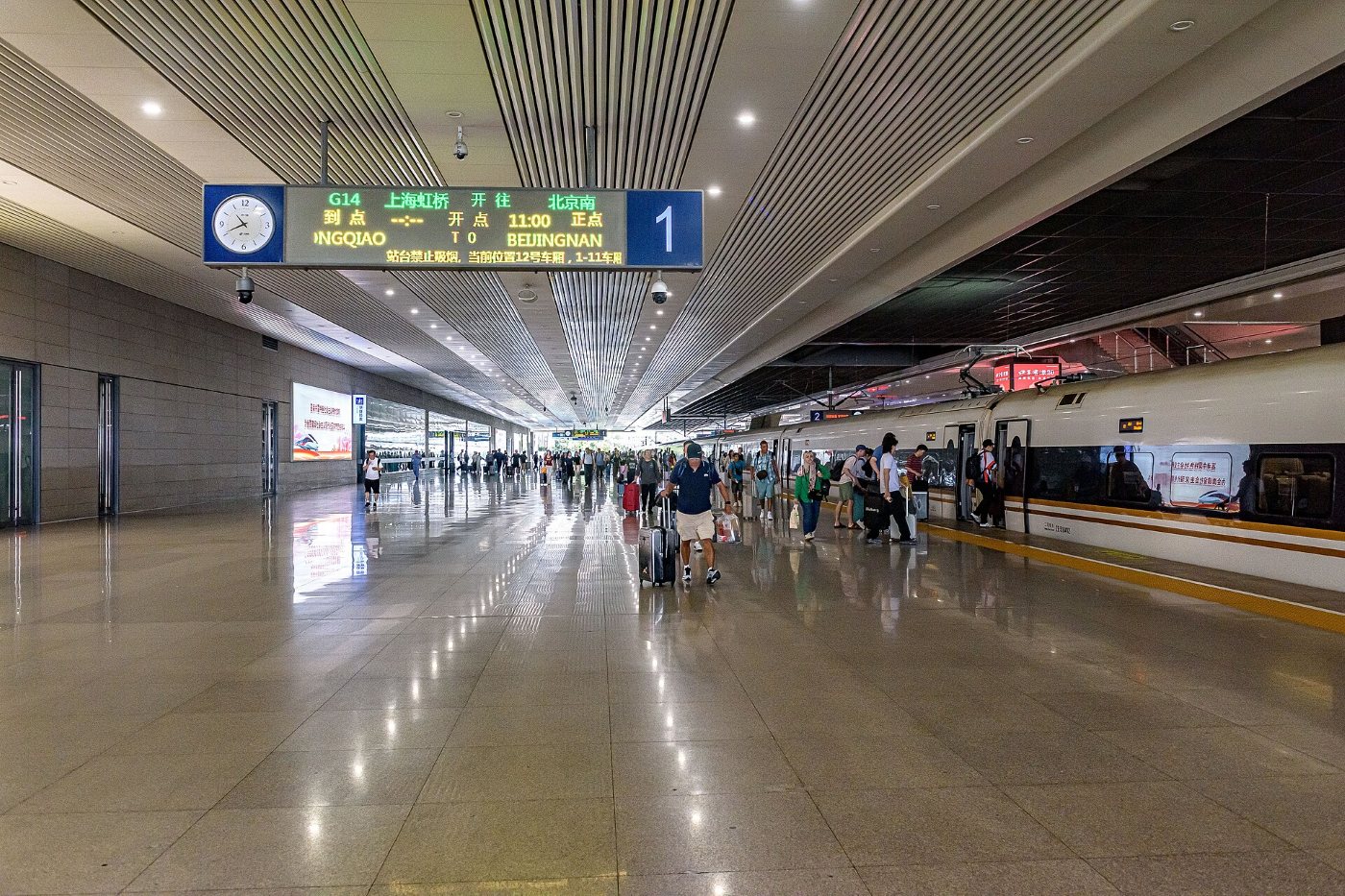
What surprised us most in China was how safe it feels, and you see it all over the railway: bags are scanned at every station entrance, tickets are in your name, and suitcases sit at the end of the carriage with no locks while nobody gives them a second thought.
Correct as of 23 October 2026. Timetables and fares on the routes below are from China Railway's 12306 system for Wednesday 4 November 2026. Amounts in yuan are converted at the National Bank of Poland rate into the currency you pick in the site menu.
Trip.com or 12306?
Both sell the same tickets at the same face value. The difference is convenience:
| Trip.com | 12306 (China Railway's official app) | |
|---|---|---|
| Language | English | Chinese with an English mode |
| Account | a normal Trip.com account | register with your passport + verification (from a few minutes to a few days) |
| Payment | foreign cards | Visa, Mastercard, UnionPay, Alipay, WeChat Pay – foreign cards are sometimes declined |
| Fees | sometimes a small service fee, shown before you pay | no fees |
| Pluses | everything in one app with hotels and attractions | seat and quiet-carriage selection, a waitlist for released seats |
Our advice: for a first trip, use Trip.com. Set up a 12306 account anyway – it helps when Trip.com shows no seats or your card won't go through. More on booking with a passport: hotels, trains and flights in China.
Booking on Trip.com step by step
- Open the Trains tab and enter cities (not stations), your date, and pick a train. G trains are the fastest, D trains a little slower, and C trains are short-distance intercity services – compare journey times and departure stations.
- Choose a class: Second Class, First Class or Business Class.
- Add the passenger: name exactly as in your passport, passport number, expiry date and nationality. One wrong digit and the gate won't let you through.
- Pay by card. Within minutes you get a confirmation with the train, carriage and seat number – take a screenshot.
- If a train is sold out, Trip.com may suggest another train or a connection – also check other stations in the same city.
Booking on the 12306 app step by step
- Download the official China Railway 12306 app (铁路12306) before you travel and switch it to English in the settings.
- Register: scan your passport photo page (the details fill in automatically), then add a username, password, email and phone number – a foreign number works.
- Wait for passport verification: since 28 November 2023 China Railway verifies passports online. It usually takes from a few minutes to a day, but sometimes several days, so do it at least a week before your trip. Without verification you can search but not buy. As a fallback, you can verify at a station ticket office.
- Search, then choose the train, class and passenger. You have 30 minutes to pay before the seat is released.
- Pay with Visa, Mastercard or UnionPay, or with Alipay or WeChat Pay. If your bank declines the card, Alipay with a linked card is the most reliable option (how to pay in China).
TipOn G trains marked 静 in 12306 you can tick that you'd prefer a quiet carriage (静音车厢). Since 1 February 2026 more than 8,000 trains have one, almost all G trains. Phone calls and loud videos are not allowed.
When to book, and what to do if it's sold out
Tickets go on sale 15 days before departure, at a fixed time that varies by station. For a normal weekday, booking a few days ahead is usually enough on most routes. Book as soon as sales open for:
- Chinese New Year and the weeks around it (Chinese New Year), the May Day holiday (1–5 May) and Golden Week (1–7 October);
- Friday and Sunday afternoons on short routes such as Shanghai – Suzhou or Beijing – Tianjin;
- routes with only a handful of trains a day, such as Dali – Lijiang or Chengdu – Jiuzhaigou.
If your train is sold out:
- check other times and other stations in the same city (for example Beijing West instead of Beijing South);
- buy a ticket to a station further down the line on the same train – getting off early is allowed;
- as a last resort, buy a standing ticket (无座, wúzuò): the same price as second class, but no reserved seat. We wouldn't do it for more than 2–3 hours;
- the 12306 app also has a waitlist for released seats (候补购票).
Classes and seats
| Class | In Chinese | Price | What it's like |
|---|---|---|---|
| Second class | 二等座 èrděngzuò | base fare | 5 seats per row (A, B, C – aisle – D, F), plenty of legroom, sockets |
| First class | 一等座 yīděngzuò | about 1.6 × second class | 4 seats per row (A, C – D, F), wider and more comfortable |
| Business class | 商务座 shāngwùzuò | about 3 × second class | 2–3 seats per row, reclining almost flat, meal included |
| Standing | 无座 wúzuò | same as second class | no guaranteed seat |
| D-train sleeper | 动卧 dòngwò | depends on the route | overnight high-speed trains with sleeper compartments |
| Classic-train sleepers | 软卧 / 硬卧 ruǎnwò / yìngwò | cheaper than high-speed trains | 4-berth compartments (soft) or open 6-berth bays (hard) |
Window seats are A and F in both second and first class; C and D are aisle seats, and B is the middle seat of three. In 12306 you can request a seat letter when you book, and you'll get it if it's free. Train types: G – the fastest (300–350 km/h), D – a little slower, C – intercity trains on short routes, and Z, T and K – classic, slower trains, often overnight.
Train fares: 23 routes
The fastest journey, the usual second-class fare (excluding the odd promotional fare) and the number of direct trains a day from the main station, from the 12306 timetable for 4 November 2026. Each route page has the full timetable in both directions, first and business class fares, and station names in Chinese.
| Route | Fastest | Second class | Trains a day |
|---|---|---|---|
| Beijing – Xi'an | 4 h 10 min | ¥525–587 | 17 |
| Beijing – Tianjin | 30 min | ¥55 | 78 |
| Beijing – Harbin | 4 h 33 min | ¥605–634 | 12 |
| Xi'an – Shanghai | 5 h 50 min | ¥666–762 | 21 |
| Xi'an – Chongqing | 5 h 14 min | ¥438–465 | 16 |
| Shanghai – Hangzhou | 45 min | ¥65–87 | 108 |
| Shanghai – Ningbo | 1 h 36 min | ¥130–164 | 27 |
| Hangzhou – Nanjing | 1 h | ¥106–223 | 98 |
| Nanjing – Wuhan | 2 h 27 min | ¥202–272 | 25 |
| Beijing – Shanghai | 4 h 18 min | ¥553–692 | 39 |
| Shanghai – Suzhou | 25 min | ¥35–46 | 71 |
| Chengdu – Chongqing | 1 h 2 min | ¥99–193 | 132 |
| Chengdu – Leshan | 46 min | ¥51–54 | 49 |
| Chengdu – Jiuzhaigou | 1 h 39 min | ¥130–143 | 9 |
| Xi'an – Chengdu | 3 h 5 min | ¥269–300 | 60 |
| Chongqing – Zhangjiajie | 2 h 6 min | ¥197–222 | 15 |
| Guilin – Guangzhou | 1 h 54 min | ¥152–189 | 14 |
| Guangzhou – Shenzhen | 29 min | ¥75 | 182 |
| Shenzhen – Hong Kong | 14 min | ¥68 | 60 |
| Hong Kong – Guangzhou | 48 min | ¥215 | 37 |
| Kunming – Dali | 1 h 55 min | ¥114–145 | 55 |
| Dali – Lijiang | 1 h 36 min | ¥72–80 | 7 |
| Lijiang – Shangri-La | 1 h 10 min | ¥56–70 | 10 |
All routes by region: China train guides. For the cost of transport over a whole trip, see how much a trip to China costs.
Children and discounts
Since 2023, children's tickets depend on age on the day of travel, not height:
- under 6 – free if travelling with an adult and not taking their own seat (one such child per adult). Declare the child when you book;
- 6 to 14 – a child ticket, about 50% of the seat fare, bought together with an adult ticket on the same train and in the same class;
- 14 and over – a full-fare ticket.
Student discounts are only for students at Chinese universities, and there is no senior discount for foreign visitors.
Refunds and changes
| When you refund | Fee |
|---|---|
| 8 days or more before departure | free |
| 48 hours to 8 days before departure | 5% of the fare |
| 24 to 48 hours before departure | 10% of the fare |
| less than 24 hours before departure | 20% of the fare |
The minimum fee is ¥2 (about 1 PLN). Refund in the app you booked with or at a station ticket office. If you booked by mistake, you can cancel free of charge within 30 minutes of paying (a rule in force since 19 January 2026, as long as departure is at least 4 hours away).
Changing to another train (改签, gǎiqiān) is free – you only pay any fare difference – and you can usually do it once. If you miss your train, you can change for free to another train with seats (including standing) until midnight the same day, at a ticket office or in the app you booked with. A ticket changed this way can no longer be refunded.
At the station step by step
Chinese stations work like airports: they're huge, and there are several checks before you reach the train. Allow an hour the first time.
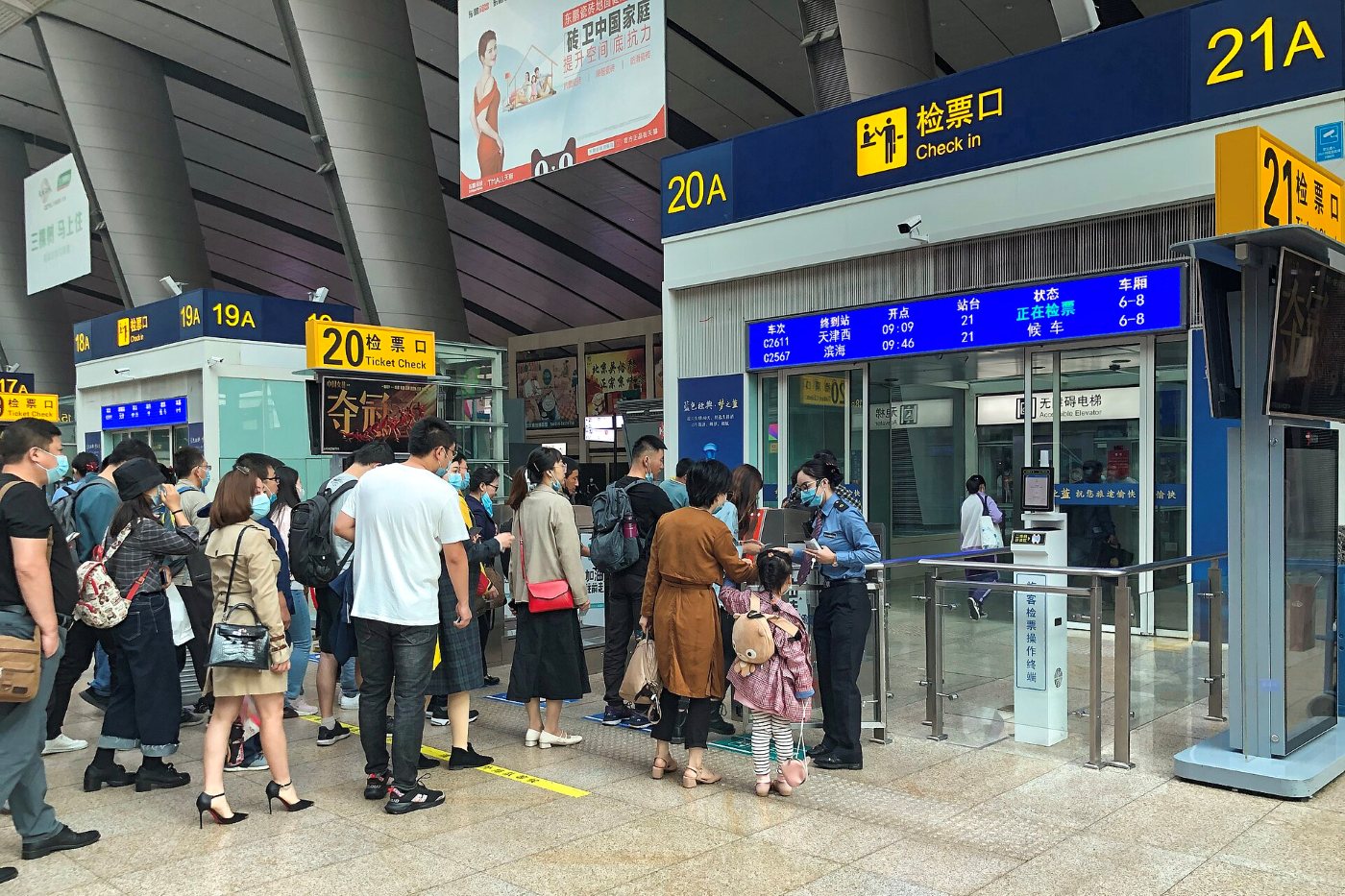
- Entrance: show your passport at the ticket check and put your bags through the scanner. Automatic gates don't always read foreign passports – if not, use the staffed lane (人工通道, réngōng tōngdào).
- Waiting hall: find your train on the departure boards and note the gate number (检票口, jiǎnpiàokǒu), for example 20A.
- Platform gate: it opens about 15–20 minutes before departure and closes 3–5 minutes before. Scan your passport or show it to staff.
- Platform: carriage numbers (车厢, chēxiāng) are marked on the floor and on signs – wait by yours, as trains don't stop for long.
NoteMany cities have several stations – Beijing alone has Beijing, Beijing South, Beijing West and Beijing Chaoyang – which can be an hour or more apart in traffic. Check the station name on your ticket and show it to your taxi driver in Chinese.
On the train
- Luggage: small cases fit on the rack above the seats, big ones at the end of the carriage. The rules allow adults up to 20 kg, and on high-speed trains each item can measure up to 130 cm in total (what to pack for China).
- Food and water: every train has a hot water dispenser (开水), a trolley with drinks and snacks, and longer trains have a dining car. You can bring your own food.
- Sockets: there are sockets at the seats (Chinese ones – bring an adapter) and often USB ports.
- Toilets: at the end of carriages, usually both Western-style and squat toilets.
- Getting off: stops are announced in Chinese and English, and a screen in the carriage shows the next station.
Station phrasebook
| English | Chinese | Pronunciation |
|---|---|---|
| railway station | 火车站 | huǒchēzhàn |
| second class / first class | 二等座 / 一等座 | èrděngzuò / yīděngzuò |
| standing ticket | 无座 | wúzuò |
| platform gate | 检票口 | jiǎnpiàokǒu |
| staffed lane | 人工通道 | réngōng tōngdào |
| carriage / seat | 车厢 / 座位 | chēxiāng / zuòwèi |
| change / refund | 改签 / 退票 | gǎiqiān / tuìpiào |
| waiting hall | 候车室 | hòuchēshì |
Frequently asked questions
Can foreigners buy train tickets in China online?
Yes. The easiest way is Trip.com in English with a foreign card. You can also use China Railway's official 12306 app, but you first need to register with your passport and wait for verification – do it before your trip.
Do I need to print my train ticket in China?
No. Your passport is your ticket. You show it at the station entrance and at the platform gate. Keep a screenshot with the train, carriage and seat number just in case.
How far in advance should I book train tickets in China?
Sales open 15 days before departure. For a normal weekday a few days ahead is usually fine, but book as soon as sales open for public holidays, weekends on short routes and routes with only a few trains a day.
How much do train tickets cost in China?
It depends on the route: for example Shanghai – Suzhou about ¥35–46, Beijing – Xi'an about ¥525–587 and Beijing – Shanghai about ¥553–692 in second class. First class costs about 1.6 times as much and business class about 3 times. See the table above for 23 routes.
What happens if I miss my train in China?
Until midnight the same day you can change for free to another train with seats, at a ticket office or in the app you booked with. A ticket changed this way can't be refunded afterwards.
How early should I get to the station?
45–60 minutes before departure, and a full hour the first time or at big stations. The platform gate closes 3–5 minutes before departure.
Is there food and water on Chinese trains?
Yes: a hot water dispenser on every train, a trolley with drinks and snacks, and a dining car on longer trains. You can bring your own food too.
Sources
- 12306: refund rules and fees (China Railway, in Chinese); timetables and fares – 12306 queries for 4 November 2026
- Beijing government: online verification of foreign passports on 12306 from 28 November 2023 (in Chinese), China News Service: passport verification (2024, in Chinese)
- Xinhua: quiet carriages from 1 February 2026 (in Chinese), Xinhua: children's tickets by age (2023, in Chinese)
- Sina: free refunds for mistaken purchases from 19 January 2026 (in Chinese), QQ News: changes and refunds (in Chinese)
- China for Travelers: the 12306 app for foreigners (2026)
- Photos from Wikimedia Commons (authors and licences in the captions)
Trains in a ready-made itinerary
In our itineraries every journey is already worked out: which train, from which station, what the ticket costs, when to leave the hotel and how to get to the station, with names in Chinese for the taxi driver. See all our China itineraries.