Before you go · 11 min read
Travel insurance for China: how much cover you need, what it must include and what it costs
In short: China doesn't ask for travel insurance at the border, but without a policy you pay for treatment yourself, usually upfront, before each test. The EHIC and the UK GHIC don't work in China, and US Medicare generally doesn't cover care abroad. Choose a policy with medical cover of at least €200,000–250,000, medical repatriation and a 24-hour assistance line that settles the bill with the hospital directly. If you're heading into the Yunnan mountains, to Jiuzhaigou or skiing, check the policy wording for altitude limits and your sport. If you have a long-term condition, check that a sudden flare-up is covered.
What surprised us most in China was how safe it is, so you're more likely to need your policy for food poisoning, a twisted ankle or lost luggage than for theft. Yet it's exactly these ordinary cases that can get expensive if you end up in a private clinic.
Correct as of 29 October 2026. Policy prices and terms change every year, so read the policy wording before you buy. Yuan amounts are converted at the NBP rate into the currency selected in the site menu.
Is travel insurance mandatory for China?
No. At the border you show your passport and arrival card, and nobody asks about insurance (entry rules). Still, it isn't worth travelling without it:
- Public health cards don't work. The European EHIC only works in the EU, the EFTA countries and the UK, and the UK GHIC mainly in the EU. China, Hong Kong and Macau aren't included. Medicare in the US generally doesn't pay for care outside the country either.
- Treatment for foreigners is expensive. Poland's foreign ministry puts it bluntly: medical care in big cities is of a high standard, but treatment costs are very high. It recommends a policy with direct billing and medical transport home.
- You pay before you're treated. In public hospitals you pay for registration, tests and medicines one by one before you get them, at a cashier or with Alipay or WeChat Pay. Without a policy with assistance, you need the money in your account.
- Help is thinner away from big cities. In the remote west of the country, including parts of Sichuan and Yunnan, access to care is more limited, and you'll often need transport to a bigger hospital.
How much does medical treatment cost in China?
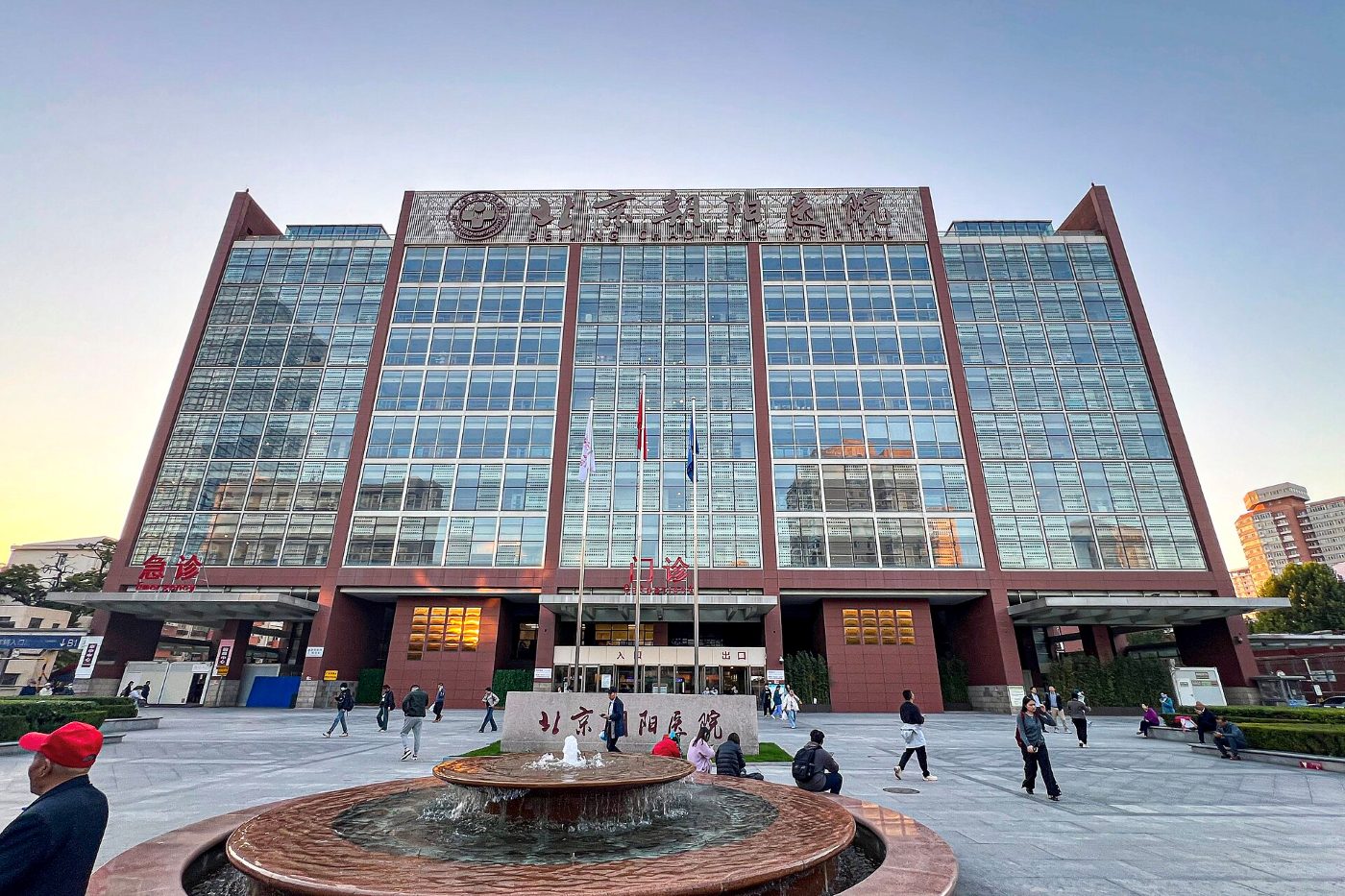
It depends on where you end up. Ordinary departments in public hospitals are cheap but crowded and almost always Chinese-only. That's why foreigners usually go to an international department (国际部 guójì bù, sometimes labelled "VIP") or a private international clinic with English-speaking doctors.
| Where | Approximate cost |
|---|---|
| Visit to an ordinary department of a public hospital | about ¥15 (about 9 PLN)–¥100 (about 60 PLN) |
| Visit to the international department of a public hospital | about ¥300 (about 181 PLN)–¥700 (about 422 PLN), sometimes up to ¥1,300 (about 783 PLN) |
| Visit to a private international clinic (Beijing, Shanghai, Guangzhou) | from about ¥1,400 (about 844 PLN), i.e. $200 and up |
| Emergency department: blood tests, a drip and medicines | usually about ¥200 (about 121 PLN)–¥1,000 (about 603 PLN) |
| A day in hospital (tests and medicines are billed separately) | about ¥400 (about 241 PLN)–¥1,400 (about 844 PLN), i.e. $60–200 |
| Surgery | up to tens of thousands of dollars |
| Medical transport from outside Europe back to Europe | can exceed €120,000 |
Doctor's visits won't break your budget. The problem starts with a hospital stay, an operation or a medically escorted flight home: then the bills run into tens or hundreds of thousands, and those are exactly the situations a policy is for.
NoteIn an emergency the hospital treats you first, but you still have to settle the bill by the time you're discharged. That's why you should call your insurer straight away.
How much cover do you need for China?
The most important figure in the policy is the medical expenses limit, the maximum the insurer will pay for treatment abroad. For China, Polish insurers and comparison sites recommend PLN 800,000–1,000,000, roughly €190,000–235,000, or more. Policies with much lower limits are cheaper, but after a serious accident they may not even cover the flight home.
| Part of the policy | What it covers | How much to choose |
|---|---|---|
| Medical expenses with 24-hour assistance | doctors, hospital, medicines, rescue, direct billing | at least €200,000–250,000 |
| Medical repatriation | getting you home with medical care when you can't fly normally | unlimited or within the medical limit – check the wording |
| Personal accident | a lump sum for permanent injury | a few tens of thousands |
| Personal liability | damage you cause to others, e.g. on a bike or in a hotel room | at least €25,000 |
| Baggage and baggage delay | theft, damage, essentials if your suitcase goes missing | optional, especially with connecting flights |
| Trip cancellation | refunds for flights and hotels if you fall ill before you go | when you have expensive non-refundable bookings |
6 things to check in the policy wording before you buy
- Pre-existing conditions. The cheapest policies often don't cover a flare-up of a condition you're already treated for (diabetes, high blood pressure, asthma). You usually have to add it.
- Altitude. Shangri-La sits at about 3,300 m, the summit of Mount Emei at 3,079 m, the Jiuzhaigou lakes at 2,000–3,100 m, and the top cable-car station on Jade Dragon Snow Mountain near Lijiang at about 4,500 m. Some policies treat trekking above 3,000–3,500 m as a high-risk activity. Riding a cable car usually isn't a sport, but check whether altitude-related illness is excluded.
- Sports. Skiing (for example at Yabuli near Harbin), rafting or diving in Hainan usually need a sports add-on. Cycling around Yangshuo or along Xi'an's city wall is normally just recreation, but it's worth confirming.
- Region. The policy must cover Asia or worldwide. If you're also visiting Hong Kong and Macau, check they're not excluded (they're usually in the "Asia" or "worldwide" zone).
- Alcohol. Many policies won't pay for the consequences of an accident after drinking.
- Direct billing. It's best when the assistance centre pays the hospital itself. With reimbursement you pay first and claim the money back after you get home.
TipSave your insurer's assistance number in your phone and keep the policy PDF offline (for example in your phone's files). On Chinese internet without a VPN you can't open Gmail or Google Drive, so the email with your policy may be out of reach.
Credit card or bank account insurance: is it enough?
Some credit cards and paid bank-account plans include travel insurance. It can be enough, but before you skip a separate policy, check its terms:
- the medical expenses limit and whether it includes medical repatriation,
- the maximum trip length (often 30–90 days per trip),
- whether cover requires you to pay for the trip with that card,
- whether it covers travel companions and children.
What does travel insurance for China cost?
The price depends on your age, the length of your trip, the level of cover and add-ons such as pre-existing conditions, sports and cancellation. As a guide, in Poland, where we're based, a 10–14-day policy with medical cover of PLN 500,000–1,000,000 (about €120,000–235,000) usually costs about PLN 100–300 (€25–70). Compare quotes in your own country and set China, "Asia" or "worldwide" as the destination.
The gap between the cheapest policy and a sensible one is usually small, less than a dinner out in Beijing. This is not the place to save money.
What we used: for our trip to China we were insured with ERGO Hestia, a Polish insurer. If you live elsewhere, pick a policy from your own country and check the same things: the medical expenses limit, medical repatriation and the exclusions in the policy wording.
When to buy? Ideally before you leave, covering the whole trip including your flight days. Many insurers will sell you a policy once you're already abroad, but it then usually starts only after a waiting period of a few days and won't cover an illness that has already started. Buy cancellation cover as early as possible, ideally right after booking your flights: you usually can't buy it just before you go, and the exact deadline is in the policy wording.
What to do if you fall ill in China
- Emergency: call 120 for an ambulance. In Hong Kong and Macau the emergency number is 999.
- Call your insurer's assistance line, ideally before you go to hospital. They'll tell you where to go and confirm they'll cover the costs.
- Take your passport. The hospital won't register you without it.
- If you pay yourself, keep the paperwork: an official invoice, 发票 (fāpiào), for every payment, your medical record, 病历 (bìnglì), prescriptions and pharmacy receipts. Ask for the diagnosis in English. Without these documents your insurer won't refund you.
- Minor problems: a pharmacy. You can buy many medicines over the counter, but antibiotics need a prescription from a Chinese doctor, and pharmacies won't accept a foreign prescription.
- Theft: the police (110) and a written confirmation of your report, 报案回执. More in Is China safe to visit?

Bring your medicines from home. Chinese pharmacies often don't stock equivalents of Western medicines, and you're more likely to be offered traditional Chinese remedies. You can bring medicines for personal use in reasonable amounts, ideally in their original packaging, with a copy of the prescription or a doctor's letter in English. For psychotropic medicines, check with the Chinese embassy before you travel. What else to pack: What to pack for China.
Phrasebook: doctor and pharmacy
| In English | In Chinese | Pronunciation |
|---|---|---|
| hospital | 医院 | yīyuàn |
| emergency department | 急诊 | jízhěn |
| international department | 国际部 | guójì bù |
| pharmacy | 药店 / 药房 | yàodiàn / yàofáng |
| I need to see a doctor. | 我需要看医生。 | Wǒ xūyào kàn yīshēng. |
| I have insurance. | 我有保险。 | Wǒ yǒu bǎoxiǎn. |
| invoice | 发票 | fāpiào |
| medical record | 病历 | bìnglì |
Frequently asked questions
Is travel insurance mandatory for China?
No, nobody asks for it at the border. But treatment for foreigners in China has to be paid for, usually upfront, and private clinics are very expensive, so without a policy you pay for everything yourself if you fall ill.
Does the EHIC or GHIC work in China?
No. The EHIC works only in the EU, the EFTA countries and the UK, and the UK GHIC mainly in the EU. In China, Hong Kong and Macau you need private travel insurance.
How much medical cover do I need for China?
Aim for at least €200,000–250,000 of medical expenses, with medical repatriation and 24-hour assistance. A lower limit may not be enough for a hospital stay, an operation or a medically escorted flight home.
Does travel insurance cover Hong Kong and Macau?
Usually yes, if the policy covers "Asia" or "worldwide". Check the list of countries and exclusions in the wording, though, as some policies have separate rules for certain territories.
Can I buy travel insurance once I'm already in China?
Often yes, online, but cover then usually starts only after a waiting period of a few days and won't include an illness that has already started. It's safer to buy before you fly.
Is credit card travel insurance enough for China?
Sometimes. Check the medical limit, medical repatriation, the maximum trip length and whether you have to pay for the trip with that card. If the limit is low or the terms unclear, buy a separate policy.
Sources
- Poland's Ministry of Foreign Affairs, Odyseusz: China – health, medical care and medicines (updated 3 September 2026)
- European Commission: European Health Insurance Card and NHS: GHIC and EHIC
- Medicare.gov: travel outside the U.S.
- CUK: travel insurance for China (May 2026, in Polish: recommended medical cover, sample policy prices, cost of a day in hospital, buying abroad)
- Warta: choosing your medical expenses limit (in Polish: recommended cover for Asia and China, medical transport costs)
- Trip.com: medical care in China for foreigners (June 2026: consultation prices, paying before treatment, emergency departments, pharmacies)
- MetLife: healthcare in China (departments for foreigners in public hospitals)
- Photos from Wikimedia Commons (authors and licences in the captions)
Emergency numbers always to hand
Every one of our itineraries has a box with emergency numbers and addresses in Chinese, and our app adds an SOS card that works offline. See all our China itineraries or read how to prepare the whole trip: Travelling China independently, step by step.