Before you go · 6 min read
China plug type: sockets, voltage, which adapter to bring and how to charge on the go
In short: mainland China runs on 220 V, 50 Hz and uses Type A sockets (two flat pins) and Type I sockets (three flat pins, two of them in a V). Australian plugs fit, US plugs fit the Type A slots, and UK and European plugs need an adapter. Phone and laptop chargers rated 100–240 V need no voltage converter – only US devices that run solely on 110–120 V do. Hong Kong and Macau use British Type G sockets. If your phone runs low, you can rent a power bank from a kiosk with Alipay for a few yuan an hour.
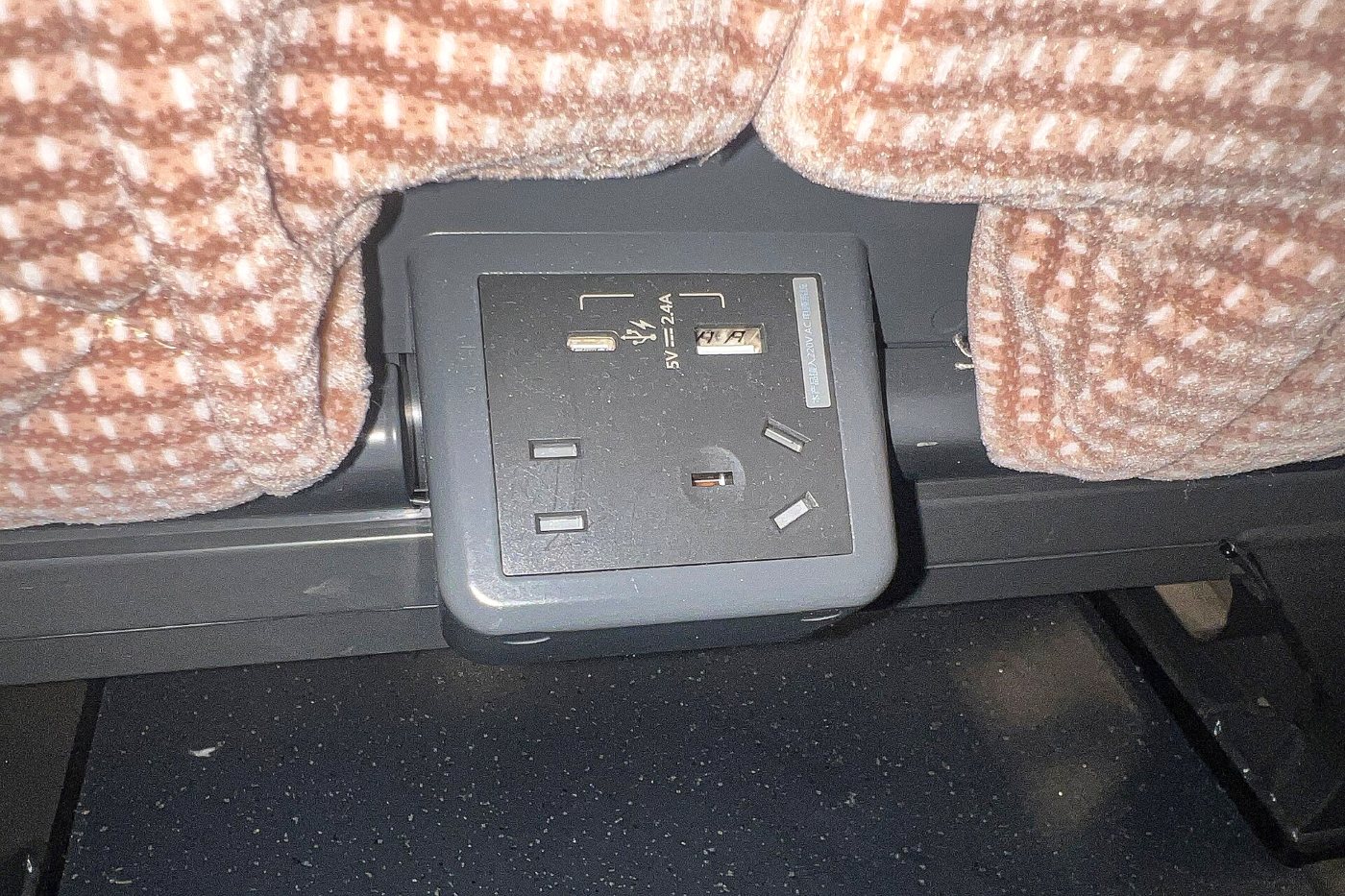
What surprised us most in China was how advanced the technology is – charging included. On high-speed trains there's a socket and USB ports at your seat, and you can rent a power bank in a café, restaurant or metro station by scanning a QR code.
As of 17 November 2026. Rules on power banks on flights and rental prices can change – check them just before you travel.
What sockets does China use?
| Type | What it looks like | Where you'll find it |
|---|---|---|
| A | two flat, parallel pins, no earth | the upper slots of almost every socket |
| I | three flat pins, two in a V, earthed | the lower slots – for laptops, kettles, hair dryers |
| C | two thin round pins (Europlug) | only some sockets with "universal" upper slots |
A typical Chinese wall socket is a double one: two slots on top for a Type A plug (sometimes shaped to take round pins too) and three angled slots below for a Type I plug. The supply is 220 V, 50 Hz.
Will your plug fit?
| Where you're from | Your plug | In China | In Hong Kong and Macau |
|---|---|---|---|
| USA, Canada | A/B, 120 V | Type A fits the upper slots (B with the round earth pin doesn't); check the voltage | adapter to Type G |
| UK, Ireland | G, 230 V | adapter needed | fits |
| Australia, New Zealand | I, 230 V | fits | adapter to Type G |
| EU | C, E/F, 230 V | thin Type C sometimes fits, E/F doesn't – bring an adapter | adapter to Type G |
| Any country | USB / USB-C cable | hotels and high-speed trains have USB ports | many hotels have USB ports |
The easiest option is a universal travel adapter with sliding pins for A/I and G: one adapter covers mainland China, Hong Kong and Macau. For a laptop or anything with an earth pin, make sure the adapter has the three-pin Type I option.
Do you need a voltage converter?
Usually not. Look at the label on your charger: phone, laptop and camera chargers almost always say "Input: 100–240 V", so they work anywhere – you only need a plug adapter.
You need a converter only for devices that run solely on 110–120 V, which mostly means hair dryers, curling irons and some shavers from the US or Canada. Plugging one of those into 220 V can destroy it. It's usually easier to leave it at home: better hotels have a hair dryer in the bathroom.
NoteAn adapter only changes the shape of the plug, not the voltage. For high-power devices from Europe, the UK or Australia (230 V), pick a sturdy earthed adapter.
Hong Kong and Macau: British sockets
Hong Kong and Macau also run on 220 V, but their sockets are British Type G: three thick rectangular pins. A mainland A/I adapter won't fit – bring a universal adapter or an extra Type G one (Hong Kong, Macau).
How to keep your phone charged in China
In China your phone is your wallet, map, translator and ticket, so it drains faster than at home (how to pay in China). A few ways not to run out of battery:
- Hotel: in many hotels the room power only comes on when you put your key card in the holder by the door. Take the card with you and the sockets go off, so charge your phone overnight.
- High-speed train: there's a socket at or under your seat, often with USB (how to buy train tickets).
- Your own power bank: keep it in your hand luggage. On domestic flights in China it must carry a clear 3C mark – without one it will be confiscated at security (what to pack for China).
- A rented power bank – see below.
Renting a power bank (共享充电宝)
Malls, restaurants, cafés and metro stations have kiosks with power banks for rent (共享充电宝, gòngxiǎng chōngdiànbǎo). Brands include Jiedian (街电), Energy Monster (怪兽充电), Meituan (美团充电) and Xiaodian (小电).
- Scan the QR code on the kiosk with Alipay (easiest for foreigners) or WeChat.
- Confirm the rental – some brands hold a refundable deposit on your card, usually up to ¥99 (about 60 PLN).
- Take the power bank – it has built-in USB-C and Lightning cables.
- Return it to any kiosk of the same brand. The fee is charged automatically.
Renting usually costs ¥3 (about 2 PLN)–¥6 (about 4 PLN) an hour, more in tourist spots and bars. Brands cap the daily fee, and if you don't return the power bank you pay at most about ¥99 (about 60 PLN) and keep it. You'll see the price on screen before you rent.
TipRent a power bank before your phone dies completely – with a dead phone you can't scan the QR code. A rented power bank isn't for flying: you have to return it to a kiosk.
In Chinese转换插头 zhuǎnhuàn chātóu "plug adapter", 插座 chāzuò "socket", 充电宝 chōngdiànbǎo "power bank", 充电 chōngdiàn "to charge". At reception: 有转换插头吗? yǒu zhuǎnhuàn chātóu ma? "Do you have a plug adapter?" Many hotels lend them.
Frequently asked questions
What plug type does China use?
Type A (two flat pins) and Type I (three flat pins, two in a V). Some sockets also take thin round Type C plugs. The voltage is 220 V, 50 Hz.
Do I need a plug adapter for China?
If you're from Australia or New Zealand, no. From the US, a two-pin Type A plug fits, but a three-pin one doesn't. From the UK and Europe, yes – bring an A/I or universal adapter.
Do I need a voltage converter in China?
Only for devices that run solely on 110–120 V. Phone and laptop chargers rated 100–240 V just need a plug adapter.
What plugs are used in Hong Kong?
British Type G, the same as in Macau. A mainland China adapter doesn't fit them.
Where can I charge my phone in China?
In your hotel, on a high-speed train (socket at your seat) or with a power bank rented from a kiosk with Alipay for about ¥3 (about 2 PLN)–¥6 (about 4 PLN) an hour.
Sources
- Trip.com: China plug types and voltage (2026: Types A, C and I, 220 V, 50 Hz, layout of a typical socket)
- Shanghai government: shared power banks and 3C rules (July 2026)
- China Survival Kit: renting a power bank in China (5 November 2026: brands, prices, deposit, fee cap)
- Xinhua: power banks without 3C banned on domestic flights from 28 June 2025 (in Chinese)
- Photo from Wikimedia Commons (author and licence in the caption)
Everything for the road in one itinerary
Each of our travel itineraries includes a packing list, and the app has a pre-departure checklist you can tick off, adapter and power bank included. For the whole trip, see China on your own, step by step.