Destinations and inspiration · 11 min read
Macau travel guide: things to do in 1–2 days, the Ruins of St. Paul's, the Portuguese old town and egg tarts
In short: Macau (澳门) is a small special administrative region of China across the Pearl River Delta from Hong Kong – about 700,000 people on about 33 km². For more than 400 years it was a Portuguese colony and only returned to China in 1999. That's why baroque churches stand next to Chinese temples and the pavements are Portuguese black-and-white cobbles. The old town is a UNESCO World Heritage Site. The highlights are the Ruins of St. Paul's, Senado Square, A-Ma Temple and Macau Tower, and on the islands of Taipa and Coloane, food streets and the most famous egg tarts. From Hong Kong it's about an hour by ferry. One or two days are enough.
What surprised us most in China was its variety – and Macau shows it like few other places. In a single block you can eat Portuguese salt cod, Cantonese dim sum and Macanese food, which grew out of both.
As of 13 November 2026. Check ticket prices, ferry fares and opening hours before you go. Amounts in patacas (MOP), Hong Kong dollars (HK$) and yuan are converted at the current rate into the currency selected in the site menu.
Macau at a glance
| Question | Answer |
|---|---|
| Where? | southern China, Pearl River Delta, about 60 km west of Hong Kong; borders the city of Zhuhai |
| From Hong Kong | TurboJET ferry about 1 h, or a bus across the Hong Kong–Zhuhai–Macau Bridge about 40 min |
| Visa | many nationalities, including EU citizens, enter visa-free; Macau has its own border and passport control |
| Currency | pataca (MOP), but Hong Kong dollars are accepted almost everywhere |
| Highlights | Ruins of St. Paul's, Senado Square, Monte Fort, A-Ma Temple, Macau Tower, Taipa, Coloane, Cotai |
| How many days? | 1 day for the old town, 2 days with Taipa, Coloane and Cotai |
| Best time | October–December; typhoons are possible from June to October |
Macau is really two worlds. On the peninsula is the old town: Portuguese squares, churches and Chinese temples. In the south, on reclaimed land between the islands of Taipa and Coloane, rose Cotai – a strip of casinos and mega-hotels. Most visitors from mainland China come for the casinos, but for us Macau is above all its old town and its food.
Things to do in Macau: 8 places
1. The Ruins of St. Paul's
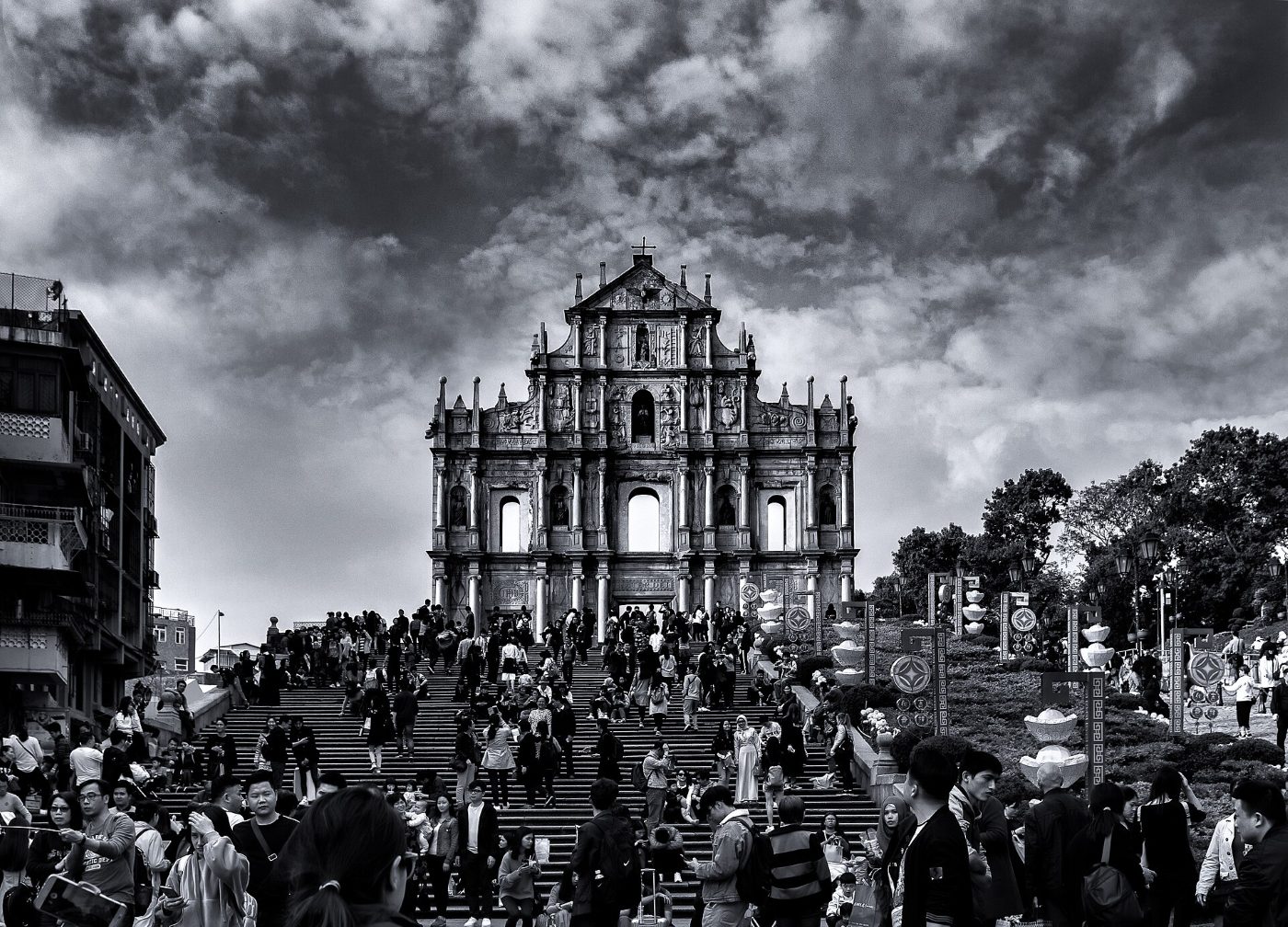
The symbol of Macau (大三巴牌坊). It's the stone facade of the Church of Mater Dei, built by the Jesuits in the early 17th century. The church burned down in 1835 and only this wall survived, at the top of a wide flight of steps. The facade is carved with saints, ships, dragons and Chinese characters. Entry is free. Come early in the morning or in the evening, when the facade is lit up – during the day the steps are packed with tour groups.
2. Monte Fort and the Macao Museum
Right next to the ruins, on the hill, stands a 17th-century Portuguese fort with cannons and a view over the whole city. The walls are free to visit. Inside the fort is the Macao Museum, about the city's history and the meeting of cultures: tickets about MOP 15 (about 7 PLN), open 10:00–18:00, closed on Mondays. Entry is often free on the 15th of each month.
3. Senado Square
The heart of the old town (Largo do Senado, 议事亭前地), with wavy black-and-white cobbles and pastel buildings. At the end of the square stands the yellow baroque St. Dominic's Church. In the evening and over the holidays the square is beautifully lit. A 10-minute lane lined with bakeries and jerky shops leads from here up to the Ruins of St. Paul's.
4. A-Ma Temple
The city's oldest temple (妈阁庙), from the late 15th century, dedicated to A-Ma, the goddess of seafarers. The city's name comes from it: Portuguese sailors asking what the place was called heard "A-Ma-Gao" – "A-Ma Bay". The pavilions climb a slope among the rocks. Free. From Senado Square it's about a 25-minute walk through lanes along the bay.
5. Macau Tower
A 338-metre tower by the sea. The observation deck on the 58th floor costs about MOP 208 (about 103 PLN) and is open until 20:00. It's best at sunset, when the bridges to Taipa light up. The brave bungee-jump from here – from 233 metres, one of the highest jumps in the world.
6. Taipa Village
The old part of Taipa island, with the narrow Rua do Cunha (官也街) packed with food: almond cookies, pork chop buns and egg tarts. A few minutes away stand the Taipa Houses – five green colonial villas from the early 20th century on the old waterfront. In the evening the restaurants around serve Portuguese and Macanese food.
7. Coloane
The quietest part of Macau: a small village with the yellow Chapel of St. Francis Xavier and a waterfront lined with restaurants. This is home to Lord Stow's Bakery – the bakery that started Macau's egg tart craze. Further south is Hac Sa beach with dark sand.
8. Cotai
The strip of casinos and hotels between Taipa and Coloane. Even if you don't gamble, step into The Venetian with its canals and gondolas under a painted sky, or catch the free shows outside the hotels. Casinos are only open to people aged 21 and over. Free hotel shuttle buses run here from the ferry terminals and the border.
Tickets and prices
| What | Price | Notes |
|---|---|---|
| Ruins of St. Paul's, Senado Square, A-Ma Temple | free | – |
| Monte Fort / Macao Museum | free / about MOP 15 (about 7 PLN) | museum closed on Mondays |
| Macau Tower – observation deck | about MOP 208 (about 103 PLN) | until 20:00 |
| TurboJET ferry from Hong Kong | HK$194 (about 99 PLN)–HK$242 (about 124 PLN) | more at weekends and in the evening |
| Bus across the bridge from Hong Kong | about HK$65 (about 33 PLN) | from the border crossing on Lantau |
| City bus | about MOP 6 (about 3 PLN) in cash | cheaper with a Macau Pass card; no change given |
| Lunch at a Portuguese restaurant | about MOP 200 (about 99 PLN)–MOP 350 (about 174 PLN) per person | in Taipa and Coloane |
How many days in Macau
- 1 day (e.g. a day trip from Hong Kong): the Ruins of St. Paul's and Monte Fort in the morning, then Senado Square, lunch, a walk to A-Ma Temple and Macau Tower at sunset. Evening ferry back to Hong Kong.
- 2 days: on day two, Taipa Village, egg tarts in Coloane and Cotai in the evening.
TipIf you can, avoid weekends and Chinese holidays. That's when crowds arrive from mainland China and hotel and ferry prices rise.
What to eat in Macau
- Egg tarts (pastel de nata, 葡挞) – most famous from Lord Stow's Bakery in Coloane or Margaret's Café e Nata near Senado Square. Eat them warm.
- Pork chop bun (猪扒包) – a crusty bun with a marinated pork chop. Best known in Taipa.
- Minchi – a Macanese dish of minced meat with potatoes and a fried egg.
- African chicken (galinha à africana) – spicy, with a peanut and coconut sauce.
- Bacalhau – Portuguese salt cod, in many versions.
- Serradura – a dessert of whipped cream and crushed biscuits.
- Almond cookies (杏仁饼) – the most popular gift from Macau, from Koi Kei and similar shops.
Getting there and around
- From Hong Kong by ferry: TurboJET from the Sheung Wan terminal to the Outer Harbour terminal on the peninsula – about 1 hour, HK$194 (about 99 PLN)–HK$242 (about 124 PLN). There's passport control on both sides.
- From Hong Kong by bus: from the Hong Kong–Zhuhai–Macau Bridge border crossing on Lantau (near the airport) – about 40 minutes, about HK$65 (about 33 PLN) (Hong Kong travel guide).
- From Guangzhou: by train from Guangzhou Nan to Zhuhai station at the Gongbei crossing (拱北口岸) – usually about 1–1.5 hours – then walk across the border. The border queue is usually 30–60 minutes (Guangzhou travel guide).
- By air: Macau International Airport (MFM) is on Taipa. From Europe you'll fly with a connection – it's usually easier to fly into Hong Kong.
- Getting around: walk the peninsula. Reach the islands by bus, the Macau LRT light rail or a free hotel shuttle from the ferry terminal and the border. Taxis are cheap but hard to find at rush hour.
NoteIf you continue from Macau into mainland China, crossing at Zhuhai is a new entry into China – the visa-free rules are in our China visa-free guide.
Money, internet and plugs
- Currency: the pataca (MOP). Hong Kong dollars are accepted almost everywhere at 1:1, but change comes in patacas. Don't take patacas away – Hong Kong won't accept them.
- Payments: hotels, casinos and larger restaurants take cards. Many shops also take Alipay. Small eateries and buses need cash.
- Internet: Google, WhatsApp and Instagram work in Macau – as in Hong Kong, unlike mainland China (internet in China).
- Plugs: British (type G), as in Hong Kong. Bring a universal adapter.
Where to stay in Macau
- The peninsula, around Senado Square – best for sightseeing on foot; small hotels and guesthouses.
- Cotai – big casino hotels. Midweek (Sunday to Thursday) they can be surprisingly cheap; at weekends prices multiply.
- Taipa – quiet, close to the airport and the restaurants on Rua do Cunha.
Macau weather and when to go
The climate is subtropical. From May to September it's hot (about 30°C) and very humid, and from June to October typhoons are possible – at signal no. 8 the ferries stop running. The most pleasant time is October to December: dry, sunny, about 20–25°C. Winter (January–February) can be cool, about 15°C.
Avoid the first week of October and Spring Festival, when crowds come from mainland China. In mid-November the Macau Grand Prix takes place and hotel prices soar (best time to visit China).
Macau in our itineraries
| Itinerary | Days | Route |
|---|---|---|
| Dim Sum & Palm Trees | 11 | Guangzhou → Shenzhen → Hong Kong → Macau → Sanya |
In Dim Sum & Palm Trees, Macau gets two days. On the first you arrive by ferry from Hong Kong and explore the old town: Senado Square, the Ruins of St. Paul's and A-Ma Temple, then go up Macau Tower in the evening. On the second it's Taipa, Coloane with its egg tarts, and Cotai. Then you cross the border at Zhuhai and fly to the tropical island of Hainan.
Frequently asked questions
Do I need a visa for Macau?
Many nationalities, including EU citizens, enter Macau visa-free – EU passport holders for 90 days. Check the rules for your passport before you go. Macau has its own border, so there's passport control when you arrive from Hong Kong or mainland China.
How do I get from Hong Kong to Macau?
By TurboJET ferry from Sheung Wan (about 1 h, HK$194 (about 99 PLN)–HK$242 (about 124 PLN)) or by bus across the Hong Kong–Zhuhai–Macau Bridge from Lantau (about 40 min, about HK$65 (about 33 PLN)).
What currency is used in Macau?
The pataca (MOP). Hong Kong dollars are accepted almost everywhere at 1:1, but you'll get change in patacas.
How many days do you need in Macau?
One day covers the old town: the Ruins of St. Paul's, Senado Square, A-Ma Temple and Macau Tower. With Taipa, Coloane and Cotai, plan 2 days.
Is Macau part of China?
Macau has been part of China since 1999, but as a special administrative region it has its own currency, border, laws and an unblocked internet.
Where are the best egg tarts in Macau?
The best known come from Lord Stow's Bakery in Coloane and Margaret's Café e Nata in the centre, near Senado Square.
Sources
- UNESCO: Historic Centre of Macao
- Macao Museum – tickets and hours: China Highlights, Trip.com
- Transport: Trip.com – Macau transport 2026, Macau Daily Times – bus fares
- Wikipedia: Macau, Ruins of St. Paul's, A-Ma Temple and Macau Tower
- Our Dim Sum & Palm Trees itinerary and Hong Kong guide (ferry and Macau Tower prices checked in November 2026); photo from Wikimedia Commons (author and licence in the caption)
Macau in a ready-made itinerary
In Dim Sum & Palm Trees Macau is planned hour by hour: the ferry from Hong Kong, the old town with Senado Square and the Ruins of St. Paul's, Macau Tower at night, then Taipa, Coloane and Cotai the next day – with prices and addresses in Chinese. The itinerary links Macau with Guangzhou, Shenzhen, Hong Kong and the beaches of Hainan. Want to add Macau to a different route? We can make you a custom itinerary.