Destinations and inspiration · 11 min read
Wuhan travel guide: things to do in 1–2 days, the Yellow Crane Tower, the Yangtze and breakfast on Hubu Alley
In short: Wuhan (武汉) is the capital of Hubei province in central China, a city of over 13 million people where the Han River flows into the Yangtze. It grew out of three old towns: Wuchang, Hankou and Hanyang. The highlights are the Yellow Crane Tower with its view over the Yangtze, the first Yangtze River Bridge (1957), the Hubei Provincial Museum with the 2,400-year-old bells of Marquis Yi, and the huge East Lake. Wuhan is also China's breakfast capital: try reganmian noodles on Hubu Alley. One or two days are enough. From Shanghai it's a high-speed train ride of 3.5 hours or more.
What surprised us most in China was the variety of its food – every province eats differently. In Wuhan you see it at 7 a.m.: breakfast is eaten on the street, on the go, and it even has its own name, guozao (过早).
As of 13 November 2026. Check ticket prices, opening hours and booking rules before you go. Yuan amounts are converted at the current rate into the currency selected in the site menu.
Wuhan at a glance
| Question | Answer |
|---|---|
| Where? | central China, Hubei province, on the Yangtze, about 700 km west of Shanghai |
| From Shanghai | high-speed train from Hongqiao: from 3 h 32 min, about 30 trains a day |
| Highlights | Yellow Crane Tower, Yangtze River Bridge, Hubei Provincial Museum, East Lake, Hubu Alley, the Hankou riverside |
| Booking | Hubei Provincial Museum – free, with your passport, via the museum's WeChat mini program |
| Monday | the Hubei Provincial Museum is closed |
| How many days? | 1 day for the highlights, 2 days with the museum and East Lake |
| Best time | March–May (cherry blossoms in the second half of March) and October–November |
Wuhan sits in the very middle of China, which is why it's called the "thoroughfare of nine provinces" (九省通衢). The main high-speed lines cross here: Beijing–Guangzhou and Shanghai–Chengdu. In 1911 the Wuchang Uprising broke out here and brought down China's last imperial dynasty. Today it's a city of universities, car factories and lakes – there are over a hundred within the city limits.
Things to do in Wuhan: 8 places
1. The Yellow Crane Tower
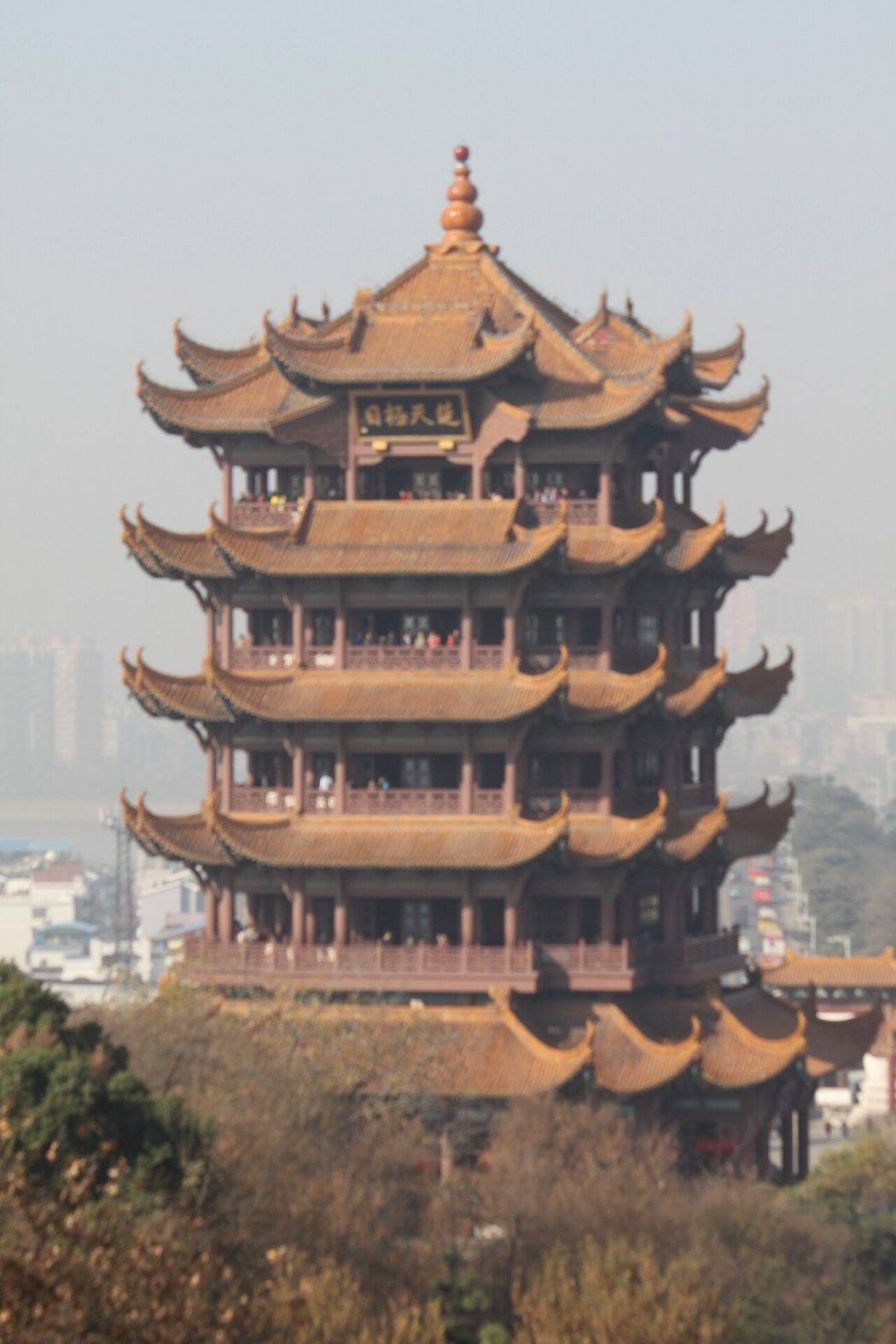
The symbol of the city. Legend says an immortal flew away from here on a yellow crane, and every Chinese schoolchild knows Tang-dynasty poet Cui Hao's poem about the place. The tower burned down and was rebuilt many times. Today's five-storey tower was built in 1985 on Snake Hill (Sheshan), about a kilometre from the original site. From the top floor you see the Yangtze, the bridge and the skyscrapers on both banks. Inside are huge mosaics telling the tower's legend and history.
A day ticket costs about ¥70 (about 42 PLN). Some evenings there's a night visit with a light show for about ¥100 (about 60 PLN)–¥120 (about 72 PLN) – check dates and prices on Trip.com. By day the park is open about 8:30–18:00, shorter in winter. The nearest metro station is Simenkou Huanghelou (司门口黄鹤楼) on line 5.
In Chinese黄鹤楼 (Huánghè Lóu) – the Yellow Crane Tower.
2. The Yangtze River Bridge
The first bridge across the Yangtze, opened in 1957, with two decks: a road with footpaths on top and a railway below. Climb the steps from the Yellow Crane Tower side and walk across to Hanyang – about 1.7 km. It's best at sunset. Free.
3. Hubu Alley – the breakfast street
A short lane next to the Yellow Crane Tower, packed with breakfast stalls. Come early, ideally before 9:00, when locals eat here too, not just tourists. Try reganmian, doupi and mianwo (see "What to eat"). Later in the day the alley is more touristy and pricier.
4. Hubei Provincial Museum
One of the best museums in China. Its treasures are the bells of Marquis Yi of Zeng – a set of 65 bronze bells about 2,400 years old that still ring true – and the Sword of Goujian, still sharp and rust-free after more than 2,000 years in a tomb.
Entry is free with your passport. Book it in the museum's WeChat mini program (湖北省博物馆). It's usually open 9:00–17:00 (last entry 16:00) and closed on Mondays. It stands by East Lake, so it's easy to combine with a bike ride along the lake.
NoteThe museum warns about sites that charge for "booking". The real booking is free.
5. East Lake and its greenway
East Lake (东湖) is several times bigger than Hangzhou's West Lake. More than 100 km of walking and cycling paths run around it (东湖绿道). Rent a shared bike in Alipay (Hellobike or Meituan). Most of the area is free; only some gardens charge, for example the Cherry Blossom Garden in the Moshan area during the blossom season.
6. Hankou: the Yangtze riverside and Jianghan Road
Across the Yangtze lies Hankou – an old trading town with former concessions of several countries. On the Jianghan Road pedestrian street (江汉路步行街) and the lanes around it stand early-20th-century banks, customs houses and hotels. The Hankou Jiangtan park (汉口江滩) runs for several kilometres along the river, and in the evening the skyscrapers on both banks light up.
TipCross the Yangtze on the ordinary city ferry, from Zhonghua Road pier (中华路码头) in Wuchang to Wuhan Guan (武汉关) in Hankou. A ticket is about ¥1.50 (about 1 PLN), and the view of the river and the bridge beats any cruise boat.
7. Guiyuan Temple
A 17th-century Buddhist temple in Hanyang (归元寺), famous for its hall of 500 arhat statues – each with a different face and pose. Chinese visitors count arhats from a statue of their choice to "draw" a fortune. There's an entry fee, but the ticket is cheap.
8. Wuhan University and Tanhualin
The Wuhan University campus (武汉大学) has 1930s buildings with green-tiled roofs. In the second half of March the cherry trees bloom and crowds arrive. Visitor rules change – in the blossom season you usually need to book entry in advance, which can be hard for foreigners without a Chinese phone number. Check the current rules on the university's WeChat account.
Tanhualin (昙华林) in Wuchang is an old street with churches, cafés and small galleries – good for a quiet walk after the Yellow Crane Tower.
Tickets and prices
| Place | Price | How to buy |
|---|---|---|
| Yellow Crane Tower | about ¥70 (about 42 PLN) (evening with light show about ¥100 (about 60 PLN)–¥120 (about 72 PLN)) | at the gate or on Trip.com |
| Yangtze River Bridge | free | – |
| Hubei Provincial Museum | free | book in the 湖北省博物馆 mini program (WeChat), with your passport |
| East Lake | free (some gardens charge) | – |
| Yangtze ferry | about ¥1.50 (about 1 PLN) | Alipay QR code or a transport card |
| Metro | from ¥2 (about 1 PLN) | Alipay QR code (乘车码) |
How many days in Wuhan
- 1 day: breakfast on Hubu Alley, then the Yellow Crane Tower, a walk across the Yangtze River Bridge, the ferry to Hankou and an evening on the riverside and Jianghan Road.
- 2 days: on day two, the Hubei Provincial Museum and a bike ride by East Lake, or Guiyuan Temple and Tanhualin.
NoteDon't plan the museum for a Monday – it's closed.
What to eat in Wuhan
- Reganmian (热干面) – "hot dry noodles" with sesame paste, pickled radish and spring onion. Wuhan's most famous breakfast, a few yuan a bowl.
- Doupi (豆皮) – sticky rice with meat and mushrooms baked in a thin egg and bean-flour crust.
- Mianwo (面窝) – a fried ring of rice batter with sesame, crispy at the edge.
- Tangbao (汤包) – soup dumplings with hot broth inside.
- Duck necks – spicy, from the Zhou Hei Ya (周黑鸭) or Jing Wu (精武) chains. A popular gift from Wuhan.
- Lotus root and pork rib soup (排骨藕汤) – a Hubei home dish, best in autumn and winter.
- Crayfish (小龙虾) – in summer, May to August, in a spicy sauce, eaten in the evening with beer.
Getting there and around
- From Shanghai by train: about 30 high-speed trains a day run from Shanghai Hongqiao to Wuhan, Hankou or Wuchang stations. The fastest takes 3 h 32 min; second class is ¥284 (about 171 PLN)–¥431 (about 260 PLN).
- From Beijing: about 47 trains a day, the fastest about 4 h 20 min, second class about ¥562 (about 339 PLN)–¥634 (about 382 PLN).
- From Nanjing: from 2.5 hours, ¥202 (about 122 PLN)–¥272 (about 164 PLN) in second class (Nanjing to Wuhan by train, Nanjing travel guide).
- By air: Tianhe Airport (WUH) – metro line 2 to Hankou and Jianghan Road takes about 45–60 minutes for ¥7 (about 4 PLN); a taxi takes about 40 minutes for ¥80 (about 48 PLN)–¥120 (about 72 PLN) (airport to city centre).
- Getting around: the metro (from ¥2 (about 1 PLN), Alipay QR code) links all three parts of the city, including under the Yangtze. Line 2 serves Jianghan Road and the airport, line 5 the Yellow Crane Tower and Hubu Alley.
Watch the station names: Wuhan (武汉站, the main high-speed station, in the east of the city), Hankou (汉口站, on the Hankou side) and Wuchang (武昌站, on the Wuchang side). Check on your ticket which one you leave from – getting between them by metro takes about 30–50 minutes.
Where to stay in Wuhan
- Hankou, near Jianghan Road – the best base for 1–2 nights: the pedestrian street, the riverside, plenty of food and metro line 2 straight to the airport.
- Wuchang, near the Yellow Crane Tower – close to Hubu Alley (handy for breakfast) and the bridge; quieter in the evening.
- Near Wuhan station – only for one night before an early train; far from the sights.
Wuhan weather and when to go
Wuhan is one of China's "furnaces". In July and August daytime temperatures are usually about 33–35°C with high humidity, and June and July bring the rainy season. Winter is cool and damp: about 4°C on average in January, and buildings are often poorly heated.
The best time is March to May (cherry blossoms at the university and East Lake in the second half of March) or October and November. Avoid Chinese holidays: Spring Festival and the first week of October (best time to visit China).
Wuhan in our itineraries
| Itinerary | Days | Route |
|---|---|---|
| Along the Yangtze | 11 | Shanghai → Ningbo → Hangzhou → Tianducheng → Wuxi → Nanjing → Wuhan |
In Along the Yangtze, Wuhan is the last stop. On the first day you arrive by train from Nanjing, visit the Yellow Crane Tower, walk across the Yangtze River Bridge and stroll the Hankou riverside in the evening. The next morning it's breakfast on Hubu Alley, then the museum or a bike ride by East Lake, and you fly out from Tianhe Airport.
Frequently asked questions
How many days do you need in Wuhan?
One full day covers the Yellow Crane Tower, the Yangtze River Bridge, the ferry and Hankou. With the Hubei Provincial Museum and East Lake, plan 2 days.
How much is the Yellow Crane Tower ticket?
About ¥70 (about 42 PLN) by day. The evening visit with a light show costs about ¥100 (about 60 PLN)–¥120 (about 72 PLN) – check dates and prices on Trip.com.
Is the Hubei Provincial Museum free?
Yes. Entry is free, but you need to book with your passport in the museum's WeChat mini program. It's closed on Mondays.
How do I get from Shanghai to Wuhan?
By high-speed train from Shanghai Hongqiao – from 3 h 32 min, ¥284 (about 171 PLN)–¥431 (about 260 PLN) in second class. Buy tickets on Trip.com or 12306.
When is the best time to visit Wuhan?
Spring (March–May) and autumn (October–November). Summer means heat above 33°C and high humidity.
What should I eat for breakfast in Wuhan?
Reganmian – noodles with sesame paste – and doupi, sticky rice with meat in a crispy crust. Best in the morning on Hubu Alley or at any neighbourhood stall.
Sources
- Wander in China (2026): Yellow Crane Tower, Hubei Provincial Museum, Wuhan University cherry blossoms and Wuhan train stations
- Trip.com: Yellow Crane Tower – day and night tickets
- China Daily: Hubei Provincial Museum
- Trains: GoAsia – Shanghai to Wuhan (12306 timetable of 16 Oct 2026) and China for Travelers – Wuhan to Beijing; our Nanjing to Wuhan train guide
- Wikipedia: Wuhan (climate, 1991–2020 normals), Yellow Crane Tower, Wuhan Yangtze River Bridge and Bianzhong of Marquis Yi
- Our Along the Yangtze itinerary (as of October 2026); photo from Wikimedia Commons (author and licence in the caption)
Wuhan in a ready-made itinerary
In Along the Yangtze Wuhan is planned hour by hour: the train from Nanjing, the Yellow Crane Tower, a walk across the Yangtze River Bridge, an evening in Hankou, then breakfast on Hubu Alley, the museum and the trip to the airport – with prices and addresses in Chinese for taxi drivers. The itinerary links Wuhan with Shanghai, Ningbo, Hangzhou, Wuxi and Nanjing. Want to add Wuhan to a different route? We can make you a custom itinerary.